
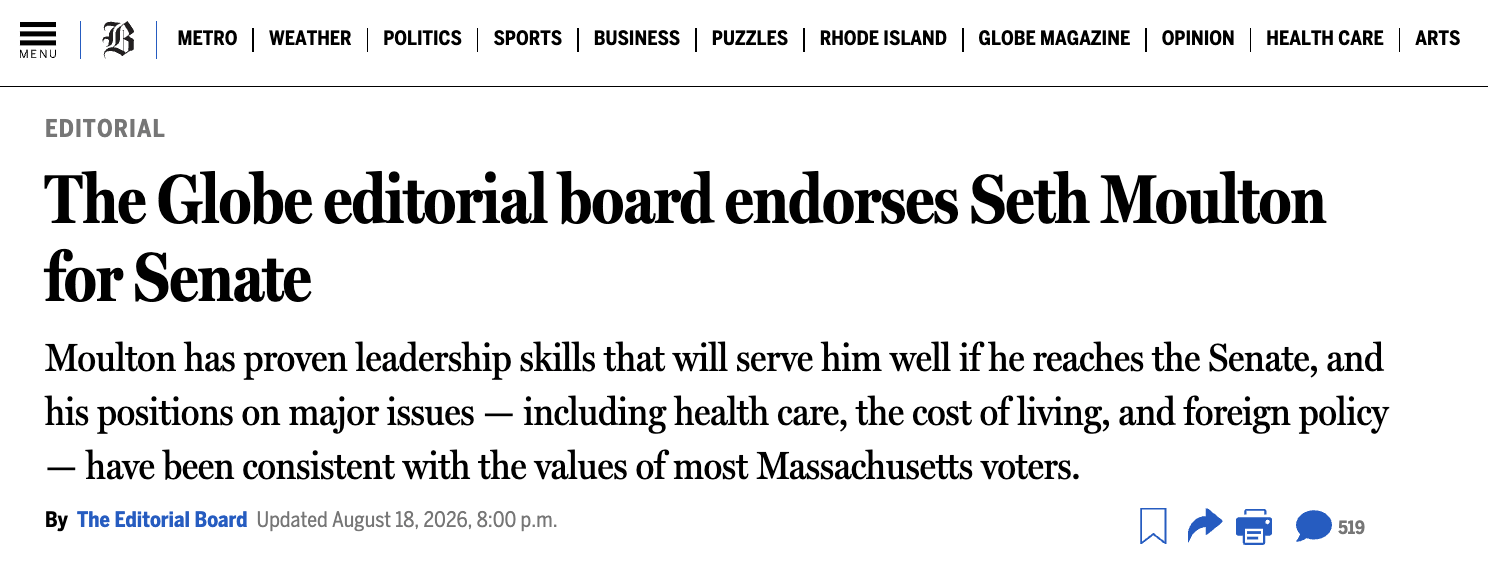
The Boston Globe’s endorsement of Seth Moulton argues that his foreign-policy positions are “consistent with the values of most Massachusetts voters.” But what exactly are Massachusetts’ foreign-policy values?
The Globe emphasizes Moulton’s courage as a Marine officer in Iraq, his independence, his opposition to Donald Trump’s war with Iran, and his recent willingness to restrict military aid to Israel. Those are important parts of Moulton’s record, but in many important cases they represent relatively recent changes, welcome though they are, to long held foreign policy positions. Unfortunately the Globe left that important piece out.
The central foreign-policy responsibilities of a US Senator are crucial. Deciding whether to authorize wars, restraining presidents who wage them without authorization, controlling military spending, and deciding when and to what countries US weapons should be sent and sold are just some of the responsibilities. The failure of Congress to assert itself in these areas is part of the reason American foreign policy is in a state of crisis.
On those questions, the differences between Congressman Moulton and Senator Markey deserve far more attention than the Globe gives them.
The courage to counsel restraint
One incident illustrates the difference. On October 9, 2023, two days after Hamas’s attack on Israel, Senator Markey stood before a large pro-Israel rally on Boston Common. He condemned the attack on Israel, called for the release of hostages, and affirmed Israel’s right to defend itself. In the same speech Markey also called for diplomacy, protection of civilians on all sides, and “a de-escalation of the current violence.”
He was booed so loudly that he struggled to continue for nearly a minute. But he did continue, “I believe in peace,” Markey said. “And it is my deepest hope that we can draw upon one of the greatest Hebrew traditions — tikkun olam — to do the work of repairing the world to work for peace, even amidst war.”
Representative Moulton explicitly disagreed. Responding to calls for de-escalation, he asked: “Did they call for a deescalation of violence after 9/11?”
That exchange deserves more attention today.
The profound lesson of the post-9/11 Global War on Terror is that wars driven by anger and revenge rather than clear, achievable objectives are profoundly unwise. More than 7,000 U.S. service members were killed in the post-9/11 wars, and more than 53,000 were officially listed as wounded in the major war zones. Brown University’s Costs of War project estimates the total cost and future obligations at roughly $8 trillion. The human toll abroad was vastly greater, with millions killed, wounded, or displaced from their homes. Markey’s vote in the Congress to authorize the war in Iraq certainly deserves criticism. Moulton has surely offered it.
But his decision to also use the example of post-9/11 war fever to criticize Ed Markey’s call for peace, so soon after the October 7th attacks, is revealing. In doing so Seth Moulton raised a serious question about his own approach. When does he consider restraint most necessary?
It’s easy to counsel restraint after a war becomes unpopular. It is much harder in the immediate aftermath of an attack, when the demands for retaliation are strongest. Restraint doesn’t mean pacifism. It means considering the consequences before resorting to military force. It means first asking: What is the objective? Can force achieve it? How many civilians will die? What happens after the first strikes? Will this actually make us safer?
Markey made that argument when it was deeply unpopular. If courage is one of the Globe’s criteria, that moment belongs in the discussion.
The power of the purse
The Globe’s biggest foreign-policy omission was on the issue of military spending.
Congress controls the purse. Whatever authority presidents claim as commander in chief, Congress determines how much money the military receives and whether wars can continue to be funded.
Moulton deserves credit for opposing this year’s NDAA and calling the existing defense budget “already-bloated.” But that is a significant change from much of his previous record.
Moulton described that record himself in 2023: “Since being elected to Congress, I have been proud to vote to pass a bipartisan NDAA each year.” During his 2019 presidential campaign, when asked what the appropriate overall defense budget should be, Moulton said it was ultimately “not about what the top line number is.” His emphasis was on spending differently, on modernizing the military and replacing outdated systems.
That may be a legitimate argument for military reform. It doesn’t question the extraordinary scale of US military spending or the justifications that keep raising it.
Markey has been doing that for years. In 2020, he joined Bernie Sanders in proposing a 10 percent cut to President Trump’s proposed $740 billion military budget, redirecting the money toward jobs, health care and education. The next year he criticized President Biden for increasing Pentagon spending and called for “smart, substantial cuts.” His current Slash the Pentagon Act would cap national defense spending at $750 billion, half of Trump’s proposed $1.5 trillion level.
That is a real difference in priorities, and surely one relevant to an endorsement based partly on foreign policy. The proposed doubling of the Department of War’s budget in just six years hammers home the importance of the issue.
War powers, nuclear weapons, and Israel
On war powers, Rep. Moulton does deserve some credit. He has supported efforts to reclaim congressional authority and this year helped introduce a War Powers Resolution to end Trump’s war with Iran. Senator Markey has likewise pushed Congress to end unauthorized wars, even going so far as to call for the impeachment of President Trump after he threatened to destroy the Iranian civilization earlier this year. The contrast is not simply hawk versus dove, but a matter of degree.
On nuclear weapons there’s a clearer difference. Markey has spent years trying to prevent a president from unilaterally initiating a nuclear first strike. His legislation explicitly grounds that restriction in Congress’s constitutional power to declare war. If the Globe believes the next senator from Massachusetts must “reinvigorate the Senate as a coequal branch to the president,” presidential authority to start a nuclear war should be a central question.
The evolution of their positions on Israel also matters.
Moulton did indeed join the entire Massachusetts delegation in voting against $3.3 billion in US military support for Israel. He also announced last fall as he declared his run for Senate that he would return AIPAC contributions and reject future support.
But the timeline and history matter. AIPAC and its supporters were Moulton’s top source of campaign contributions in the 2023-24 cycle, totaling roughly $43,000. By contrast, Markey received no AIPAC contributions from 2019 through 2024, according to OpenSecrets data reported by Boston.com.
And Jewish Insider subsequently reported that Moulton had sought AIPAC’s endorsement for his Senate campaign before publicly breaking with the organization. His campaign disputed the suggestion that his decision was motivated by AIPAC’s unwillingness to guarantee an endorsement, but did not deny the reported outreach.
Markey, meanwhile, began voting to block offensive weapons transfers to Israel in 2024 and has repeatedly done so since, though he continues to support defensive assistance.
What counts as national security?
There is a broader question underneath all of this: What do we mean by national security?
Nuclear weapons can destroy human civilization as we know it. Climate change threatens lives, infrastructure, food systems and global stability. The Pentagon itself has called climate change an existential threat and warned that it is already reshaping the security environment. Markey has spent decades working on nuclear weapons and made climate action one of the defining projects of his career, authoring the Senate version of the Green New Deal.
A reasonable definition of national security should also factor in the health of the nation. Markey supports Medicare for All. Moulton doesn’t. A 2009 Harvard study estimated that lack of health insurance was associated with 45,000 American deaths a year. In 2020 a Yale study showed that a universal health system could prevent approximately 68,500 deaths per year.
The US government is considering a $1.5 trillion budget for the Department of War while, by either estimate, more Americans die from a lack of medical coverage each year, than were killed in the entire 20 year involvement in the Vietnam War.
The Globe is entitled to prefer Moulton’s national security approach over Markey’s. He has taken several important steps toward restraint this year, and those should be acknowledged. But that’s a serious departure from Moulton’s 10 years in Congress before this campaign. On military spending
If the Globe is going to claim that Congressman Moulton’s foreign policy values represent the People of Massachusetts they should look back at his whole record, not just his positions during this senate campaign. Rep. Moulton’s full record tells a very different story.
By Brian Garvey
—
Brian Garvey is the Executive Director of Massachusetts Peace Action.