
Tuesday’s Massachusetts primary gave peace and justice advocates plenty of reason for hope. Not every candidate endorsed by Massachusetts Peace Action won, but the clearest message from the election was a positive one: progressive politics remains powerful in Massachusetts, and there is a growing hunger for leaders who will connect peace abroad with justice and investment in our communities at home.
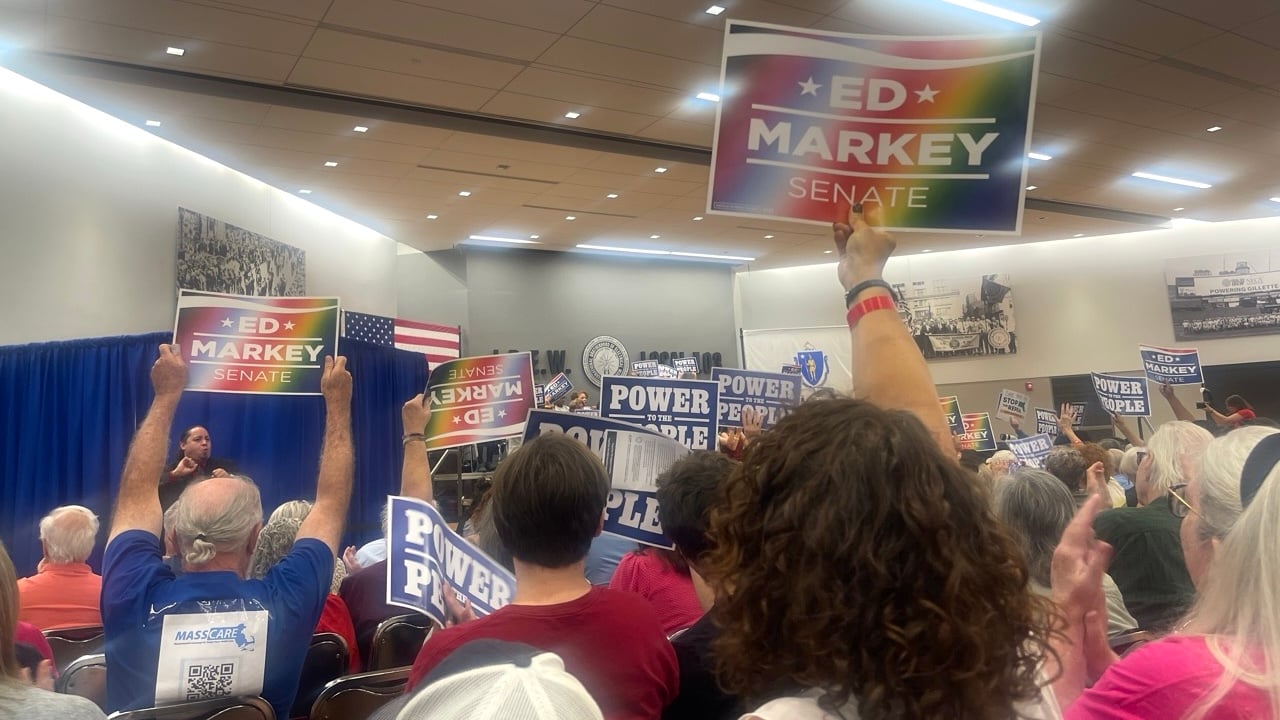
The most significant result was Senator Ed Markey’s overwhelming victory over Congressman Seth Moulton. According to unofficial results, Markey won 65.6 percent of the vote to Moulton’s 34.4 percent—a margin of more than 31 points. Moulton built his campaign around the need for a new generation of leadership. At 47, he was challenging an 80-year-old senator who has served in Congress for nearly half a century. Yet it was Markey who assembled the more energetic, multigenerational coalition and offered the more forward-looking vision.
The lesson isn’t that voters don’t want younger leaders. They do. But age alone isn’t enough. Replacing an older progressive with a younger, more corporate and militarist Democrat is not progress. Ideas, policies and records matter more than identity, and Massachusetts voters saw a real difference between these two candidates.
Markey ran on the Green New Deal, Medicare for All, workers’ rights, protection for transgender people, a smaller Pentagon budget and an end to the wars in Iran and Gaza. He brought together young climate activists, organized labor and leaders including Bernie Sanders, Elizabeth Warren, Ayanna Pressley and Alexandria Ocasio-Cortez. Moulton has regularly voted for growing military budgets and military aid to Israel and opposed Medicare for All. His claim that the two men were essentially the same on policy, with only age separating them, just wasn’t true. And Massachusetts voters didn’t fall for it.
For MAPA, one moment captured the difference. Two days after the attacks of October 7, 2023, Markey was loudly booed at a pro-Israel rally on Boston Common because he called for diplomacy, protection of civilians and de-escalation. Moulton responded by asking, “Did they call for a deescalation of violence after 9/11?” This difference is crucial. Wars driven by anger and revenge have cost millions of lives and trillions of dollars. It is one thing to oppose a war after it has become overwhelmingly unpopular. It is another to call for de-escalation and peace when war fever is burning hottest.
Foreign policy was not the only issue in this race, but Markey’s peace record, and his ability to connect foreign policy issues to rising authoritarianism and kitchen table economics, contributed to his landslide victory. It was part of the progressive vision voters chose. Calls for nuclear restraint, climate action and diplomacy aim to solve the real threats to our security. Medicare for All and investments in housing, education and childcare protect families from dangers they face every day. These priorities are connected, because every additional dollar handed over to the Pentagon is a dollar that cannot meet urgent human needs.
Several other long-serving Democrats also survived challenges from younger candidates. Incumbency still comes with enormous advantages: money, name recognition, institutional support, constituent relationships and congressional seniority. But the contrast between the Senate race and the 1st Congressional District is instructive. Richard Neal defeated MAPA-endorsed educator Jeromie Whalen by 55.2 percent to 44.8 percent—a margin of just over 10 points. Still, Whalen’s showing against a congressman first elected in 1988 was remarkable.
Whalen ran openly for Medicare for All, stronger unions, a Green New Deal, an end to corporate PAC influence, an end to military aid for Israel and a reduction in Pentagon spending so that we can invest in education and other community needs. He also connected endless militarism abroad with the authoritarian crackdown carried out by ICE at home. His campaign showed that a new, peace-oriented progressive politics can compete even against one of the most deeply entrenched incumbents in Congress.
Other MAPA-endorsed congressional challengers didn’t prevail either, but their efforts helped to move the public debate. Jason Poulos received about 28 percent against Jake Auchincloss in the 4th District. Jonathan Paz won 20.1 percent in a three-way race against House Democratic Whip Katherine Clark in the 5th. Jamie Belsito received nearly 10 percent in the crowded open-seat contest in the 6th, while Craig Swallow received 20.5 percent against Bill Keating in the 9th. These candidates challenged AIPAC and corporate influence, opposed US support for Israel’s assault on Gaza, demanded reductions in Pentagon spending and connected those savings to healthcare, housing, education and childcare. We are also proud that Representatives Jim McGovern and Ayanna Pressley, two important progressive allies, advanced without primary opposition.
MAPA candidates also recorded important victories at the state level. Erika Uyterhoeven topped a five-candidate field for the open 2nd Middlesex Senate seat with 37 percent. She won while running openly for Palestinian rights, prison reform, climate action and greater transparency in an undemocratic State House. Mike Connolly defeated his challenger with nearly 76 percent in the 26th Middlesex District, and Lorena Betts won the open 16th Middlesex primary with roughly 70 percent. Tom Melville advanced unopposed to challenge Republican Representative Marcus Vaughn in November.
Evan MacKay again came close to unseating Marjorie Decker in Cambridge’s 25th Middlesex District, finishing only 505 votes behind. Alison Leary received about 39 percent in her challenge to John Lawn in the 10th Middlesex. These were losses, but not defeats for the movements their campaigns helped build. MacKay in particular demonstrated for the second consecutive election that there is a large and durable constituency for a peace candidate committed to transparency and action in the State House.
The overall picture is encouraging. Progressive incumbents prevailed. Progressive challengers gained ground. Candidates across Massachusetts showed that peace is not a separate or secondary issue, but part of a larger struggle over who our government serves and where our resources go. The work of building the next generation of leadership continues. This election showed that the constituency for peace, justice and democracy is already here.
By Brian Garvey
—
Brian Garvey is the Executive Director of Massachusetts Peace Action.