
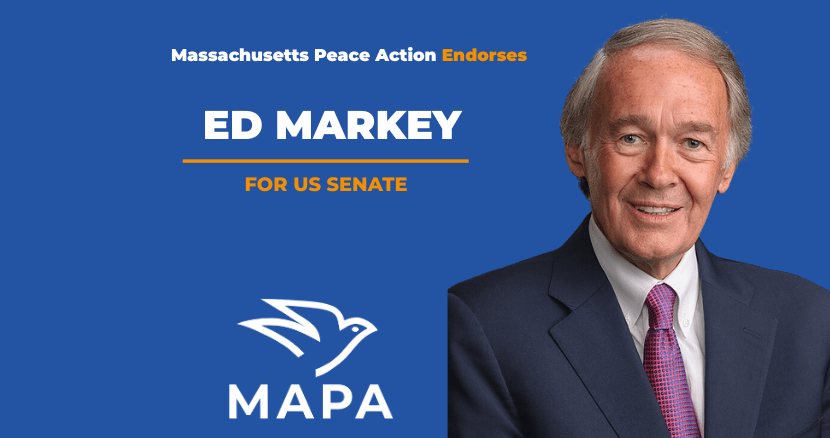
The Democratic primary between Senator Ed Markey and Congressman Seth Moulton matters considerably for Palestinian human rights and U.S. policy toward Israel. It is therefore imperative to look beyond the speeches and posturing and examine the record. On the question of Palestine, Senator Markey and Representative Moulton have taken notably different positions and actions. Very recently, Moulton has taken positions that supporters of Palestinian rights have welcomed, including his July 2026 vote in favor of the Massie Amendment that unsuccessfully sought to strip $3.3 billion in foreign military financing from Israel and his opposition to a version of the National Defense Authorization Act (NDAA) in the House Armed Services Committee. At the same time, however, Moulton voted in favor of the 2024 Israel military aid package and subsequently voted for the final 2026 NDAA. For a voter who opposes the illegal and brutal invasions of Lebanon and Iran, the escalating violence in the West Bank, and the unrelenting genocide in Gaza, it is wise to question motive. Is Moulton’s very recent vote to restrict arms to Israel an act of political expediency? Or a genuine change of heart?
In sharp contrast, Senator Markey has been a consistent opponent of sending U.S. arms that have enabled the slaughter in Gaza, now numbering 1265 killed since the so-called ceasefire was signed in October of last year, with a child killed by Israeli forces every single day, according to the United Nations and UNICEF. Near-daily bombardments, shelling, ground incursions, and sniper attacks have persisted. International organizations and humanitarian groups note that severe blockades, restrictions on medical evacuations, and limited access to food, clean water, and adequate shelter compound the death toll and humanitarian crisis in the Gaza enclave.
In response to this crisis, the Institute for Middle East Understanding (IMEU) created a scorecard for congressional actions during 2025–26 to assist voters as we navigate the choices for elected office. The Institute’s research shows a very different voting record between the two lawmakers. Moulton ranks last among Massachusetts’ nine representatives in positive actions concerning Palestinian human rights. Markey, by contrast, is identified as one of the 13 senators nationwide with the strongest record on the issue.
For example, eight Joint Resolutions of Disapproval (JRDs) were introduced in the House to block particular types of offensive weapons, while six were introduced in the Senate. Moulton did not co-sponsor any of the eight House resolutions and has declined to co-sponsor the Block the Bombs Act, which would restrict transfers of certain offensive weapons to Israel, including 2,000-pound bombs. By contrast, Markey voted for all six Senate JRDs.
The two lawmakers have also differed in their responses to actions taken by the International Criminal Court (ICC). Following the ICC’s issuance of arrest warrants for Israeli officials Benjamin Netanyahu and Yoav Gallant, as well as three Hamas leaders, Republicans introduced legislation imposing sanctions on the ICC and individuals assisting it. Moulton was the only one of Massachusetts’ nine representatives who did not vote against the legislation when it came before the House. Moreover, his name appears on a congressional letter castigating the ICC for its actions and arguing that Israel’s judicial system was capable of investigating allegations of misconduct. Markey, while himself critical of the ICC arrest warrants, voted in the Senate to prevent the Republican legislation from coming up for a vote.
Another significant difference between Moulton and Markey is with regard to calls for a ceasefire in Gaza. Representative Moulton did not call for a ceasefire until two days before the ceasefire agreement was actually signed on October 9, 2025. Earlier, in March 2024, he supported a six-week pause in hostilities tied to the release of Israeli hostages, while continuing to argue that a broader ceasefire was not reasonable while Hamas remained intact. By contrast, Markey spoke out early and consistently. Two days after the Hamas attack of October 7, 2023, despite vocal opposition from some who attended a Boston Common event, Markey called for de-escalation of violence on both sides. He subsequently made multiple public calls for a ceasefire. At the 2025 Massachusetts Democratic State Convention, Markey stated, “The US should not be complicit in the horror that is happening in Gaza….We need a ceasefire now. This war must end.”
In summary, the voting records of Senator Markey and Representative Moulton on Palestinian human rights and U.S. policy toward Israel differ significantly. Unlike Moulton’s recent votes on some aspects of military assistance to Israel, Senator Markey has a long record of using his position in the Senate to challenge weapons transfers, assert Congress’s authority over U.S. military assistance, support congressional oversight, and call for an end to the violence in Gaza. The shift across the Massachusetts delegation also illustrates the potential impact of Markey’s sustained congressional leadership: Today, every member of the Massachusetts delegation has voted against weapons transfers to Israel.
Support Ed Markey’s re-election campaign! Sign up here to tell us how you can help
By: Susan Nicholson and Beth Verani