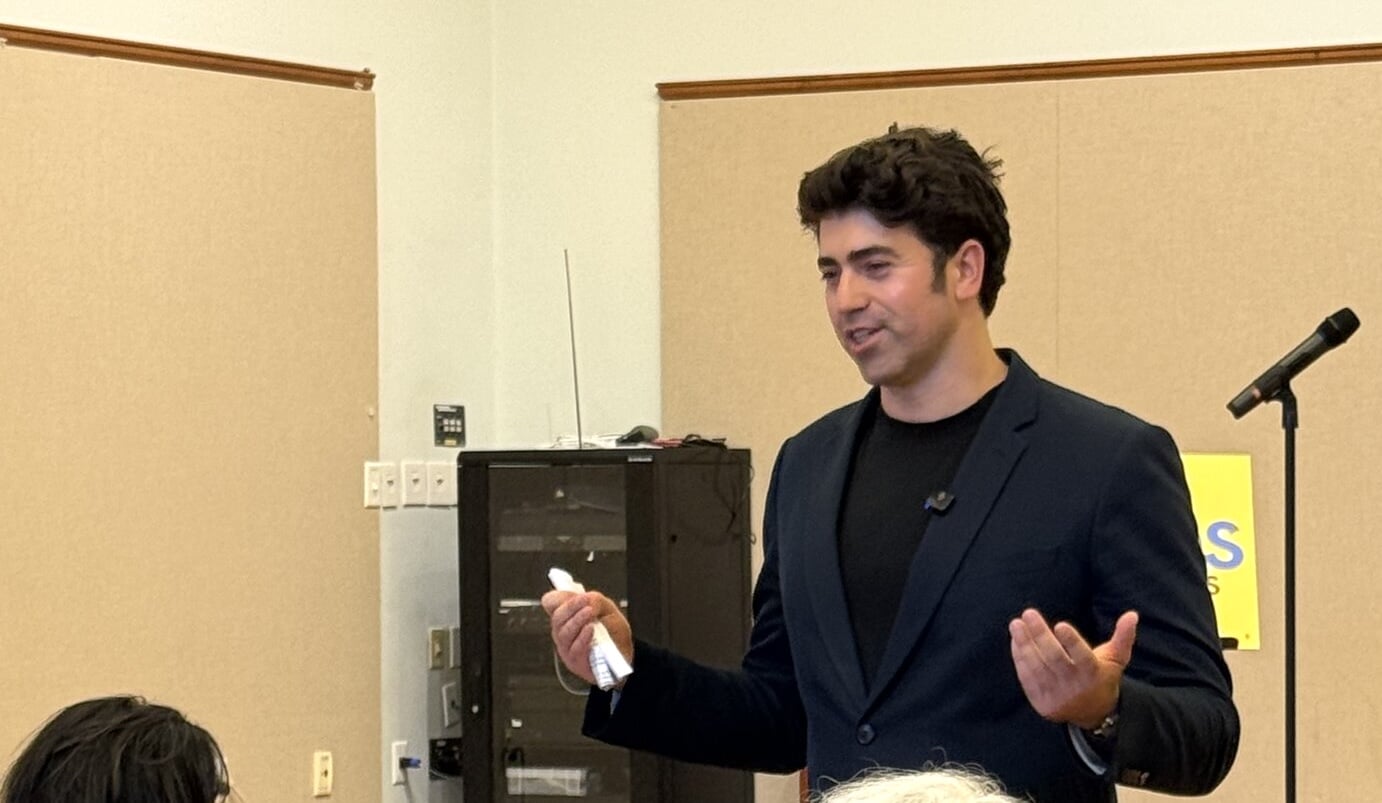
On August 12, I spoke with Jason Poulos, candidate for Congress in Massachusetts District 4, running to replace incumbent, Jake Auchincloss. We covered a range of issues, including AI, Medicare for All, Israel, workers’ rights, corruption, and the future of the Democratic party.
—
It’s a pleasure to speak with you today. Would you please give us a short overview of your campaign and your top issues?
Thanks for having me.
One of the main themes of the campaign is the urgency of artificial intelligence displacing jobs. A few months ago, the company Oracle announced that 21,000 employees would be laid off due to AI. It’s not because they weren’t profitable — it was actually the opposite. They just wanted to reinvest their profits into AI infrastructure — these AI data centers that are causing environmental degradation and harm the health of the individuals in the surrounding community. And over the course of the next decade, about 7% of the entire workforce, both blue-collar and white-collar jobs, are estimated to be displaced.
One of the main policy positions of the campaign is to provide a floor for every American in this country, and the number one issue is Medicare for All, because we have 27 million people uninsured in this country, and we pay more on health care than any other industrialized nation in this country, and we receive middling health returns from it.
The second thing is we need to reinvest the productivity gains of AI towards people. The data that the AI models are trained on are trained on data that we produce. Our writing, our music, our books, the activities on our phones are being used by AI companies to train their models and to create more profits for their companies that are then being reinvested into AI data centers. So, I think that these companies should be taxed, and we should get something of an AI dividend in the form of a universal basic income back from these companies.
The third thing is that we have to make sure that workers have a seat at the table, especially at a time when companies are deciding how to deploy AI in the workforce. And so that’s why I support the PRO (Protecting the Right to Organize) Act, which would help strengthen collective bargaining rights. More importantly, it would reclassify gig employees and contract employees as legal employees so that they can organize and demand higher wages, better working conditions.
It’s as if our leaders are just ignoring the implications of AI and hoping it will resolve on its own if we pretend it isn’t happening. The same goes for privacy issues. Can you talk a little about that? What about all this data that’s been collected with our voices, tweets, emails and everything we’ve ever said or written and every photo we’ve ever posted online?
Our campaign is proposing a federal AI regulatory agency, a board that’s independent of the executive and legislative branches of government, that isn’t tied to the tech industry, that would have real independence with thinkers and policymakers on the board. The board would have real teeth. They would be able to create new regulations. They would be able to review new model releases to decide whether these models are safe for public consumption.
They would be able to create new and binding regulations that would ensure that individuals’ privacies are protected. Another aspect of that is the proliferation of these flock cameras, these autonomous license plate readers, which are just harvesting people’s data in terms of where they’ve been, at what times or what places. It’s collecting all this data, which can be carried by federal agencies like the Department of Homeland Security, and it’s without our consent. I believe that the collection of individuals’ data, especially by the federal government, needs to have a warrant, and a warrant should be required for any collection of data, whether it be from the FBI in the form of a FISA 702 (Foreign Intelligence Surveillance Act) collection effort, which is collecting data from individuals’ metadata, whether or not they’re the target of an investigation.
Representative Auchincloss voted against the FISA warrant requirement in 2022. His was the tie-breaking vote, and so that gave Trump the ability to use the FBI to collect data on Americans. And Representative Auchincloss also then voted again to re-extend the FISA warrantless requirement recently. That’s an area in which we differ.
Let’s talk about Medicare for All. How do you propose that would be funded?
The Medicare for All Act would open the Medicare program to every American. It would expand traditional Medicare to include dental, vision, hearing, and long-term care. Workers would be paying into the system through the payroll tax. Overall, it would save money on healthcare. We’d be shifting costs away from the private health insurance system. A new study coming out from researchers at Yale University estimates that Medicare for All would save one trillion dollars per year.
That’s for a few reasons. One is that the Medicare system has lower administrative costs than the private health insurance system. Two is drug prices, so under Medicare for All, there would be an expansion of drug price negotiation, so more drugs would have their prices negotiated down. We wouldn’t have this system where people can’t afford insulin. And number three is simply the elimination of the profit incentive. Healthcare would no longer be a for-profit industry.
It would also save a lot of local and regional hospitals from the threat of closure. What’s happening now in Fall River and Taunton, for instance, is that hospitals that have existed for decades are under threat of closure because they’re no longer profitable and private equity took over the companies and tried to sell them for parts. Medicare for All would ensure that is no longer a possibility.
What do you see as your major differences with Auchincloss? Why do you think he’s bad for the country and for the people of Massachusetts, and why are you running to unseat him?
Everything in this campaign is a contrast, whether we’re explicit about it or not. Medicare for All is something I believe in deeply. I was volunteering for Bernie Sanders in 2020, and I would knock on doors, and I would tell people about Medicare for All, and how it would save billions of dollars a year, and thousands of lives a year. The threat of AI displacement heightens the demand for Medicare for All because we’re now in this economy where workers can get laid off easily. Their jobs might be more transitory, so we really need to decouple health insurance with employment. And not only is Representative Auchincloss not a co-sponsor of the Medicare for All Act, but he has [also] explicitly said that he doesn’t believe in Medicare for All. He’s [Auchincloss] the only representative in the Massachusetts delegation not to be a co-sponsor of the PRO Act in the current Congress. All other representatives in our delegation have co-sponsored this bill.
Tell us a bit more about the PRO Act.
The PRO Act is labor’s number one priority, the number one bill that they want to pass. It would allow workers more opportunities to organize and demand fair wages; it would penalize companies that try to break up unions; it would ban the practice of firms who bring workers into the company cafeteria, for example, and tell them how bad unions are and why they shouldn’t create one. And it would also let gig employees, like rideshare workers and part-time contractors, form unions. Auchincloss has not co-sponsored this bill, and I would co-sponsor it on day one.
Another big difference between us is the issue of money in politics. I’m running a campaign that takes zero PAC money. We have individual donations of $35, 84% of that come within the district. In this cycle alone, Auchincloss has taken $700,000 in PAC money. Since being elected to office, he’s taken over a million dollars from the pharmaceutical industry. He’s taken money from healthcare PACs. He’s taken money from drug manufacturing PACs. He’s taken over a million dollars from AIPAC.
This is an issue about who your representative is going to answer to–are they going to answer to the voters in their district, or are they going to answer to the special interests and the billionaire donors outside of the district?
On day one, I would co-sponsor the Citizens Over Corporations Amendment to overturn Citizens United, which is the disastrous Supreme Court decision in 2010 that unleashed unlimited PAC spending in our elections. At that time, Auchincloss was not a co-sponsor of this amendment. I pointed this out to a journalist in Newton, who then called Auchincloss’s office, who said, “Oh; we actually do support this bill.” And then the next day, he co-sponsored the amendment.
Where do you differ from Auchincloss on the issues of Israel, Palestine, and the Middle East?
I’ve always stated that I do not support military funding to Israel, and that’s because we have the Leahy laws which say that if a country is in violation of human rights laws, then we cannot transfer money to them. But we’ve continued to do so anyway; we’re skirting our own laws. We should no longer fund Israel in terms of military assistance. That’s why I support the Block the Bombs Act in Congress right now, which would cease military transfers to Israel in terms of weapons transfers and (in terms of) supplemental assistance.
The United States should not send any weapons or military funds to Israel, and that includes so-called “defensive” military aid. It should apply pressure on Israel to cease the illegal settlements on the West Bank. It should apply pressure to cease the illegal invasion of Lebanon. And it should bring in international partners in Europe to apply this pressure, and say to Israel explicitly: “If you want to be part of this international community, you can’t behave like a rogue country.”
Auchincloss has recently decided that the U.S. should not be funding Israel’s military in terms of the $3.3 billion that we send there annually, but it’s not because he doesn’t support Israel’s atrocities against the Palestinian people and against the Lebanese people. It’s because he disagrees with the way in which Israel and the Trump administration has been conducting the war against Iran.
I also support the resolution in Congress that would call what has happened in Gaza a genocide, and that’s important because with that definition come legal consequences. The United States must play a role in making right what has happened, because we’ve contributed to it through our military assistance, selling weapons, and also providing diplomatic cover to Israel.
Auchincloss has voted in favor of the appropriations of $1 trillion to the Trump Pentagon, which is now being used to bomb elementary schools in Iran. I would not have voted for that budget. I don’t think the Pentagon should have a $1 trillion budget. The Pentagon has failed its federal audit year after year for eight consecutive years. I believe in shrinking the Pentagon budget and sending money away from the war machine back to our communities in health care, housing, and education.
Let’s talk about the Democratic Party. You’re running as a Democrat. We know Auchincloss is a centrist Democrat and there are a lot like him who take money from AIPAC and from corporate PACs. The Democratic Party seems to do everything they can to prevent progressives who refuse this money from winning elections. Do you see the Democratic Party as something that could be changed from within by progressives, or do you think they’re too corrupted and too far gone into agreements with corporations, with Israel, and with other entities that don’t stand for the people.
I’ll talk a bit more about AIPAC because that also ties into this question. I was speaking with an ardent Israel supporter in Needham when canvassing, and the conversation ended with the issue of AIPAC. He said, essentially, “What’s the problem with AIPAC? They give money to Democrats.” And my answer to that was, “Well, the people funding AIPAC are the same people funding Trump and the MAGA Republicans. This is the same set of donors. And so if you’re taking money from the same set of donors that funds Trump and MAGA Republicans, how are you going to stand up to Trump on issues of ICE or issues of government surveillance? You can’t, because you’re funded by the same pool.”
AIPAC poured $10 million into the Michigan Senate primary race against Abdul El-Sayed, who ended up winning. After he won the primary, they decided they’re going to pour another $10 million to the Republican in the race, Mike Rogers. They’re not promoting the Democratic Party. In fact, they’re subverting the Democratic Party. If you’re a Democrat taking money from AIPAC, you’re participating in the subversion of your own party.
But I see a silver lining in the clouds. The spokesperson for the Illinois governor, J.B. Pritzker said AIPAC is a right-wing MAGA organization. J.B. Pritzker is not a leftist; he’s a centrist Democrat with ties to the Clinton administration. If he sees AIPAC as this right-wing organization, it is good news for the Democratic Party going forward. I think association with AIPAC is going to be a drag on the Democratic Party, and I think even centrist Democrats acknowledge that at this point.
Right now, we see this ideological battle within the Democratic Party. Once again, it’s really a question about who the party will answer to. Is it going to be the billionaire class? Is it going to be the people who are also funding Donald Trump? Or is it going to be the working class? We can only pick one side.
Would you tell us your views on ICE and what you think would be a reasonable immigration policy for the United States?
I’m the only candidate in this race who has called for abolishing ICE. Representative Auchincloss has called for reforming and retraining ICE, and I don’t believe that’s possible. Just look at ICE’s activities in Minnesota and elsewhere. This is not an organization that can be reformed or retrained; it’s being used by the president as a paramilitary force. I believe that we have to dismantle ICE, but that doesn’t mean that we have no immigration enforcement in this country. It means that we transfer immigration enforcement outside of the Department of Homeland Security towards a department such as the State Department in which there can be immigration enforcement that more resembles the pre-DHS era, when the INS was persecuting immigration cases like white collar, paper cases, and not, like a military operation.
The Department of Homeland Security also has a budget that’s tripled over the past couple years. It should not be growing; we need to pare down the DHS budget and reinvest that money into our communities. ICE and CBP (Customs Border Patrol) agents should not enjoy qualified immunity that shields them from civil prosecutions. And in terms of immigration policy, I believe that we have to be working towards a humane, fair, and quick pathway to citizenship for undocumented people in this country.
You touched a little bit on your past. Maybe we could take a deeper dive into that. What led you to become interested in politics, to be interested in progressive politics, and to want to run for office?
I’m an academic researcher, and I’m a product of public schools here in Massachusetts. I went to high school here in Dover-Sherborn Regional High. I did my undergrad at UMass Amherst on a Pell Grant and a work study and did my PhD at UC Berkeley in political science and computational science and engineering. I came back here to do a postdoc at Harvard Medical School in AI and health policy.
I’m the son of a single mother, and we didn’t always have it great growing up in terms of economic security. When I went to UMass Amherst, I worked at a research institute called the Political Economy Research Institute that did great work on union issues and issues related to living wages. The first academic published publication I put out was a policy paper on indexing the Massachusetts minimum wage, which ended up being indexed in the future. I was primed pretty early on in favor of these progressive, pro-worker policies.
I volunteered in North Carolina when I was a postdoc there at Duke for the Bernie Sanders campaign, and I would go around neighborhoods in Durham on my Vespa, knocking on doors, telling people about Medicare for All and how we need single-payer health insurance in this country, and that was essentially an organizational experience.
About my decision to enter this current race, when I was a postdoc at Harvard Medical School and the encampments were happening at Harvard, I felt a strong need to stand with the student protesters who were just asking for their voices to be heard. They wanted to sit down with administrators and ask them to divest their tuition dollars from the war machine, from companies profiting off of war. In many instances, these students were brutalized. The police were called, and the encampments were torn down in a violent way.
I saw Representative Auchincloss go to Harvard, essentially threatening Harvard, for the federal government to pull funding away from the university, because he thought that Harvard was not acting brutally enough against these students. I thought that was disgraceful. It also paved a pathway for Trump to then come into office and then put the boot down on these university administrators. It’s a direct consequence of what was happening at that time.
I signed onto a few petitions from university scholars to university presidents, saying you should sit down with these students and hear what they’re saying, and just for putting my name on these petitions, I was put on this Israeli-run doxing website, which was, you know, heavily promoted and advertised on the internet, and it turns out that this website was being used by Trump’s DHS to target student protesters who were here on visas.
What would you like to accomplish in your first year in office, and what are some of your longer-term goals?
The first things are co-sponsor and help move the Medicare for All Act to a vote on the House floor. Co-sponsoring is easy, but really advocating for it and pushing for it is going to take time and effort, and it’s going to take pressure from the newly elected progressive wing in the party towards House leadership, which tends to be more conservative. It’s going to take some time to apply that pressure.
Similarly with the PRO Act and with the Citizens Over Corporations amendment to overturn Citizens United. These are bills that are growing in popularity within the Democratic Caucus, but we also have to act on them and apply pressure to the leadership.
There’s another one I haven’t mentioned, the Expand Social Security Act, which would eliminate the payroll tax cap, and in doing so, we could expand Social Security by $2,400 a month for recipients. That’s a bill that’s also growing in popularity. Representative Auchincloss does not co-sponsor it, even though he says that he supports expanding Social Security. And that is also a bill that has many of Democratic co-sponsors, but the leadership won’t let it go up for a vote. And so, we really have to apply pressure from below.
I also saw on your website that Auchincloss also wants to raise the retirement age.
Yes. He did a Substack post last year in which he framed Social Security as at risk of becoming insolvent, and we have to implement fundamental reforms to save it. It’s a real Republican type of framing. He proposes three reforms, and two of those reforms would have the effect of reducing benefits.
One reform is essentially testing, so that Social Security is no longer a universal program — it’s a means-tested program. The second thing, as you mentioned, he said he wants to raise the retirement age. I’ve learned that recently he’s going to Democratic town committees saying that he is actually in support of expanding Social Security. Well, if that was the case, he would be co-sponsoring the Expand Social Security Act, which is in Congress right now, and he hasn’t.
How can people support your campaign?
There are a number of ways. We’re a small dollar campaign with an average donation of $35. One way is to donate $35 through https://poulos.house/donate. And that goes directly to the campaign; we don’t spend money on overhead. It’s all directed towards voter outreach. We’re doing canvassing efforts. The canvassing requires literature. It requires campaign merch. It requires phone and text banking, which costs money to reach voters directly. To do the phone and text banking, you don’t have to live in the district or the state. Go to https://poulos.house/phone bank. We have virtual events. We have local events in which you can get together with other volunteers and help make calls and place texts to voters in the district who are likely to show up to the primary. And we’ve had a lot of success with that. We have identified a lot of people who have already voted for this campaign through mail-in ballots.
We have canvassing events every day. Today I’m going to Attleboro to canvass the entire day. And we’re going to have at least two [canvassing events] per day up until election day.
We have a town hall in Taunton coming up this coming Monday, on the 17th. And details on that are on our website.
As we draw to a close, is there anything else you want to highlight?
Yes, in speaking with voters across the district, my message is always the same, whether I’m speaking to someone in Brookline or in Fall River: We need Medicare for all in this country to decouple health insurance with employment. We have to get big money out of politics. There’s too much corporate PAC spending in politics. Representative Auchincloss has received an F score from the Political Integrity Index, while I have taken the Political Integrity Pledge of not taking any corporate PAC money. We are spending way too much money on war. The House just passed a $1.5 trillion Pentagon budget. We need to send that money back to our communities and healthcare, education and housing instead. And these three messages together are winning messages in this district, and it doesn’t matter if you are voting in Brookline or in Fall River. This message is resonating with voters, and they want progressive change.
By Jeannie Connerney
For more information:
MAPA Statement Endorsing Jason Poulos
—
Jeannie Connerney is an activist and writer. She is a member of Watertown Citizens for Peace, Justice and the Environment; Pax Christi; and Massachusetts Peace Action, where she serves on the editorial board of The Peace Advocate.