
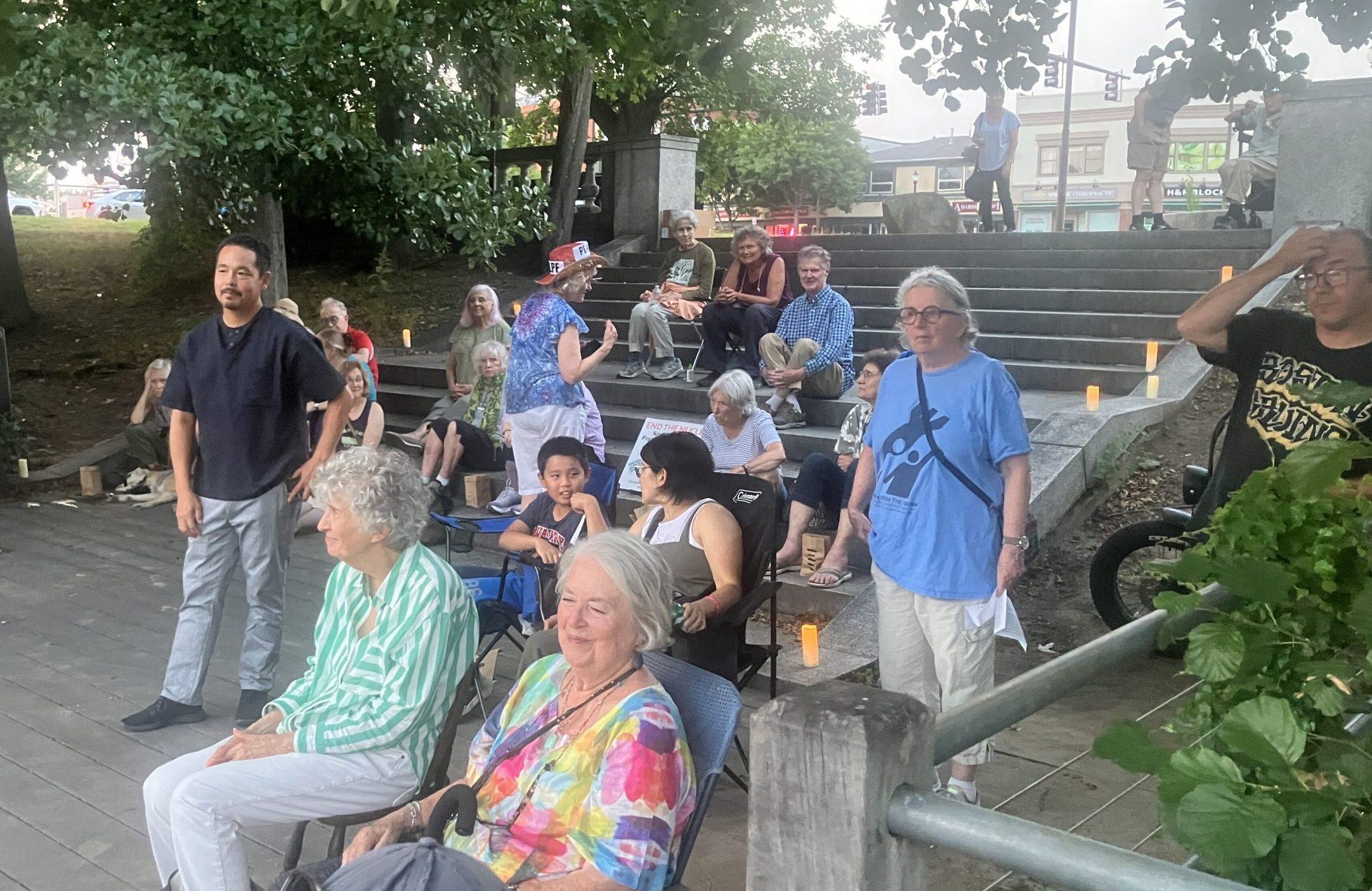
Anti-nuclear weapons activists gathered by the dock in Watertown Square on August 9, to mark the anniversary of the second atom bomb that the US dropped on Japan in 1945. Seventy-five thousand people died in that blast on Nagasaki, after 145,000 had been killed in Hiroshima 3 days earlier.
One of the speakers was Ray Matsumiya, grandson of one of the survivors of the Hiroshima attack, who was the head of the volunteer fire department of a town close by. He went into Hiroshima and spent 3 days treating the wounded. A week later one of his eyes started to hurt and, in another week, he was blind in that eye.
During the explosions, parts of Nagasaki and Hiroshima reached the temperature of the sun.
There is a tradition in Japan of honoring ancestors by floating lanterns to honor and comfort their souls. Survivors of both blasts began immediately to float lanterns for the victims, a tradition which they have kept up to this day, as have many locations around the world. Watertown’s lantern commemoration has been going on for 40 years.
Both Nagasaki and Hiroshima have become impassioned centers of peace activism and peace education is required at every level of schooling.
Sen. Ed Markey and Rep. Jim McGovern are sponsoring the Back from the Brink Resolution in Congress, calling for the US to ratify the Treaty for the Prohibition of Nuclear Weapons, for it to pledge never to use a nuclear weapon first, not letting one person decide when to launch a nuclear weapon and stopping refurbishing our nuclear stockpile. On July 31, the Massachusetts Senate adopted S-3247, calling on the Mass Congressional delegation to support the Treaty on the Prohibition of Nuclear Weapons and the whole Back from the Brink platform, joining California, Oregon, Rhode Island, Maine and New Jersey.
After speeches and songs, the lanterns were put in the river. As they floated down stream, a flute played and people joined in singing “Let there be peace on earth and let it begin with me!”
By Susan McLucas