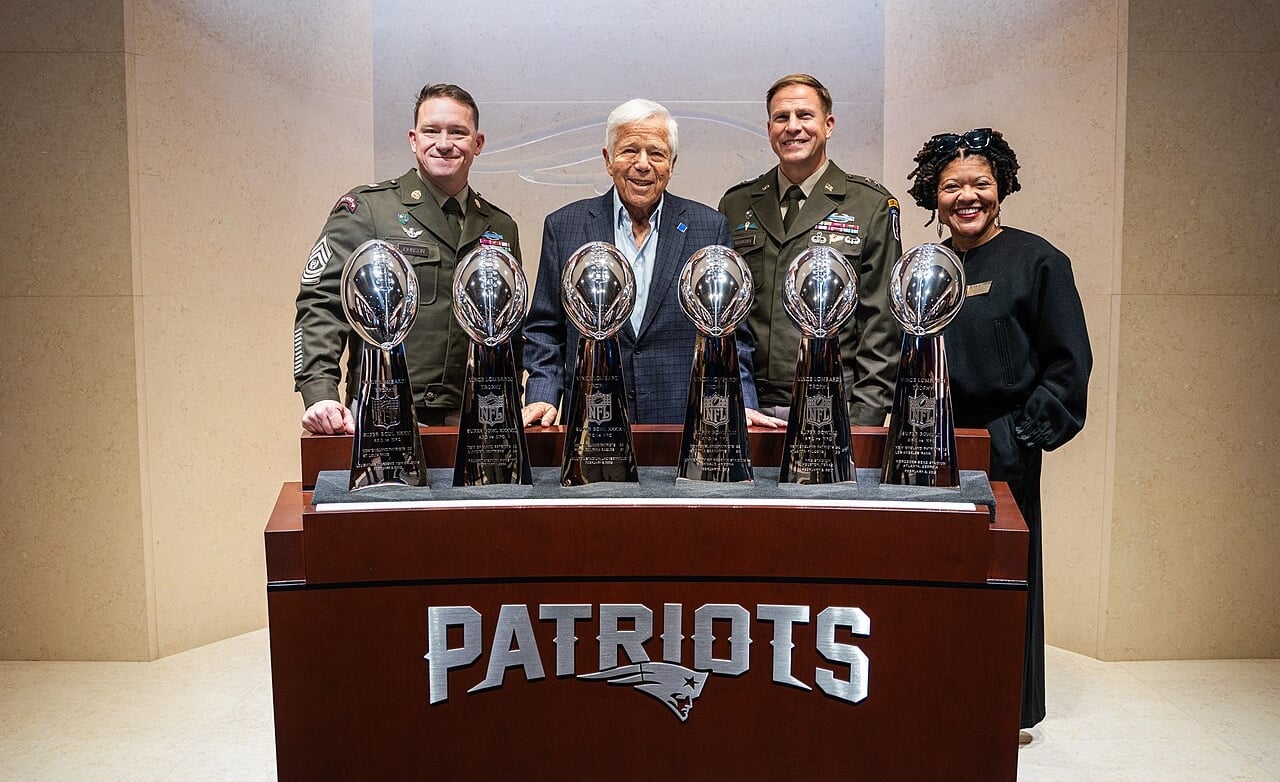
Most people in Massachusetts know Robert Kraft as the owner of the New England Patriots. And it’s safe to say Pats fans like him. Most of us even feel comfortable calling him Bob. Six Super Bowl championships will do that for you.
But Bob’s role in removing rapper Macklemore from Ed Sheeran’s tour is giving fans a look at another side of Bob Kraft.
Kraft isn’t just an NFL owner with political opinions. He’s a political billionaire. He gives millions to political organizations, funds national messaging campaigns, and has spent decades building ties between political leaders, professional football, and Israel.
Now we’ve seen another kind of power he has: the ability to decide who gets to take the stage at Gillette Stadium, and apparently to help decide who gets to perform at stadiums around the country.
The controversy started earlier on in Ed Sheeran’s Loop Tour when Macklemore opened for Sheeran at MetLife Stadium on September 5, 2026, and used his performance to say “Free Palestine” and talk about the suffering of Palestinians in Gaza and the West Bank.
But an important part of what Macklemore said has gotten lost. He directly addressed Jewish members of the audience and made a distinction between antisemitism and criticism of Israel.
“Criticism of Israel, criticism of apartheid, being against genocide in no way is a criticism of you,” Macklemore told the crowd, before saying his message was about peace, dignity, and equality for everyone.
That didn’t stop his critics from accusing him of antisemitism.
According to Macklemore, Kraft called Ed Sheeran and told him Macklemore would not be allowed to perform at Gillette, citing what Kraft described as a broader history of antisemitic rhetoric and imagery. However, Bob Kraft didn’t just stop with his own stadium. Macklemore said Kraft also contacted other stadium owners to participate in the boycott. Sheeran later confirmed that multiple venues refused to host concerts with Macklemore still attached to the tour.
Whether one person should have even that much power is a subject for another article. Bob Kraft led an effort to censor Macklemore at stadiums across the country.
And that didn’t come out of nowhere.
Since 2022, the Kraft Group has given $3 million to United Democracy Project, AIPAC’s super PAC. During the current election cycle alone, UDP has raised more than $107 million and spent nearly $51 million on independent expenditures supporting or opposing candidates.
Kraft’s political reach doesn’t stop at the Massachusetts border either.
In 2021, Kraft was one of the major donors backing Shontel Brown in an Ohio congressional race against Nina Turner, a critic of US-Israel policy and prominent spokesperson for Senator Bernie Sanders. Democratic Majority for Israel spent more than $1.9 million supporting Brown and attacking Turner, who supported putting conditions on US aid to Israel. Brown won.
While Kraft’s financial support of these groups doesn’t necessarily mean he controls everything the groups dol,But we must keep in mind that his money is part of a national political network spending heavily in races far beyond Massachusetts.
And Kraft’s influence goes beyond campaign contributions.
In 2019, Kraft founded the Foundation to Combat Antisemitism, now known as the Blue Square Alliance Against Hate. He’s funded the organization with more than $150 million. That makes his personal definition of antisemitism very important, and Kraft has been very clear about how closely he connects this work to Israel.
When he received the Genesis Prize from Israeli Prime Minister Benjamin Netanyahu in Jerusalem in 2019, Kraft said, “After my family, there is nothing I’m more passionate about than the State of Israel and my Jewish identity.” That same year, he said his new foundation would fight what he called antisemitic narratives questioning Israel’s right to exist that were “disguised as part of legitimate debate” on campuses and in the media.
Opposing antisemitism is important. Antisemitism is real and, like all forms of prejudice and discrimination, it’s dangerous.
But opposing antisemitism and defending the policies of the Israeli government aren’t the same thing. Even though Macklemore made that difference explicit, Kraft still barred him from Gillette.
Kraft says Macklemore crossed the line anyway. And unlike most people having that argument, Kraft has spent decades building the kind of influence that lets him do something about it.
According to the Kraft Group (founded by Robert Kraft in 1998)the Kraft family has led “dozens of missions” to Israel that have “made an impact” on former Massachusetts governors Bill Weld, Paul Cellucci, and Deval Patrick. Kraft has also taken Patriots players and Pro Football Hall of Famers to Israel on three “Touchdown in Israel” trips.
Bob Kraft’s influence isn’t limited to campaign contributions or organized advocacy either.
Kraft has rubbed elbows with presidents of both parties, including Bill Clinton, George W. Bush, and Barack Obama. He worked alongside Clinton on the US World Cup bid, and Patriots championship visits put him at the White House with Bush and Obama.
But Trump is different. Kraft has described him as a close friend, and their relationship goes back decades. In 2024, Kraft said he had stopped speaking to Trump after January 6. That appears to be over. In January, Kraft sat beside Trump at the Kennedy Center premiere of Melania.
This is a side of Bob Kraft New Englanders don’t see when the television camera finds him sitting in the luxury box during a Pats game.
And Kraft himself has acknowledged that owning the Patriots means something different from owning an ordinary business.
In 2024, Kraft called his family “the custodian of this asset” and said they understood how important the Patriots are “to the psyche of the community.” He’s right.
The Patriots may be privately owned, but they’re also a New England institution. Gillette Stadium was privately financed, but taxpayers have still spent tens of millions of dollars on roads, transit, and other infrastructure around it. Massachusetts authorized up to $70 million in infrastructure financing connected to construction of the stadium, and the MBTA more recently spent about $35 million upgrading Foxboro Station, with the Kraft Group contributing more than $5 million.
If Kraft sees himself as the custodian of a public institution then how he uses its power matters.
Then there’s the question of who gets labeled unacceptable.
Raymond James Stadium in Tampa hosted two concerts earlier this year by Kanye West, who has repeatedly made antisemitic statements and publicly praised Adolf Hitler. Yet Tampa officials say their stadium was not one of the venues demanding Macklemore’s removal.
Unlike Gillette, Raymond James Stadium is publicly owned. The Tampa Sports Authority says it doesn’t get involved in freedom-of-speech disputes because it is a public facility. It took the same basic position when it faced pressure to cancel Kanye West’s concerts.
Think about that contrast. A public stadium faced pressure over Kanye West and stayed out of the speech question. Private stadium owners faced political speech they objected to from Macklemore and could tell one of the world’s biggest musicians: drop him or find somewhere else to play.
Who gets to decide what political speech is acceptable? Should a few billionaires get to make that decision for the rest of us because they own the stadiums?
Even if Bob Kraft believes he’s doing the community a service — well-intentioned people can still be wrong. That’s part of the problem with concentrating so much power in the hands of one person. When it’s a billionaire with no restrictions on his or her spending, those decisions can affect elections, institutions, the public debate, foreign policy, and the lives of millions of people they’ve never met. The issue isn’t whether Bob Kraft is good or bad. It’s whether anyone should have this much power.
That’s why this is about more than Macklemore, Ed Sheeran, or Bob Kraft. It’s a moment where we should recognize a much larger problem. Billionaires like Bob Kraft are using their wealth to build enormous influence not only in business, but in politics and culture as well.
Massachusetts and New England know Bob Kraft as the beloved owner of the Patriots. Millions of Patriots fans appreciate what he’s done with the team. Six Super Bowl championships will do that for you.
But we should get to know Bob Kraft the political billionaire as well. His story is another example of how enormous wealth can translate into enormous influence over our politics, our institutions, our laws and even who gets access to the country’s biggest stages.
By Brian Garvey