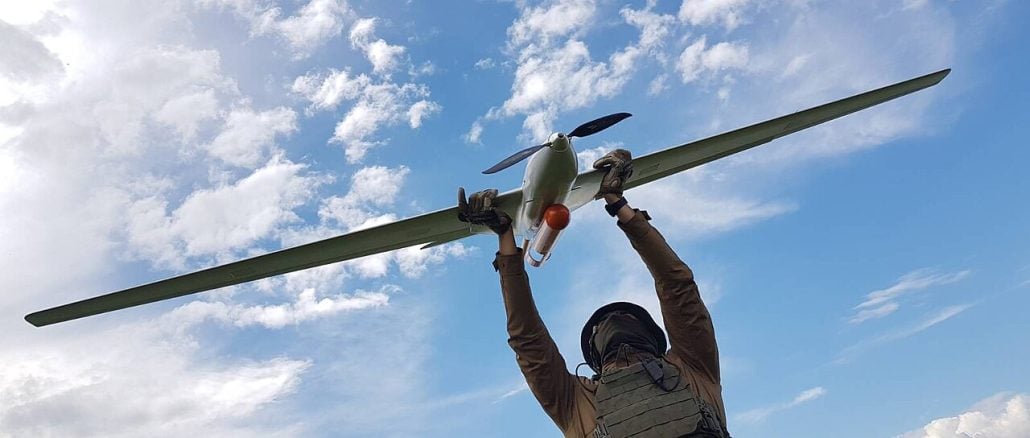
The Ukraine War has escalated dangerously in recent days and threatens to balloon into a direct confrontation between Russia and NATO. Ukraine has sent hundreds of drones deep into the Russian homeland, attacking Moscow itself, military facilities, energy infrastructure, and civilian targets across a wide swath of territory. Most disturbingly, Ukrainian drones struck a girls’ dormitory in Luhansk where 21 people were killed, mostly children, and dozens injured.
The long-range drones and missiles used in such Ukrainian attacks are deployed with the intelligence, targeting, and logistical assistance provided by the US, according to a New York Times report.
The War Expands
Calling the strike on the dormitory the “last straw”, Russia retaliated with a massive assault on Kyiv, using hundreds of drones and missiles, including one or more Oreshniks – the intermediate-range, hypersonic, nuclear-capable ballistic missiles that Russia has used only twice before in this war. Moscow has now announced that it will soon conduct “systematic and sustained” strike operations across the city of Kyiv, targeting military production facilities and “decision-making centers.” The latter could mean that posts where Americans and Europeans assist Ukraine in planning and executing the war will be in the cross-hairs. [Since this article was written, Russia has begun a renewed attack on Kyiv.]
Moscow has issued a grave warning to Western countries – including a phone call from Russian Foreign Minister Sergey Lavrov to US Secretary of State Marco Rubio – urging them to evacuate their embassies and citizens from Kyiv immediately to ensure their safety.
“This is madness!”
– Prof. Jeffrey Sachs of Columbia University, speaking of the developing escalation of the war.
Step by step, the war seems poised to spill beyond Ukraine’s borders and involve NATO countries directly. European leaders—led by German Chancellor Merz, British Prime Minister Starmer, and French President Macron—openly discuss preparing for war with Russia, as they increase their military budgets, attempt to ramp up their defense industries, step up military recruitment drives among young people and wage propaganda campaigns in the media. To what extent their rhetoric can be backed up with effective action remains to be seen – but they recently approved a loan package of €90 billion to Ukraine.
Moscow, which has asserted from the beginning of this conflict that it was existentially threatened by the expansion of NATO right up to its borders, the accompanying US unilateral withdrawal from one nuclear treaty after another, and the siting of nuclear-capable missiles in Romania and Poland near Russia’s borders, now says that if Europe is preparing for war, then Russia is ready for it.
Long Range Missile Strikes
According to commentators who have traveled to Russia, anger against the West has slowly been building there, in reaction to the duration and destructiveness of the war. That feeling has intensified since November 2024, when President Biden, in one of his last acts in office, announced that US missiles sent to Ukraine could be used for long-range strikes into Russia itself. Shortly thereafter, the Russians revised their nuclear doctrine, lowering the threshold for the use of nuclear weapons. President Putin cited Western support for the long-range missile strikes as the catalyst. In late May 2025, Germany, France and the UK followed the US lead and lifted all restrictions on the use of their missiles for strikes into Russia. (Not all these intentions could so easily be carried out, however, because the missiles were not always readily available.)
Attacking Your Adversary’s Nuclear Radars and Bombers?
Then, on June 1st of 2025, the Ukrainians launched a drone attack on Russia’s strategic bombers, which constituted one leg of its nuclear deterrence triad. The planes were sitting out in the open on the tarmac of Russian airfields, in accordance with the provisions and practices of the New START Treaty (which is now defunct). While estimates vary, somewhere between ten and twenty percent of Russia’s strategic bombers were destroyed or damaged. According to their nuclear doctrine, the Russians could have used nukes to retaliate, but Putin refrained.
The Ukrainians had undoubtedly been emboldened by their drone strikes the year before on Russia’s nuclear early warning radar sites. One site was damaged. MIT Emeritus Prof. Ted Postol has described how those strikes could have set off a catastrophic nuclear accident. And, considering the effect that damaged radar systems could have on Russian calculations, James Acton of the Carnegie Endowment for International Peace noted, “If Moscow believes that Washington could conduct a successful preemptive attack on its nuclear forces, its trigger finger could get very itchy, raising the risk that Russia might launch a large-scale nuclear attack based on a false or misinterpreted warning.”
Russia also alleges that Ukraine launched a highly reckless and provocative drone attack in December 2025, targeting not just a military base, but also one of Putin’s residences outside of Moscow.
During all the decades of the Cold War, neither side dared to take such actions as these – approving the use of their missiles for strikes on the adversary’s home territory or assisting another country in attacking the adversary’s radar systems and nuclear bombers, never mind a residence of the adversary’s leader. Both sides understood that some red lines must never be crossed.
Chilling Calls for War with NATO
Sentiment has been growing in Russia—among both the populace and policy-making circles—for President Putin to prosecute the war more aggressively. Putin appears to be listening. Some hawks in Kremlin circles assert that NATO countries are already at war with Russia and therefore have become legitimate targets themselves. Sergey Karaganov, is head of Russia’s Council on Foreign and Defense Policy, has called for direct strikes on NATO countries. He advocates beginning with conventional weapons but, if that does not convince the West to stop fueling the war in Ukraine, then using smaller, tactical nuclear weapons.
Where Will It End?
Many have asked why Europe appears to be on a suicide mission with respect to the Ukraine war. As the US has pulled back in recent months from trying to engineer a peace process, European leaders (with some notable exceptions) have become ever more belligerent in their rhetoric against the largest nuclear power on the planet. Leaders of the Baltic states, in particular, have been fiercely Russophobic and have apparently in some cases allowed Ukrainian drones to use their airspace on their way to an attack on Russia; some have even called for NATO to launch a military assault on the Russian exclave of Kaliningrad.
While some geopolitical analysts say that Russia now believes it is useless to try to negotiate with the West, others are calling on European leaders to open a dialogue with Moscow. In an Open Letter to German Chancellor Friedrich Merz published in Berliner Zeitung, Prof. Jeffrey Sachs urges Merz to acknowledge the role that Germany has played in bringing this war about, stop his warmongering rhetoric, and seek to restart relations with Russia. He writes:
The way to defend Ukraine is not continued slaughter, but peace..[W]e face escalation, with more deaths, more destruction, and the real prospect of a war that expands beyond Ukraine. By calling for ever more weapons, ever greater war-fighting capacity, and ever louder demonstrations of “resolve,” and by signaling that Germany is preparing for war rather than working to end it, you have allowed Berlin to become an accelerant rather than a brake to a European-wide war.
Sachs’s warning is, of course, just as relevant for the American government. And it is a perspective that should be heeded by the American peace movement as well, which has been divided about the Ukraine War. We need to call for an end to the destruction of hundreds of thousands of lives, the devastation of Ukraine’s economy and environment, the expansion of the war into a direct confrontation between Europe and Russia, and the climb up the escalatory ladder toward possible nuclear Armageddon.
Please note this is a developing story.
By Jackie King
—
Jackie King is a Board member of the Massachusetts Peace Action Education Fund and a member of MAPA’s Peace in Ukraine Campaign committee.