by Jeannie Connerney
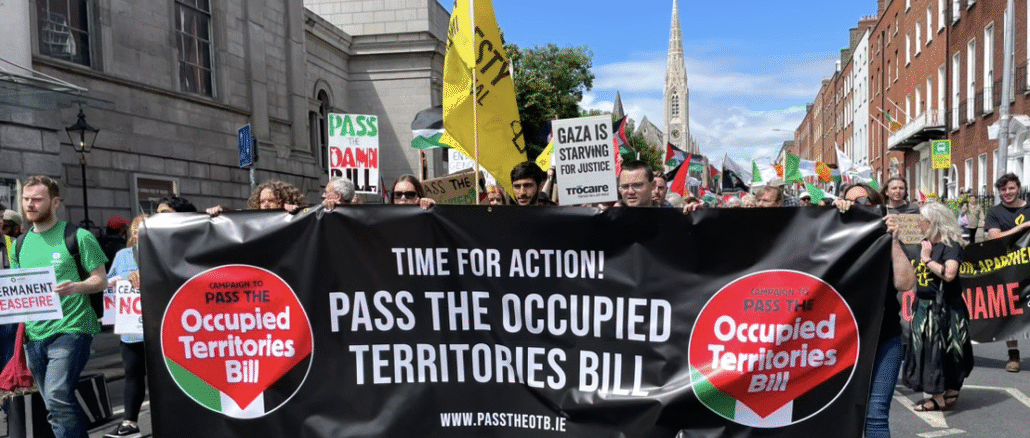
On July 19, tens of thousands of people marched through Dublin in solidarity with Palestine. Among their demands were that the Irish government finally enact a bill first proposed and passed by both houses of parliament in 2018. The Occupied Territories Bill would ban trade between Ireland and the West Bank, East Jerusalem, and the Golan Heights. During the past seven years, however, U.S. pushback has been constant, and the bill has been delayed and diluted. Renamed in June due to the removal of services from the proposed legislation, the Israeli Settlements Prohibition of Importation of Goods Bill 2025 progressed through the Foreign Affairs Committee in July. Irish Tánaiste (Deputy Head of Government and Minister of Foreign Affairs), Simon Harris has said he is confident it will be passed before the end of the year.
Now economically even less impactful than the former version, the bill would prohibit approximately merely €300,000 in imports. Why then, does the bill matter, and why does the U.S. continue to oppose it?
First, the bill would respect international law at a time when other countries fail to do so. Last summer the International Court of Justice upheld the illegality of Israeli occupation of the West Bank, Gaza, and East Jerusalem and outlined the obligation of states to abstain from trading with “Israel concerning the Occupied Territory.” The U.N. General Assembly called on countries “to take steps towards ceasing the importation of any products originating in the Israeli settlements.”
Second, passage of the bill would be symbolic. Supporters hope that Ireland will set a precedent and create a domino effect in Europe, leading other countries and eventually the European Union to pass similar laws. This would mimic events of three decades earlier when Ireland led Europe by banning imports from South Africa. That legislation was instigated when a cashier at Dunnes Stores, the second-largest grocery chain in Ireland, refused to handle South African produce at the direction of her union. Other employees joined her, the movement caught on, and Ireland banned trade with the apartheid country in 1987. Eventually Europe and most Western countries followed.
That was before the European Union existed, however, and before the Irish economy was so strongly tied to American business. Because Ireland offers both the lowest corporate tax rate in the European Union and a well-educated, English-speaking workforce, two-thirds of all foreign investment in Ireland is by companies headquartered in the United States. These include the European headquarters of several global tech giants who also operate in Israel as well as major pharmaceutical companies. 20% of all Irish jobs are with American companies.
Still, Ireland has long been one of the most vocal countries in Europe in opposing the occupation of Palestine and the genocide in Gaza. It was the last country to recognize Israel and the first to recognize Palestine. In May 2024, along with Spain and Norway, Ireland officially recognized the Palestinian state, and in January 2025, Ireland joined the South African case against Israel in the International Court of Justice. Israel has since both withdrawn its ambassador to Ireland and closed its embassy in Dublin.
On September 1, Israel moved the approval process for its European investment bonds from Ireland to Luxembourg. Irish activists had been protesting the Irish Central Bank for continuing to issue of these bonds and pressuring their government to ban the practice if the bank continued. It’s hoped that no country in Europe will continue their facilitation.
Occupied for 800 years by Britain, Ireland experienced its own ethnic cleansing and apartheid. A British-enabled famine from 1845-1852 caused one million deaths and the emigration of another one million people. Five years after the 1916 revolution, the island was partitioned: 26 counties in the south became the independent Republic of Ireland while six counties in the North remained under British rule. There, apartheid and violence continued until the 1998 Good Friday Agreement ultimately enabled a permanent ceasefire and a power sharing government.
Polls have showed that 80% of Irish people believe Israel is committing genocide in Gaza and 61% approve passing the Occupied Territories Bill. Passage of the bill was a key election promise during the 2023 election of Taoiseach Micheál Martin and his Fianna Fáil party.
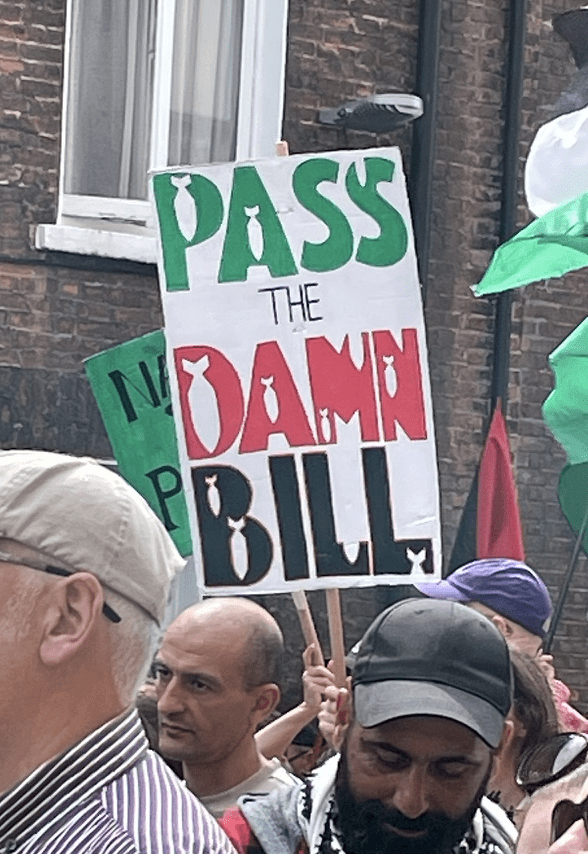 In 2018, the Occupied Territories bill passed in the Seanad (Senate); it then passed in the Dáil (House) in 2019. This prompted ten members of the U.S. Congress to write a letter to then-Taoiseach Leo Varadkar, threatening “potentially severe implications” for Ireland’s economy should it become law. The bill was subsequently stalled and blocked.
When the bill resurfaced last October, senior members of the Irish government purportedly received an email from U.S. Ambassador to Ireland, Claire Cronin, warning of “consequences” and “unforeseen economic uncertainty” should the bill pass and advising them to conduct “due diligence.” Less than 90 minutes after the email was sent, Taoiseach Micheál Martin changed course on immediate passage of the bill and stated that it would be “reviewed and amended.”
Then, in March of 2025, when Martin visited the United States, he reportedly told Jewish leaders in a meeting that passage of the bill was “off the legislative calendar,” something he now denies ever having said.
In June, services were deleted from the bill, leaving only goods, which account for only 30% of Irish trade with the Occupied Territories. While the renamed bill was approved by the Foreign Affairs Committee, the attorney general advised against passage, stating it’s incompatible with EU law, an opinion legal scholars strongly dispute. Meanwhile, Irish politicians, including the Committee, continue to advocate for services to be included once again.
On July 10, U.S. Rep. Claudia Tenney, R-N.Y, and 15 other republican representatives sent a letter to the U.S. Secretary of the Treasury, Scott Bessent, requesting that Ireland be added to the Israeli boycott list if the bill becomes law. This would result in tax penalties for businesses in Ireland. The letter also states that the Occupied Territories Bill promotes discrimination, is part of the Boycott, Divestment, and Sanction movement (BDS), and could violate IRS tax code. “Efforts to economically isolate Israel will carry consequences,” it said. Currently, 38 U.S. states have anti-boycott laws in place.
Less than a week later, the Wall Street Journal published an opinion piece by Eugene Kontorovich of the right-wing Heritage Foundation, titled, “BDS Will Be Bad for Irish Business.” In it, he states that Ireland “has a lot to lose.”
Then, in a racist post on X, U.S. Ambassador to Israel, Mike Huckabee called the proposed legislation “so stupid that it would be attributed to [an] act of diplomatic intoxication.”
“Did the Irish fall into a vat of Guinness?” he asked and concluded with the words, “Sober up, Ireland!”
Government debate on the bill will continue this fall. If passed, Ireland would be the first European country to introduce a ban on trade with the Occupied Territories. We can only hope that Ireland will not bow to threats by AIPAC-funded U.S. politicians and corporate pressure and finally enact the legislation, that other European countries will follow their example, and that any threatened economic repercussions will be minimal.
Irish Member of Parliament, Lynn Bolan, appeared on the Irish “Tonight Show” in late July. She summed up the vision of those who have continued to promote the bill during the past seven years: “This will be the crack in what has been a legacy of complete impunity…We cannot allow AIPAC to bully the entire world and sacrifice international law.”
__
Jeanne Connerney is a member of MAPA; Watertown Citizens for Peace, Justice and the Environment; Pax Christi; and Irish-Americans for Palestine, Boston.