
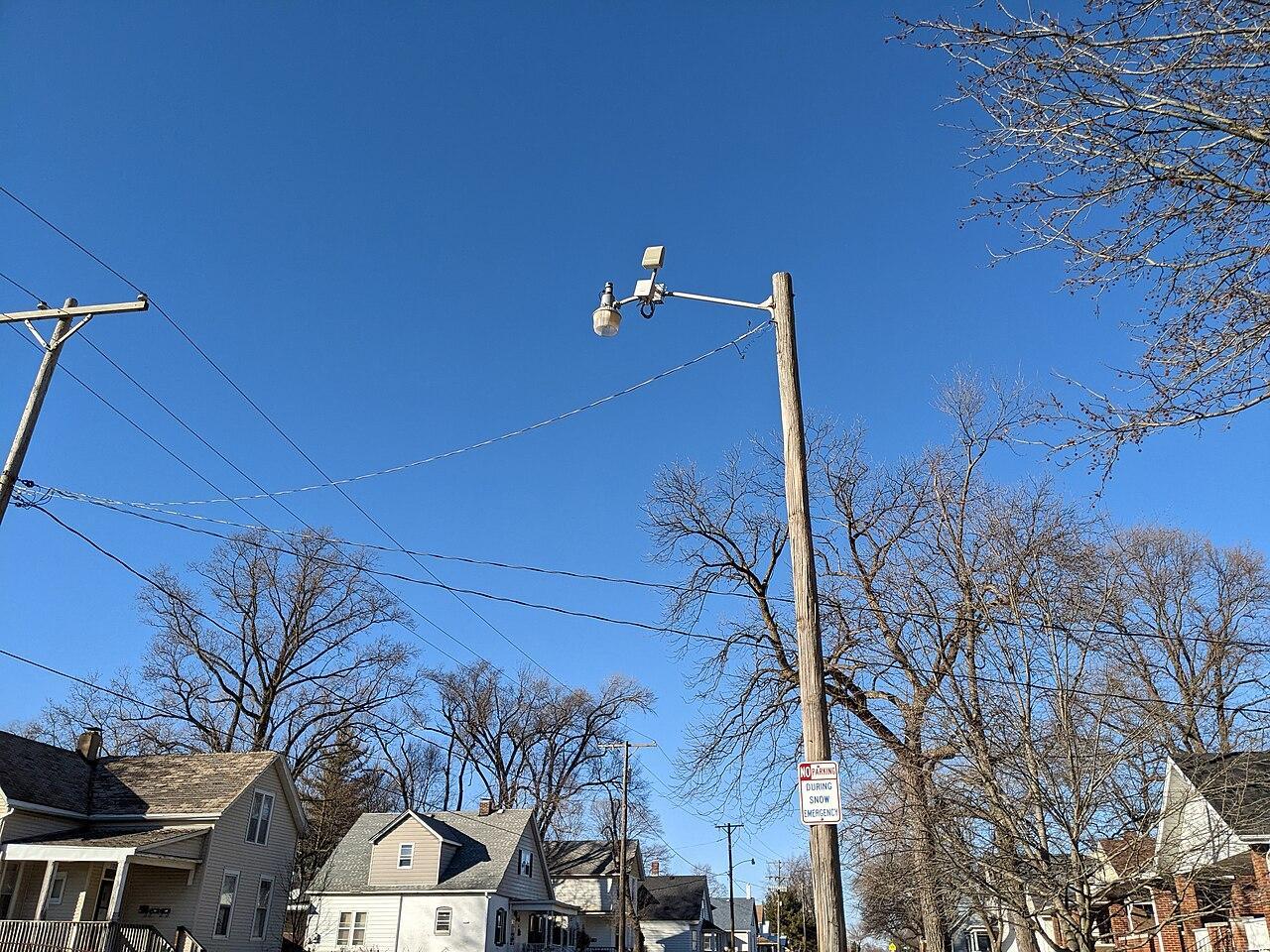
MAPA’s Racial Justice and Indigenous Solidarity Working Group collaborates with The Black Response Cambridge (TBR Cambridge) and recently heard their analysis of the effects of the use of ShotSpotter technology in Cambridge. Interestingly, we learned that the neighborhoods in Cambridge where this surveillance technology has been installed roughly correspond to areas that had been redlined by banks in the past. Here is a brief produced for TBR Cambridge by Boston University Associate Professor Spencer Piston on the use of ShotSpotter as well as a look at recent press coverage following the Cambridge City Council vote to remove ShotSpotter equipment from its city streets. —Rosemary Kean, co-chair of MAPA Board
ShotSpotter devices are microphones attached to computers placed nearly exclusively in Black and Brown neighborhoods in many cities across the United States – although many other cities have either refused to install such devices or have stopped using them after finding them ineffective. In theory, the devices send out an alert upon detecting a gunshot, at which point some combination of inputs from an algorithm, an employee, and police officers results in a decision for police to respond to the gunshot.
The parent company of ShotSpotter, SoundThinking, has changed its claims about the supposed benefits of ShotSpotter devices over time. Originally, the company marketed these devices as a deterrent to gun violence. However, a number of academic studies soon followed, indicating that the devices were ineffective at achieving this goal. Initially, SoundThinking disputed the findings of these studies, but it eventually pivoted to a new justification: that ShotSpotter devices improve the response times of police. This claim may also prove unfounded. While some studies suggest that average response times improve incrementally when ShotSpotter devices are introduced, a recent study, conducted by sociology professor Robert Vargas, found that response times actually decreased once ShotSpotter devices were eliminated in Chicago.
The downsides of ShotSpotter devices are serious indeed. Numerous studies have shown that the devices are unreliable at achieving their stated aims, leading not only to many false positives (sending police out without any gunshot occurring, due to fireworks, cars backfiring, or other road noise) but also many false negatives (failing to detect actual gunshots). These devices expose residents – disproportionately Black and Brown residents – to involuntary police encounters, heightening the risk of brutality, intimidation, arrest, and even killings. The devices also record conversations; one conversation was presented as evidence in the criminal legal trial Massachusetts v. Denison. However, this evidence was thrown out, as the recording of the conversation was deemed by the court to be a violation of the Massachusetts Wiretap Act. Such racially-disproportionate surveillance may violate Title XI of the Civil Rights Act, according to a letter written by Senators Markey and Warren calling for an investigation. ShotSpotter devices may also expose cities to liability; in Chicago, a class-action lawsuit against the city related to ShotSpotter was recently settled for tens of millions of dollars.
In May of this year in Cambridge, the city council voted to remove ShotSpotter devices, leading to a backlash in the media that promoted a number of falsehoods, chief among them the claim that ShotSpotter does not record conversations, despite clear evidence of these recordings appearing in criminal legal trials. Requests for corrections to these false statements went unheeded by The Boston Globe and The Harvard Crimson. The Globe printed an op-ed by two city council members who supported ShotSpotter, a piece that contained a number of errors and misleading statements, while rejecting a submission by The Black Response, a Black-led organization that led the campaign of more than two years duration to eliminate the use of ShotSpotter in Cambridge. In general, the media downplayed or ignored the role of Black and Brown organizers and residents while amplifying false claims by ShotSpotter supporters that participants in the campaign were exclusively out-of-touch white liberals. This media backlash notwithstanding, it appears that the Cambridge City Council has stood strong, and the city government will soon remove ShotSpotter devices.
In other cities in Massachusetts, such as Boston, ShotSpotter devices are being used, despite evidence from the ACLU of Massachusetts that the devices used are unreliable (about 70% of ShotSpotter alerts yielded no evidence of a gunshot), and that the city of Boston has spent over $4 million on ShotSpotter since 2012.
By Spencer Piston
—
Spencer Piston is an Associate Professor of Political Science at Boston University.