
by Jeanne Trubek
Does Tylenol cause autism? Do vaccines? Do they really prevent diseases? Is melatonin bad for your heart? All of these questions have been in the news, whether last week or years ago. How do we make sense of them?
The gold standard in medical studies is to conduct double-blind controlled experiments. In most cases, however, these are prohibited because they are unethical. Tylenol, for one, cannot be administered to pregnant women to determine whether or not their children develop autism. Consequently, medical researchers analyze these questions by examining the relevant data and using probability to reach a conclusion.
While this sounds rather simple, it is not. The first step is to know exactly what question is being asked. The question must be stated very clearly in order to arrive at a valid conclusion, and it must include identifying the population being studied. The second step, which is often more difficult, is to identify all the variables which may influence the outcome. Next, a sample set must be selected from the population, large enough to be able to draw conclusions, but varied enough to represent the entire population, and not weighted in favor of or against any given outcome. Then the members of the population — the subjects — are examined and perhaps interviewed, and the data collected is analyzed to determine the relationship between the variable being studied and the observed result.
Let’s look at the first question as an example. Does taking acetaminophen — Tylenol — during pregnancy cause the child to have autism?
This question hit the news when Donald Trump cited a paper by the Dean of Harvard School of Public Health — HCPH — claiming that Tylenol taken during pregnancy causes the child to have autism. According to an article published in the spring of 2024, this dean had been rejected as an expert witness in a court case in 2023 for what the judge called his shifting and “unreliable” testimony.
In contrast to the HSPH paper, a 2024 article in the Journal of the American Medical Association, or JAMA, published in 2024, reports on a study in Sweden that included over 2 million children. The big difference between this Swedish study and the one done by Harvard School of Public Health was the careful look at other influential variables such as the background reasons mothers were taking acetaminophen, parental medical history, and whether siblings had autism. The researchers found that the history of autism in siblings was an important variable to consider; once they controlled for sibling conditions, they found that there was no causal relationship between acetaminophen and autism.
Their finding was that the difference in percentage of children with autism whose mothers had taken acetaminophen during pregnancy was so small that it fell into the category of sampling variability; that is, the amount of variation you would expect if there were no impact of the acetaminophen. Health of the parents, presence of siblings with autism, reasons for the mothers to take a painkiller are all examples of confounding variables – variables that play an important role in the study but might be overlooked by the researcher. Sometimes these are more important than the initial study variables and turn out to be even more important.
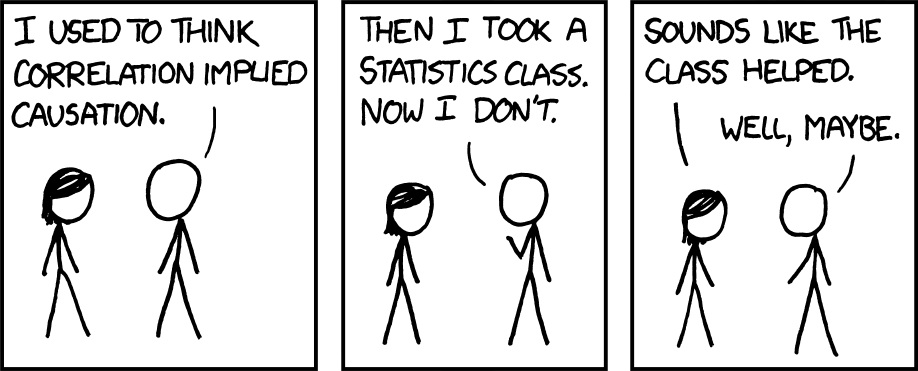
The standard example of such a case is a study of elementary school children which found a high correlation between foot size and vocabulary size. Do children store their vocabulary words in their feet? Of course not. Both foot and vocabulary size are related to age. Ten-year-olds have bigger feet and bigger vocabularies than five-year-olds. Here, age is a “lurking” variable — an important variable that the researcher didn’t see, but was lurking around the corner.
If decisions are based on statistical evidence, all factors must be studied and considered. As citizens, we must not leap to conclusions or rush to believe Trump’s often unsubstantiated statements, and we must remember that although variables may exist in conjunction with one another, correlation is not causation.