
By Jeannie Connerney
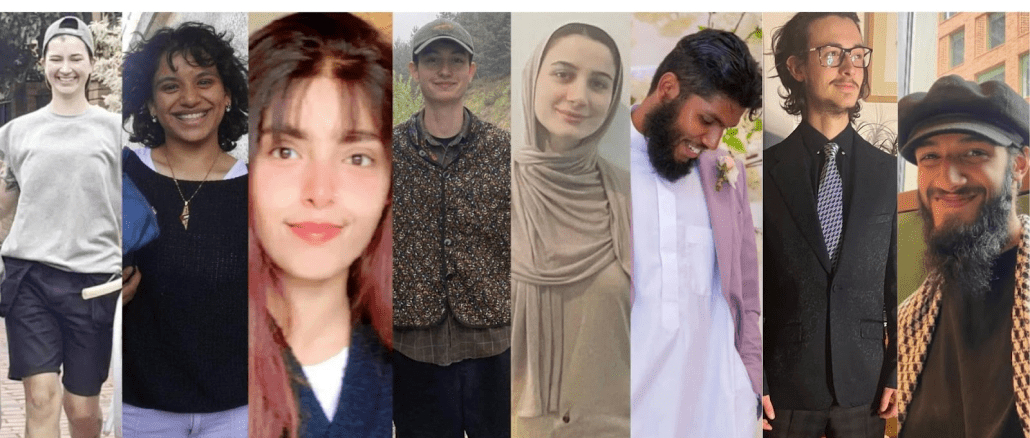
As of January 7, British prisoner Heba Muraisi is on day 66 of a hunger strike. She is struggling to speak, has trouble breathing, and is experiencing muscle spasms, indicative of neurological damage. “My body shakes, I get dizzy to the point of nausea and now breathing is getting hard. I am deteriorating in this cell, I am dying,” she told Metro in an interview recorded over several days and published on January 6.
“And it’s the rage from the injustice my comrades and I are facing that keeps me going. I’m well aware that things could turn at any minute, I’m terrified, I’d be stupid not to be.”
Prisoner Kamran Ahmed, on day 58, has hearing loss and has been hospitalized five times. Another prisoner, Lewie Chiaremello, who is striking every other day due to diabetes, is on day 41.
Prisoner Teuta Hoxha paused her hunger strike on Saturday. She was previously reported to have been blacking out, and she has now allegedly been denied urgent medical care to manage her food intake. Ingesting food after a long period of not eating can trigger refeeding syndrome, which can be fatal if not properly executed.
Hunger strikers Amu Gib, Jon Cink, Umer Khalid and Qesser Zuhrah have also paused their participation.
All British citizens under 31 years old, these activists are members of Palestine Action, proscribed as a terrorist organization in August for alleged non-violent actions at a Royal Airforce base and an Elbit manufacturing plant. Elbit Systems provides 85% of land-based weapons and drones used by Israel. The terrorist designation of the group places them in the same category as ISIS and Al-Qaeda.
For over a year, dozens of Palestine Action members have been denied bail and imprisoned without being charged. Their communications have been limited; some have not been allowed visitors, even from their lawyers. Kamran Ahmed complained of being shackled to guards in the hospital, even while lying in his bed and while using the bathroom. A former prisoner described being locked in his cell over 23 hours per day. Prison officials refused an ambulance requested by a former striker, and only called one 12 hours later, after an all-night vigil outside the prison, attended by Member of Parliament Zarah Sultana. Heba Muraisi was transferred to a prison far from her mother, who is now unable to visit her due to the long train journey.
Begun on November 2, the anniversary of the Balfour Declaration, which ushered in the creation of a Jewish state in Palestine, the hunger strike has five demands: end all censorship, immediate bail, the right to a fair trial, the deproscription of Palestine Action, and that Elbit be shut down. Since 2012, the company has won 25 public contracts in the UK, according to Prisoners for Palestine, and the Ministry of Defence is preparing to award them a £2.7 billion contract.
Former Guantanamo detainee Mansoor Adayfi, who spent time on hunger strike while being held for 14 years without charge, joined the Palestine Action hunger strike in solidarity on December 17. Speaking in Italy a few days earlier, he said, “A hunger strike begins when every other door is slammed shut. When the system makes it clear your life has no value, as long as you stay quiet and obedient. When it looks straight at you and tells you you’re already dead. So, you answer with your body.”
Palestine Action has engaged in the largest coordinated hunger strike in the UK in 45 years. This is not the first time strikers’ demands have been ignored, however. In 1976 Margaret Thatcher revoked Special Category Status for prisoners arrested for resisting occupation, apartheid, and state-sanctioned violence against Catholics in the North of Ireland. In 1981 she watched Bobby Sands, an elected Member of Parliament at the time, die after 66 days, the same number of days on hunger strike as Heba Muraisi as of the publication of this article. Subsequently, nine other Republican prisoners in Long Kesh Prison starved to death, while Thatcher continued to refuse to reinstate their status and acknowledge that their struggle was political. “A crime is a crime is a crime,” she said infamously.
Labour Party Deputy Prime Minister and Secretary of State for Justice, David Lammy and Prime Minister Keir Starmer have shown the same intransigence. Despite pressure from British politicians, including Independent Parliamentarian Jeremy Corbyn, and a letter signed by 61 other Members of Parliament, they refuse to acknowledge the strikers or their demands. When confronted about the hunger strike in public in early December, Lammy responded, “I know nothing about it.” When Corbyn asked Parliament whether the minister would meet with representatives of the hunger strikers, he was told flatly, “No.”
The silence continues, despite the threat of a High Court action by lawyers for the hunger strikers and condemnation of government inaction by the United Nations and Amnesty International. In a press release published on December 26 seven UN experts urged the UK to provide appropriate healthcare to the hunger strikers and to “engage in meaningful dialogue and action.” The statement also cites “serious questions about compliance with international human rights law and standards, including obligations to protect life and prevent cruel, inhuman or degrading treatment.”
“The State bears full responsibility for the lives and wellbeing of those it detains,” it reads. “Urgent action is required now.”
A December 17 press release from Amnesty International claims the hunger strikers are “victims of the UK’s excessively broad terrorism laws which have been misused to escalate ordinary criminal prosecutions of direct-action protesters into terrorism cases.”
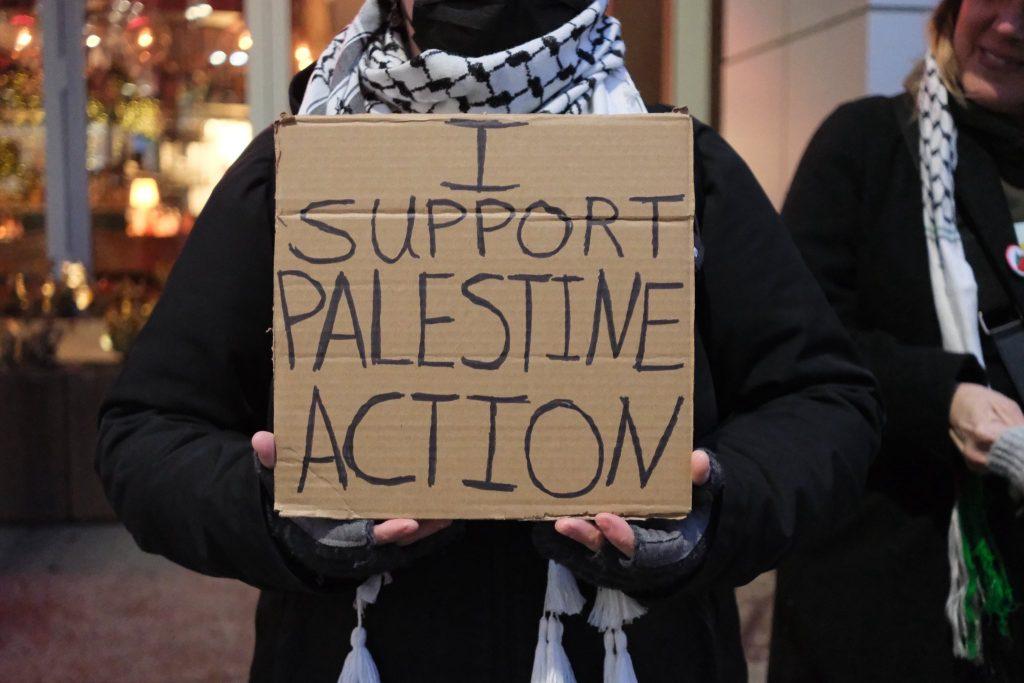
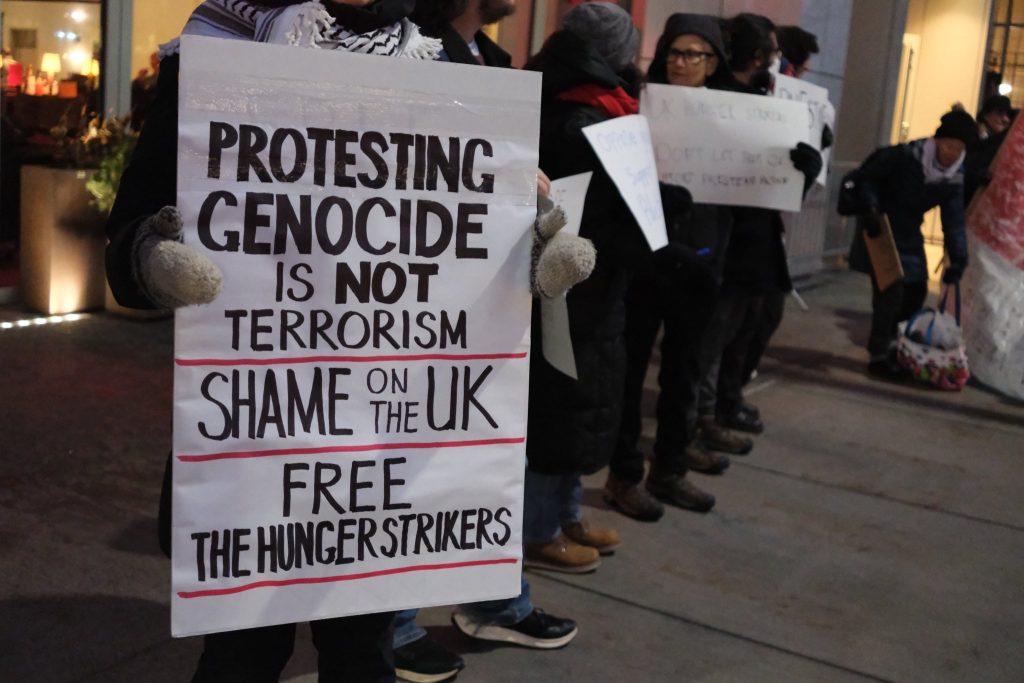
Massive protests across the UK demand the release of the prisoners and enactment of their five demands. Two days before Christmas in front of the building which houses Aspen Insurance, who now insures Elbit, Greta Thunberg was arrested for holding a sign on which was written, “I oppose genocide. I support Palestine Action.” Across the UK, over 2,700 other protesters have been handcuffed and arrested for the same reason—showing support for a “terrorist” group.
Meanwhile, Palestine Action has continued its campaign. Sean Middleborough, a prisoner who was released to attend his brothers’ wedding and failed to return to prison, said in a recorded statement. “You have tried asking nicely. You have asked too nicely. You have begged the powers that be to bring about change, when even the hunger strikers have known for such a long time that only direct action will bring about change.”
“If you believe this is a genocide, act like it,” said hunger striker Lewie Chiaramello. The group insists that direct action remains the only effective means of change. “Follow the money and make it too expensive to support genocide,” said another member. This tactic has proven successful in some cases: After the Elbit actions, insurers Allianz and Aviva ceased doing business with the weapons manufacturer. Their accountants did the same. Eleven HSBC banks remained closed after they were vandalized. Recently, the group has focused on some of Elbit’s suppliers, including blocking roads in front of a logistics company who ships their weapons and an action inside a parts supplier in Scotland.
The outcome of this hunger strike remains to be seen. The situation is dire, and the Labour government remains silent, despite daily protests across Britain and the world, including one outside the British Consulate in Cambridge, MA on January 6. Unlike in 1981, when the Irish Hunger Strike made front page news across the globe, the mainstream press has largely ignored the story.
As the Western war machine maintains their enablement of occupation and genocide and Palestine Action persists in their calls for action, the chances of permanent damage or death for these committed activists increases.
In a November 2 statement, Heba Muraisi wrote, “I want to make it abundantly clear that this is not about dying, because unlike the enemy, I love life.”
“From behind these steel walls and sensors, I will continue the fight and to resist,” she continued. “This is for the mothers who can’t bury their children, for the fathers who had to bury all of theirs. For the children who have no family left and are too young to understand why. And for my family—who I don’t even know if they’ve made it out of Rafah.”
—
This is a developing story.