by Cambel Shim
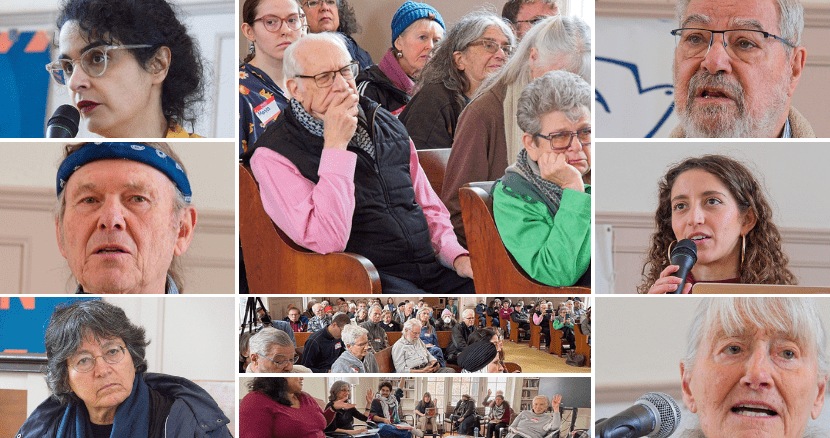
On Saturday, March 7, 2026, members of Massachusetts Peace Action convened for an all-day conference bringing together activists, scholars, journalists, and community members to confront what the movement is calling “the new face of genocide,” as well as the Iran war that started on February 28. The conference encouraged its 160 attendees to discuss the growing regional momentum behind Palestinian solidarity and anti-war organizing. The event featured two morning panels with seven different speakers, followed by an afternoon of breakout sessions focused on strategy, messaging, and concrete action.
The conference opened with an urgent look at conditions in Gaza, the West Bank, and the broader Middle East. The panel featured Nancy Murray of the Alliance for Water Justice in Palestine and Gaza Mental Health Foundation; Leila Farsakh, professor of political science and Palestinian rights advocate at UMass Boston; Amira Hass, Haaretz correspondent and activist; and Susan Akram, clinical professor of law and director of the International Human Rights Clinic at Boston University. The panelists laid out what is at stake right now, noting that the Trump-Netanyahu Gaza agreement, now adopted as official UN Security Council policy, breaks sharply from seventy years of UN resolutions on Israel and Palestine. Speakers stressed that the Palestinian national community faces an existential threat under this agreement, and that Trump’s war on Iran has destabilized the region and pushed aside international law. The panel made clear that past strategies focused on ceasefire demands and documenting humanitarian aid violations are no longer enough. The movement now needs a unified approach that directly challenges the agreement and stands firmly behind Palestinian self-determination.
The second panel focused on strategy, bringing together Rami G. Khouri, Palestinian-American journalist and public policy expert; Lea Kayali, organizer with the Palestinian Youth Movement in Boston and steering committee member of the People’s Embargo for Palestine; and Paul Shannon of MAPA, co-chair of the Gaza Israel Mideast Peace Campaign. The panel called on the movement to challenge the current rhetoric being pushed by the United States and Israel, including the phony “board of peace” and the pseudo-ceasefire.. Panelists talked at length about the implementation of strategies to outline and dismantle the hypocrisy of the current war. Discussion ranged from the importance of isolating Zionism to highlighting how the war is decimating Palestine for Israeli gain.
The afternoon sessions divided participants into focused working groups, each producing concrete takeaways and action items. The knowledge, community, and energy participants brought to these discussions made them among the highlights of the day, with many attendees sharing opportunities to discuss, listen, and learn. There were eight breakout sessions in total with the first four focusing on movement messaging, boycott and divestment, political action, and refuting claims of anti-semitism and the second four focusing on Iran, legislative action, free speech, and public education.
In the first afternoon session the messaging group stressed connecting the issue to everyday domestic concerns so ordinary people feel personally invested and use faith-based and Christian language around peace and nonviolence. The boycott and divestment group focused on broadening the BDS message by linking corporate and government complicity across multiple issues and building engagement at the neighborhood level. Political action participants called for legislative call-in campaigns, educational videos, street theater, and faith community actions targeting war profiteering corporations. Additional suggestions included a shared activist calendar across Massachusetts and Vermont and cross-state networking through Maine, and sharing MAPA newsletters, and the AWJP list. The refuting false antisemitism group developed tools for confidently responding to common attacks, working through logical fallacies in small groups, and stressing the importance of staying on topic. As one participant put it, “every accusation is a confession.”
The second afternoon sessions focused on geopolitics, legislation, and civil liberties. On Iran, participants urged tying the conflict to everyday economic pressures like rising gas prices, keeping Palestine and Iran in focus at the same time, and holding elected officials accountable for war funding. Legislative priorities included opposing a long term U.S. commitment that US taxpayers will provide arms to Israel, separating Israel aid from the Pentagon budget, and using existing laws like the Leahy Law to restrict military aid, all tied together by the message “we will not pay for Israel’s bombs.” The free speech and public education group mapped pro-Palestine electoral opportunities, proposed ending Massachusetts government contracts with Israeli businesses, and recommended faculty union coalitions and institutional shaming campaigns. Across all sessions, the day reflected a movement that is growing stronger and more strategic, with connections across faith communities, union halls, campuses, and state legislatures building a solid base for continued action.
A final brainstorm session laid the basis for a new campaign against the Iran war to mobilize the broad, but shallow, opposition of Americans to the unprovoked and illegal war launched by Trump.
The conference was a great success. Across both the morning panel discussions and afternoon breakout sessions, attendees left with concrete action steps, a deeper understanding of the issues, and a renewed commitment to keeping the conversation about Palestine alive and moving forward.
You can view videos of the talks and notes from the breakout sessions. The conference was cosponsored by the Alliance for Water Justice in Palestine; CD8 for Palestine; Watertown Citizens for Peace, Justice and the Environment – Palestine/Gaza committee; Cambridge Friends Meeting – Peace and Social Justice committee; Needham for Palestine; Palestinian Youth Movement; Arlington for Palestine; MTA Rank and File for Palestine; and Sawa: Newton-Area Alliance for Peace and Justice.
Cambel Shim is an undergraduate at Northeastern University and an intern at MAPA Education Fund