by Jeannie Connerney
“What we have witnessed in recent days in the Middle East, and beyond, are not political disputes. They are deliberate assaults on international law, the international laws that have underpinned global peace for eighty years. We must name them as such, without euphemism and without equivocation. Ireland is uniquely positioned to do precisely that.”
These are the words, not of Irish Taoiseach Micheál Martin, who visited the White House on Saint Patrick’s Day, but of President Catherine Connolly last week in anticipation of his meeting with Trump.
When a reporter asked Trump for his reaction to her statement during the press conference, he responded by misgendering Connolly, saying, “Look. He’s lucky I exist” and saying he will never allow countries who are “sick and demented” to have nuclear weapons. Martin smiled awkwardly and said nothing to correct or contradict him.
Since 1952, members of the Irish government have visited the White House every March 17 to offer the sitting president a bowl of shamrocks as a gesture of friendship aimed at strengthening Irish American relations and in recognition of the Irish diaspora in the United States.
Calls for the Taoiseach to boycott the visit began in February. “The situation on the ground in Gaza and the West Bank remains dire,” said Mary Lou MacDonald, President of opposition party, Sinn Féin. “The genocide continues. It is important that Sinn Féin uses its voice to demand that international law is upheld and peace and justice prevail.”
Michelle O’Neill, First Minister of Northern Ireland, joined MacDonald, saying, “Despite the hopes and promise offered by the ceasefire agreement in Gaza, horrific Israeli military attacks continue…It is my responsibility as a political leader to stand firmly on the side of humanity.”
Since Israel and the United States began their aggression against Iran on February 28, organizations including Amnesty International, Ireland joined even more representatives in their calls for Martin to cancel the trip or, when it was clear he would not, to speak up against Trump’s illegal actions.
“Because the world let Israel and its sponsors, the United States and the Western powers commit a genocide in Gaza and continue the ethnic cleansing and persecution of the Palestinian people, now they think they can get away with doing it in Iran,” said Richard-Boyd Barrett of the People Before Profit Party in the Irish Parliament last week. “So, their plan is to do to Iran what was done to Gaza.”
“Are you really going to go over there and give this guy a bowl of shamrock?” he asked.
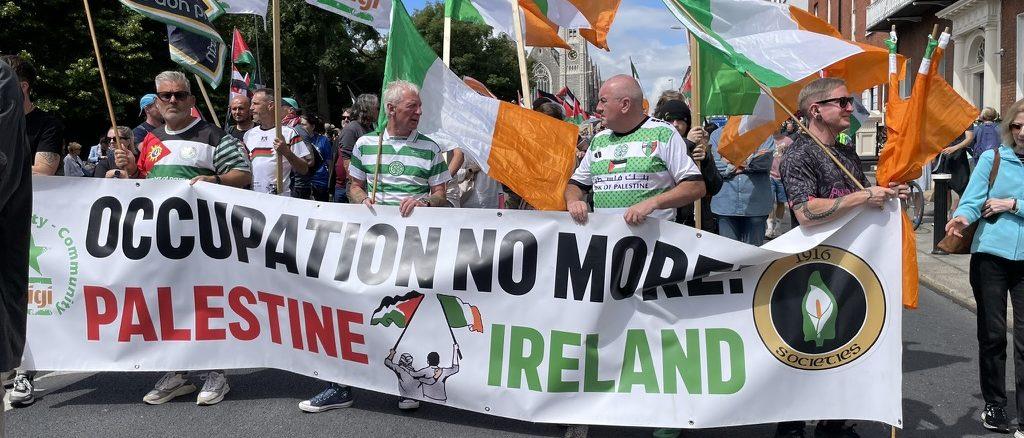
Pro-Palestinian sentiment remains strong in Ireland. A 2024 poll showed 79% of Irish people believed a genocide was occurring and ¾ favored finally passing the Occupied Territories Bill, a major issue in the 2024 elections. The bill, which was preliminarily passed in 2018, would ban trade with Israeli-occupied territories. Despite promises, the bill was diluted and remains stalled. In 2025 Connolly, who is an outspoken critic of the genocide in Gaza, was elected president in a landslide, winning 63% of votes.
Ireland is no stranger to land theft, dehumanization, apartheid, and starvation, and their treatment by British colonizers under 800 years of occupation is widely considered as a blueprint for colonization in Asia, India, Africa, and the Middle East. The indigenous Irish were treated as morally and intellectually inferior, as what British author and clergyman Charles Kingsley called “white gorillas.” Under the Penal Laws, for example, it was illegal for Irish people to own land, practice law, practice Catholicism, or speak their own language or even at times, wear the color green because it represented support for rebellion. The failure of the potato crop in 1845 and the refusal of the British government to intervene in the profitable export of other crops and livestock by British landlords led to what became known as An Gorta Mór, the Great Hunger. At least one million people starved to death from 1845 to 1852 and another one to two million emigrated.
A partition agreement broke up the island in 1921. Twenty-six counties became the independent Republic of Ireland, while six counties remained under U.K. rule. There, the occupation and discrimination continued, eventually resulting in a 30-year period of violence known as “The Troubles.” The 1998 Good Friday Agreement ushered in a ceasefire and representative government, although the six counties still remain under U.K. sovereignty.
As early as 1917, Ronald Storrs, British governor of Jerusalem described the increase of Jewish settlers to Palestine, saying “We are creating in Palestine, a little, loyal Jewish Ulster in a sea of potentially hostile Arabism.”
After the 1916 revolution, Winston Churchill sent a military force nicknamed the Black and Tans to Ireland, where they became infamous for arbitrarily burning and looting civilian homes and businesses and killing civilians as reprisals for IRA attacks. In 1921 he sent members of the same force to Palestine.
British Foreign Secretary, Arthur Balfour, author of the infamous 1926 declaration, which guaranteed Palestine to Zionists, had previously held the post of British Ambassador to Ireland. Nicknamed “Bloody Balfour” due to his defense and enablement of the murder of Irish civilians, he was also staunchly opposed to both Home Rule and Irish nationalism.
“Leaders often ask me why the Irish have such empathy for the Palestinian people,” said former Taoiseach Varadkar when he visited President Biden on St. Patrick’s Day two years ago. “We see our history in their eyes, a story of displacement, of dispossession, a national identity questioned and denied, forced emigration, discrimination, and now hunger.” He continued by pleading for food, medicine, and shelter and concluded, “Most especially they need the bombs to stop. This has to stop.”
Varadkar and his successor Simon Harris took steps toward Palestinian self-determination, including formally recognizing a Palestinian state and joining the South African genocide case in the International Court of Justice. Despite calling the attacks on Gaza a genocide, Micheál Martin, on the other hand, has stalled the Occupied Territories Bill and denied arms are being shipped through Shannon Airport to support the attacks by Israel and the United States in the Middle East, while he refuses to allow inspection of the planes.
In what Boyd-Barrett later described as “an abuse of history and a craven display of bootlicking,” the Taoiseach, ironically seated in front of a bust of Winston Churchill, who he praised as “a great war leader,” spoke about the need for dialogue and negotiation to resolve disputes and praised Trump for “doing his bit” for peace in Gaza. While Trump ranted against NATO, immigration, and windmills, Martin smiled and timidly defended Europe, the United Nations, and immigration during his short, but vague interjections. The bowl of shamrocks, which he ceremoniously handed to Trump, seemed to represent not the will of his own population, but complicity when face-to-face with the realities of genocide, disregard for international law, and the violent expansion of United States-Israeli hegemony.