
The World Stands with Palestinian Prisoners
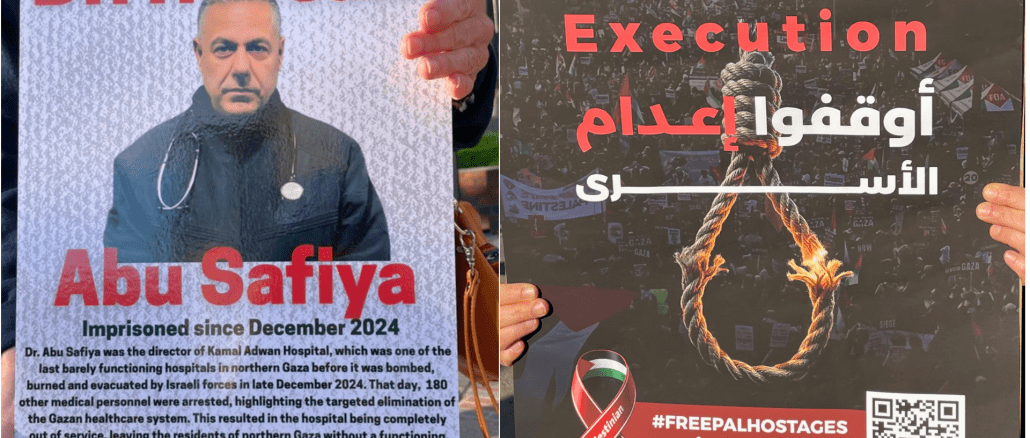
“I refused to leave the hospital and sacrifice my patients, so the army punished me by killing my son.” These are the words of Dr. Hussam Abu Safiya, who was one of 180 medical personnel arrested for refusing to evacuate the last functioning hospital in Northern Gaza before it was attacked over two years ago. Not only did the Israeli army murder his son, but he has now been held without charge in an Israeli prison for close to 16 months and has reportedly been subjected to what the UN Human Rights Office of the High Commissioner recently called “severe torture.”
Last Friday, activists stood outside Park Street Station holding signs telling both Dr. Safiya’s story and those of other political prisoners held behind bars in Israel. Organized by members of Arise & Resist, the standout was one of many held globally in response to calls by the Red Ribbons Campaign to publicize atrocities committed against detainees. Activists handed out informational flyers to passersby, and members of the public were encouraged to send letters of support to Palestinian prisoners. Red ribbons were distributed, to be worn in solidarity with those held in Israeli custody and to bring the issue to the forefront of public attention.
April 17 marked Palestinian Prisoners Day, dedicated to supporting those held in Israeli prisons, working for their release, and expressing solidarity with the overall Palestinian struggle for freedom. The day is especially relevant this year in light of two recent reports which reveal widespread systemic barbarity within prisons, and the recently-passed Prisoners’ Execution Law, which facilitates the death penalty for Palestinians, but not for Israelis.
Of the close to 10,000 Palestinian prisoners, over one-third are held in administrative detention, allowing them to be jailed indefinitely without charge or trial. Eighty-four prisoners are women, and 342 are children.
Israel is the only country in the world to try children in military courts, and an estimated three-quarters of child prisoners have experienced violent treatment. Interrogation often occurs without a parent or lawyer present and involves physical and psychological torture.
“Living Hell”
Israeli human rights organization B’Tselem released a report in January called “Living Hell.” It follows their 2024 report “Welcome to Hell,” which concluded that Israeli prisons function as “torture camps.” Using testimony gathered since October 2023 in addition to reports from human rights organizations, “Living Hell” concludes that prison brutality has increased since the genocide of Gaza began. The report claims that systemic torture is abetted and often celebrated by Israeli courts, media, and public officials. It cites:
- sexual violence, including genital beating and mutilation and penetration by objects and dogs;
- physical violence, including severe beatings, tear gas, rubber bullets, burning with cigarettes and boiling water;
- inhuman living conditions, including overcrowding, starvation, restricted access to clean water, and lack of hygiene; and
- denial of medical care, resulting in loss of limbs or eyesight and sometimes death.
Other methods of abuse often used during interrogations include prolonged stress positions, sleep deprivation, constant loud music, and continuous bright lighting. Psychological abuse includes threats to family, nakedness, being urinated on, forced confessions, and being forced to sing Israeli national songs.
At least 84 detainees have died in custody since October 2023.
“Another genocide behind walls”
A 2024 report by Euro-Med Human Rights Monitor had documented 40 different torture methods used in Israeli prisons. A new report released on April 12 focuses specifically on sexual violence in the two years since October 2023. In “Another genocide behind walls” researchers base their findings on the testimonies of 100 released prisoners, other human rights organizations and, on rare occasions, doctors and former soldiers themselves. As with the B’Tselem report, many former prisoners refused to testify due to threats to themselves or their families by prison authorities if they did, plus potential societal shame.
A 42-year-old woman recounted, “I was forced to strip completely, and the soldiers deliberately uncovered my eyes while filming me naked. Four masked soldiers took me to a small room with a metal table. I was shackled to the table, and two soldiers took turns violently raping me while the two others filmed.”
This is the testimony of 35-year-old Amir, a detainee released from the Sde Teiman detention camp: “They took a group of detainees and me to a corridor between the sections and forced us to strip completely naked. The soldiers brought in several dogs. One of them urinated on me. One of the dogs then raped me, penetrated my anus in a trained manner while I was being beaten. This continued for several minutes.”
These are just two of dozens of similarly disturbing accounts. The report reaches the same conclusion as B’Tselem: since October 2023, Israeli prisons have become “legal and physical ‘black holes’” in which the “systematic torture and widespread destruction of Palestinians” have been institutionalized.
Sde Tieman
In July of 2024, CCTV footage from Sde Tieman showing the alleged gang rape of a Palestinian prisoner as some soldiers held up shields to block the cameras was leaked. After it was broadcast on Israeli television, protesters converged on the prison. Their outrage, however, was directed neither toward the soldiers in the video, nor toward the system which allowed this behavior. Instead, protesters scuffled with soldiers who had arrived to take the accused to a separate facility for questioning. Later, a crowd of several hundred broke through the gates of that building, inside which the accused soldiers were being held, and demanded their release.
Last month all charges against the five soldiers accused of the gang rape were quietly dropped.
Defense Minister Israel Katz applauded the decision, saying “justice has been served” and admitting the bias underlying the legal process by announcing, “The role of the IDF’s legal system is to protect and safeguard IDF soldiers who heroically fight in the war against cruel monsters, and not the rights of Nukhba terrorists.” Prime Minister Netanyahu echoed the sentiment, claiming, “The State of Israel must persecute its enemies, not its heroic fighters.”
The Prisoners’ Execution Law
Last month the Israeli Knesset passed a law which makes death by hanging the default punishment for those who “intentionally cause the death of a person with the aim of denying the state of Israel.” The law also eliminates any right of appeal. Due to a conviction rate of 96%, mostly because of forced confessions collected under torture, death will be almost certain for those convicted. In contrast, the conviction rate of Israeli settlers who kill Palestinians is below 2%, and because they’re tried in separate courts, the apartheid law does not apply to them.
When the law passed to loud applause, Israeli Minister of National Security Ben-Gvir gleefully opened a bottle of champagne and shared it with those Knesset members, who like him, wore gold lapel pins in the shape of nooses.
Conclusion
It almost goes without saying that the treatment of Palestinians described above violates international law and the UN Genocide Convention of 1951. Such actions qualify as serious war crimes and crimes against humanity under the Rome Statute of the International Criminal Court and have been condemned by multiple humanitarian organizations. As we know by now, however, these levers have so far proven ineffective – both to stop current atrocities and to prevent future ones. Israel’s impunity continues.
Multiple human rights organizations have reached the same conclusions as both reports cited above, and the UN has concluded that torture has become “state doctrine” in Israel. As Special Rapporteur Francesca Albanese put it, “Since the onset of the genocide, the Israeli prison system has degenerated into a laboratory of calculated cruelty.”
It can be difficult to remain hopeful in such circumstances.
It’s important to remember, however, that prisoner exchanges do yield freedom for some detainees. And some of them provide potent evidence that prison brutality exists at all. Now the cat is completely out of the bag. Several European countries have prohibited US planes from using their airspace to transport weapons to Israel. A recent survey by the Pew Research Center finds that 60% of adults in the United States have a negative view of Israel, an all-time high. More and more politicians are refusing AIPAC donations and questioning unqualified support for Israel.
While none of this is sufficient, it presents an opportunity for us to increase pressure on those in power.
World leaders must demand the humanitarian treatment of Palestinian prisoners and must punish Israel economically and diplomatically for non-compliance. They must demand prisoner releases and simultaneously implement safeguards to put an end to random and endless internment without charge, compromised courts, and widespread torture. They must use all means available to dismantle an apartheid system which celebrates unimaginably sadistic prison conditions and demand the eradication of a law which ensures almost certain death for some prisoners. And we must push them to do so via protests, disruptions, and phone calls to our representatives, and by using the leverage of our labor, our dollars, and our votes.
By Jeannie Connerney
—
Jeannie Connerney is an activist and writer. She is a member of Watertown Citizens for Peace, Justice and the Environment, Pax Christi, and MAPA, where she serves on the editorial board.