
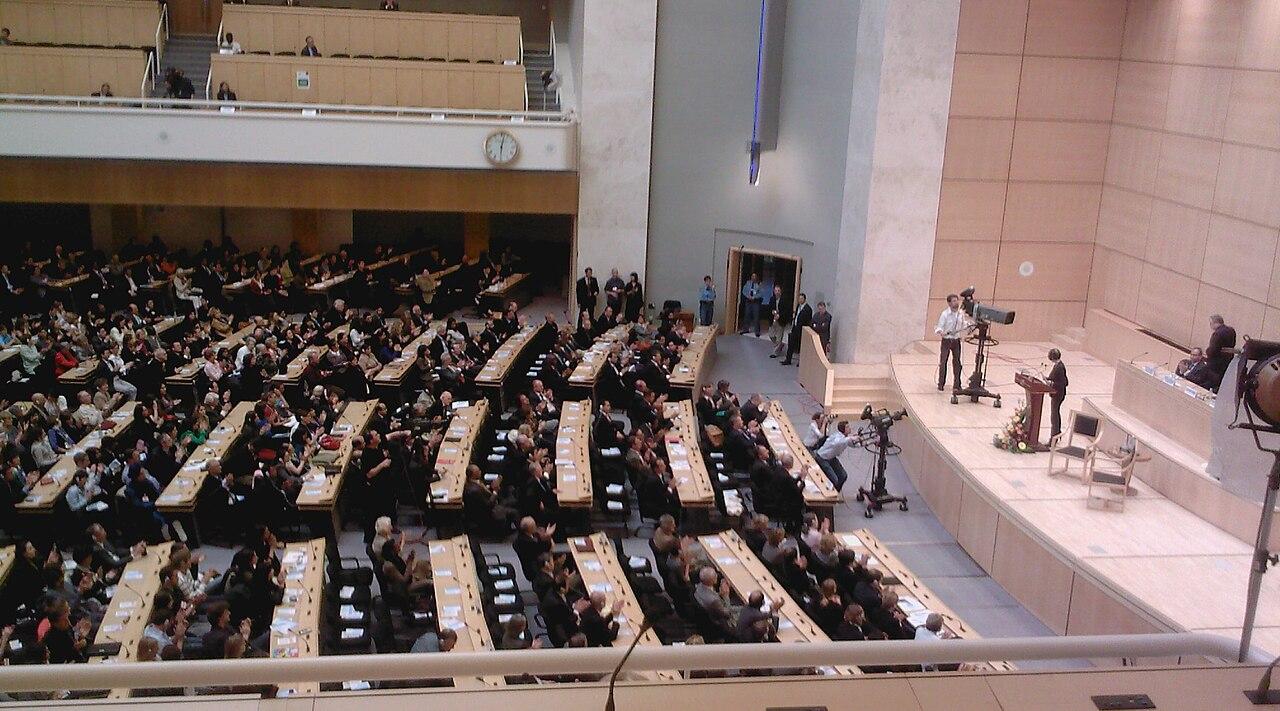
Today, humanity is just one misunderstanding, one miscalculation away from nuclear annihilation. We need the Treaty on Non-Proliferation of Nuclear Weapons as much as ever. That is why this Review Conference is so important. It’s an opportunity to hammer-out the measures that will help avoid certain disaster, and to put humanity on a new path towards a world free of nuclear weapons.
—ANTÓNIO GUTERRES, United Nations Secretary-General
Tenth Review Conference of the Parties to the NPT
1 August 2022, New York
Representatives from 191 countries and states met in New York on April 27 aiming to reach consensus on how to prevent nuclear annihilation. After 25 days of discussion, however, delegates at the Review Conference of the Parties to the Non-Proliferation of Nuclear Weapons (N.P.T.) have failed yet again. The U.S. delegation insisted that language faulting Iran must remain in the document, and Iran wanted to retain an earlier version which condemned US-Israeli military attacks on its safeguarded nuclear facilities.
The meeting was chaired by Viet, Vietnam’s U.N. ambassador. At a news conference he said, “No one state blocked consensus because I realized there was not consensus, and so I did not put the document forward.”
The Non-Proliferation of Nuclear Weapons (N.P.T.) contains three main pillars: nonproliferation, disarmament, and the peaceful uses of nuclear energy. It is the only multilateral treaty with the goal of disarmament by the nuclear-weapon states. Opened for signature in 1968, the Treaty entered into force in 1970 and was extended indefinitely in 1995. An essential foundation for the pursuit of nuclear disarmament, it remains the cornerstone of hope for global disarmament and has been ratified by more countries than any other disarmament agreement. These include the five states who had nuclear weapons when the Treaty was created in 1967. Three countries–India, Israel, and Pakistan–have developed nuclear weapons since then and have never signed the N.P.T. North Korea signed in 1985 but formally withdrew in 2003. South Sudan has never signed. The provisions of the Treaty include a review of the operation every five years (with past modifications due to Covid).
Despite strong support from all of the signers, the 2015 and 2022 reviews also ended without the adoption of a consensus statement. In 2015 there was disagreement over Israel’s nuclear program and in 2022 over the war in Ukraine. The 2026 Review Conference was the eleventh, and as one observer pointed out, it had never before taken place in such severe international circumstances. There was great danger of a third consecutive failure. According to observers, there was no real effort at negotiations and the speeches were mainly propaganda. The main source of conflict was that the United States insisted on singling out Iran. In addition, the U.S. sought the right to test nuclear weapons, and the five states with nuclear weapons remained committed to maintaining and expanding their nuclear arsenals. These states–China, France, Russia, the United Kingdom, and the United States–refused once again to take meaningful steps toward fulfillment of the Article VI obligations to cease the arms race and to engage in good faith negotiations for the elimination of their nuclear arsenals.
The vast majority of N.P.T. signatories are non-nuclear-weapon states whose programs for development of nuclear energy are already subject to international inspections. Their primary concerns were the inequities and dangers of nuclear apartheid, and this year many were unhappy with the weak language on disarmament. They complained that the proposed text walked back commitments from past review conferences (even though the text asserted that those commitments remained valid) and reflected a lack of political will by the nuclear-weapon states. Many said they would not accept a watered-down, least common denominator text as an outcome of this conference, but none threatened to block consensus.
During this unsettled time when major states are using war as the way to resolve disputes, the N.P.T. is especially important. The non-nuclear-weapon states are frustrated with the refusal of the five-nuclear-weapon states to abide by the commitment they made to work toward nuclear disarmament when they signed the Treaty. Notably, calls for the nuclear-weapon states to adopt no first use policies, which were included in initial drafts of the review conference outcome document, were deleted. As the world becomes more dangerous, the dangers of both nuclear proliferation and nuclear war are rising. We desperately need adherence to this Treaty and for the nuclear-weapons states to fulfill their obligation to work with each other to reduce the threat. Not doing so risks global disaster.
By Jeanne Trubek with Joseph Gerson