
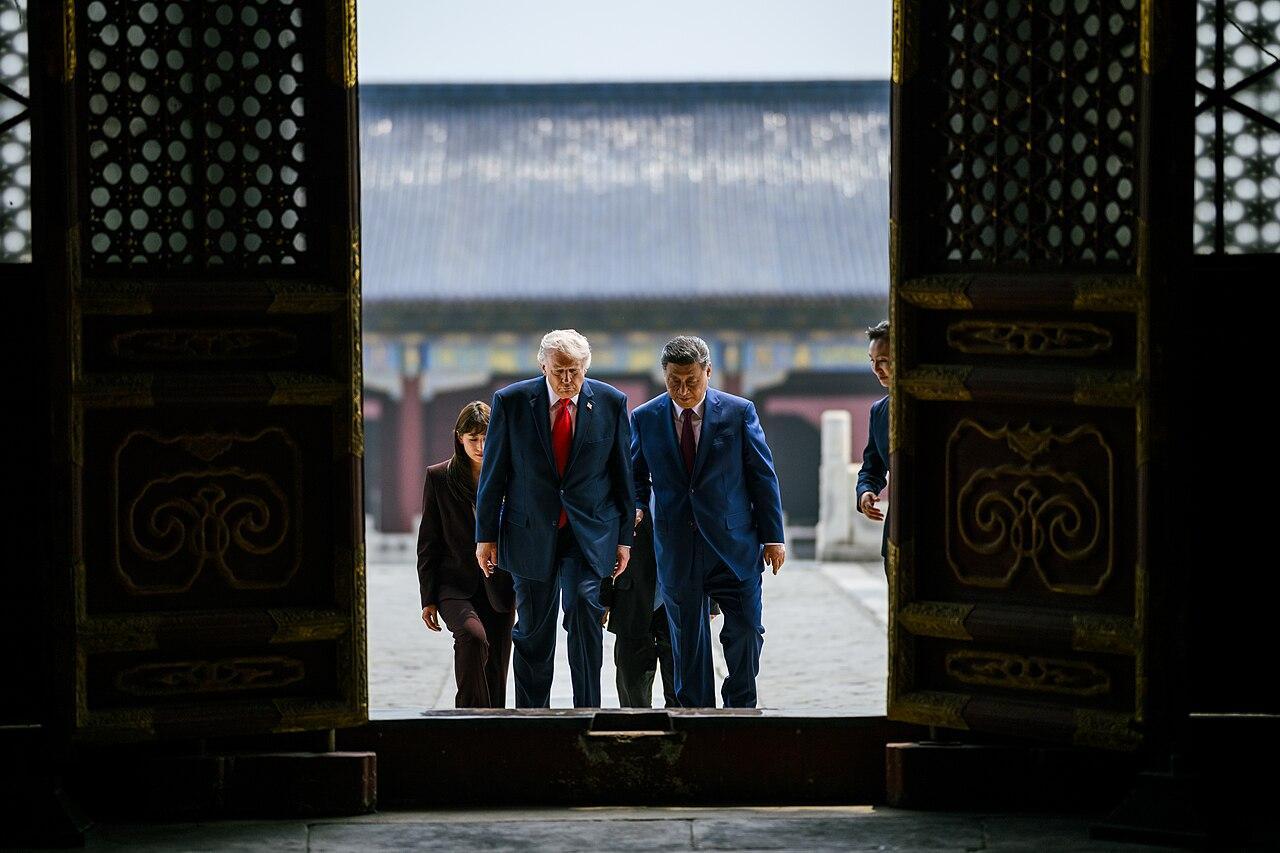
Peace advocates should take positive vibes from the meetings in Beijing, May 13-15, between President Xi Jinping and President Donald Trump. Put simply, the face-to-face meetings during the State Visit offered a welcome change to the belligerent, even bellicose, anti-China blatherings emanating from the Trump Whitehouse.
What we saw was distinct diplomatic engagement. Through talking and presenting their points of view, the leaders each expressed their nation’s priorities in line with their respective styles. Perhaps that is a good thing as Rana Foroohar noted in “US-China summit: postgame analysis,” in “Swamp Notes,” a Financial Times subscription newsletter: “…one could say that the summit met American expectations. Little was ventured, little was gained…”
Talking down the event with low expectations does not deny several salient moments in the diplomatic engagement process. One especially reminds China watchers of the ideological foundations that inform the conflict. These differences need to be respected as “the state of things,” that is, those elements of history that cannot be changed, yet inform the present and the future.
One event serves as an example: President Xi, speaking at the official banquet, noted the 5000 years of Chinese history in contrast to this year’s celebrations of the 250 years of the United States. In other words, the USA has five percent of national history over time compared with China.
The importance of the temporal reference was: First, that the Chinese have been at the diplomatic negotiating table for thousands of years. Second, to place the meetings in an ideological setting. Third, that the US approach is reactive and unpredictable, while China’s approach is planned and predictable.
Understanding what happened in Beijing is knowing that a specific rendering of history, or historiography is deployed in China. History in China since 1949 is an expression of Marxist theory in which contradictions emerge and are met with solutions. The Chinese learn about Marxism from an early age within the Chinese model of development. This nation-centric approach includes the dialectical method, in which contradictions are accepted in the knowledge that experimental resolutions will be attempted in finding a synthesis. In other words, socialism, communism and capitalism are unsteady bedfellows that are in a managed relationship with the state of China.
Different approaches raise the question of diplomatic style: China has an ideologically informed system that it studies, then implements in Five Year Plans, in which the contradictions are evaluated then “resolved.” The focuses on measurable outcomes matched to planning goals and are deeply contested by no-socialist interests such as the US-China Business Council.
The United States champions the capitalist system of profit maximization, one that mostly embodies the principles proposed by John Maynard Keynes in his 1936 book, The General Theory of Employment, Interest, and Money (1936), that “animal instincts” of entrepreneurs feeding popular consumption are the drivers of capitalism.
Reinforced by the media-technology landscape – speed with just-in-time delivery – the animalistic American way of culture is crash or crash through. Most US diplomats and their policy makers now respond to the demand for communication immediacy in a way that jettisons manners, etiquette and the peace premium.
Another contrast gives way to the civilizational policies that China has raised. Marxist theory is not interested in reproducing anti-human animal behavior or more correctly, barbarians. Human decency will, according to Chinese theory, be accomplished with state planning directing greed-for-profit into productive social relations that suit development goals.
In the US, peace is always at risk because the animal spirits insist on asserting barbarian energy through violence and warfare, as we have seen with Trump’s attacks on Iran, and the US Government support for the decimation of Gaza and South Lebanon.
Analyst Stephen Kinzer, writing in the Sunday Boston Globe on May 17, 2026, immediately after the Beijing meetings noted that “shallow and conventional thinkers” like Marco Rubio, Hillary Clinton, Madeline Albright, Condoleezza Rice, Antony Blinken and Mike Pompeo have none of the skills of “geopolitical chess masters” like Henry Kissinger and James Baker. This is another way of stating that old school US conservatives see Grand Plans played out over time and act accordingly, while the immediacy of now is the best the shallow thinkers can manage. By the way, Kinzer’s Op-Ed was titled, “In foreign policy, the best modern presidents have all been Republicans – present company excluded.” This is to say that old school Republicans value manners, etiquette and peace… and will go to war!
It is helpful to keep in mind the Chinese axiom of “win-win,” to give meaning to the distinct diplomatic engagement used in Beijing. The meetings were not China versus USA, as in a competition, reducing International Relations to team sports in which one side must win. Rather, the meetings involved a process in which ideas were exchanged, as one leader along with their senior cabinet members, looked each other directly in the eye. However, as Radhika Desai wrote in her Geopolitical blog Trump’s stakes and losses in Beijing: “Who budged or blinked on all the major issues: tariffs, investment, Hormuz, Taiwan, Iran’s nuclear programme (sic)?” There was an unequal outcome because the US style unraveled.
The contrast in styles is a product of the divergent ideologies at stake in the meetings. That the peace movement can take some pleasure from the meetings is due to an increasing understanding of China as a global player, in which the USA is one party and may be reluctantly accepting itself as one of several “leaders.”
Multipolarity by any other name, also underpins the Chinese approach to long term diplomatic principles. Nations are building new approaches alongside China, and the US needs to join in before it falls badly behind. For example, Chinese and Russian Presidents Xi and Putin proposed “Declaration on the Establishment of a Multipolar World and a New Type of International Relations”—appearing to be part of their late May discussions in creating multiple world leaders with positive vibes for peace.
Perhaps peace activists can work toward a new type of International Relations in which the US is a major player. When and if the US learns diplomatic manners, then we can be somewhat comforted.
By Marcus Breen
—
Marcus Breen co-convenes MAPA’s No War With China working group.