

Trump and his administration have offered a grab-bag of justifications for the US-Israeli attack on Iran: “democracy” for Iranians, regime change, ending Iran’s supposed support for regional “terrorism,”and eliminating its missile capability that supposedly threatens the US (it doesn’t). Lately, the purpose has centered around “opening” the Strait of Hormuz – which, of course, was open before the US-Israeli attack on Iran.
The claim of “democracy-promotion” is perhaps the most laughable. Iran is not fully democratic, but it has elections – unlike the US Gulf allies, which are all hereditary monarchies and have economies that function on the labor of millions of imported workers who live in almost slave-like conditions. The other US regional allies are either thinly-veiled dictatorships or effectively vassal states. “Democratic” Israel, of course, is committing genocide in Gaza and maintains an Apartheid system where the Palestinians in its occupied territories have no political or civil rights and are effectively stateless.
The pretexts for war come and go, but only one has remained constant: the supposed threat of Iranian nuclear weapons. Trump has regularly posted to social media and repeated (his caps!): IRAN CAN NEVER HAVE A NUCLEAR WEAPON. Secretary of State, Marco Rubia, has stated: Iran must be prevented from having a nuclear weapon “by any means necessary.”
What is the reality?
The only nuclear weapons in the Middle East are in possession of the US ally Israel — and likely on US bases and naval assets in the region.
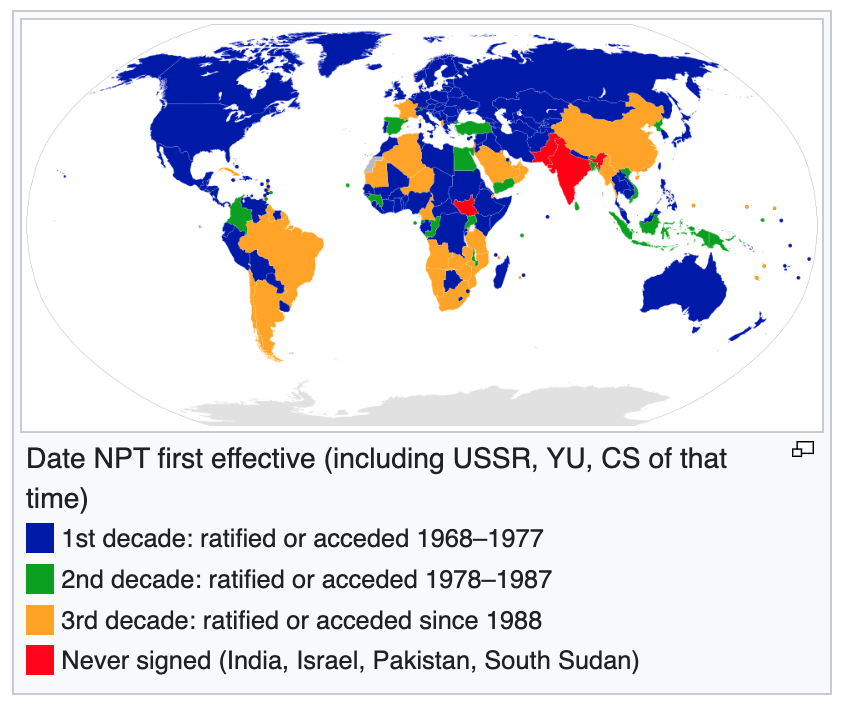
Iran was an initial ratifier of the Treaty on the Non-Proliferation of Nuclear Weapons (NPT) in 1968 and was eventually joined by every other Middle East state – except Israel. The NPT requires member states to permanently renounce the acquisition of nuclear weapons. (The treaty also obligates nuclear weapons states to promote negotiated nuclear disarmament, but, except for now-expired treaties, this has never been seriously pursued.)
But the NPT Article IV also acknowledges the right of all Parties to develop nuclear energy for peaceful purposes and to benefit from international cooperation in this area, in conformity with their nonproliferation obligations. It states explicitly that “Nothing in this Treaty shall be interpreted as affecting the inalienable right of all the Parties to the Treaty to develop research, production and use of nuclear energy for peaceful purposes without discrimination and in conformity with Articles I and II of this Treaty.” Civilian nuclear programs are subject to monitoring and inspections by the International Atomic Energy Agency (IAEA) to ensure that they are not being used for the development of nuclear weapons.
Iran, like other NPT signatories, has hosted IAEA inspectors at its civilian nuclear sites, who have repeatedly affirmed over the years that Iran has not diverted nuclear materials to weapons production. Israel, as a non-NPT signatory, is subject to no such monitoring and is estimated to possess up to 200 nuclear weapons, with the capability to produce many more.
Beyond Iran’s obligation by treaty not to develop nuclear weapons, the religious authorities of the Islamic Republic have repeatedly ruled that such weapons violated Muslim beliefs. Ali Khamenei, Iran’s supreme religious authority—who was targeted and killed on the first day of Israel’s attack—affirmed earlier rulings against nuclear and other weapons of mass destruction: “We are not after nuclear weapons. And this is not because they are telling us not to pursue these things. Rather, we do not want these things for the sake of ourselves and our religion and because reason is telling us not to do so. Both shar’i and aqli [related to logic and reason] fatwas dictate that we do not pursue them.”
As for other WMDs, even after Sadam Hussein used poison gas to kill thousands of soldiers and civilians during the Iraq’s US-supported invasion of Iran in the 1980s, the Iranians refused to develop or use chemical weapons.
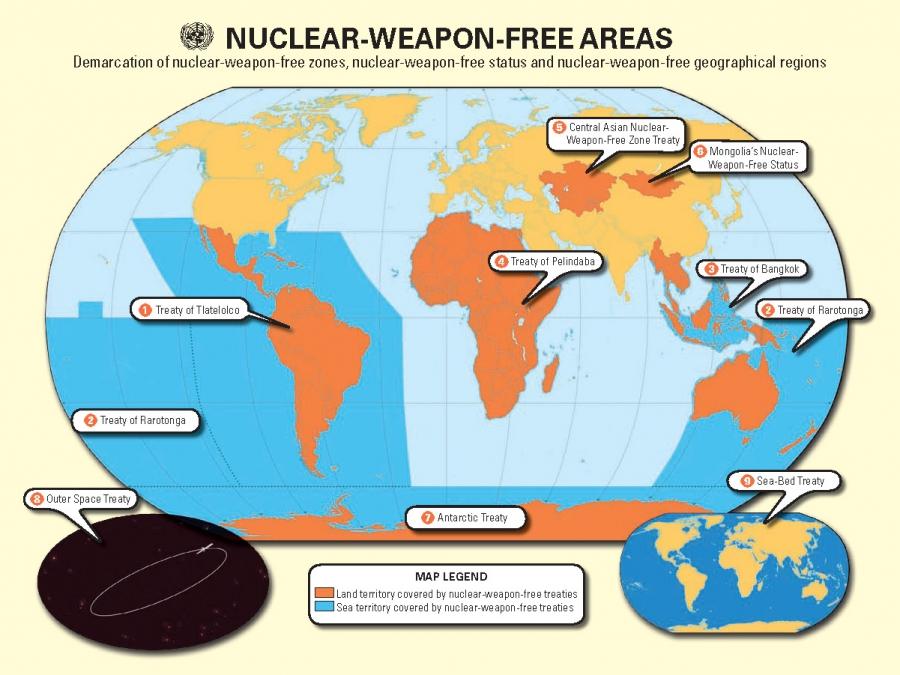
Iran not only rejected its own development of WMDs, it also joined with other regional powers to enact by treaty a Middle East Nuclear Weapons Free zone. This policy was adopted by every country in the Middle East – except Israel – and was endorsed overwhelmingly on numerous occasions by the UN General Assembly. Follow-up conferences to promote the treaty were repeatedly blocked or boycotted by the US in defense of Israel maintaining its nuclear weapons arsenal and a monopoly on WMBs in the Middle East.
Readers in the US may be forgiven for believing a nuclear-weapons-free zone is mere pie-in-the-sky. But there are large regions of the globe where nuclear weapons are banned by treaty, though this is almost never reported in the US press.
Israel has been cynically raising the alarm of an Iranian nuclear weapon for decades. As far back as 1992, Israel’s Benjamin Netanyahu warned that Iran would have a bomb “within three to five years.” This assertion has been repeated with growing vehemence since then, as Israel often claimed that Iran was just weeks or months from having a bomb.
Meanwhile, US intelligence assessments have concluded that Iran never seriously advanced a program to develop nuclear weapons and have repeatedly affirmed that Iran had no active weapons program. Just this March, Tulsi Gabbard, Director of National Intelligence in the Trump administration — during the ongoing US-Israeli assault — was compelled to admit in testimony before Congress that “we [the US intelligence community] continue to believe that Iran is not building a nuclear weapon.”
If Israel were truly concerned about an Iranian nuclear weapons program, it would have welcomed the 2015 nuclear agreement reached by President Barack Obama with Iran. But, knowing that Israel might attempt to torpedo any deal, the Obama administration began the negotiations with Iran in Oman, under strict secrecy.
The Joint Comprehensive Plan of Action (JCPOA), commonly known as “the Iran nuclear deal,” included stringent limitations on Iran’s nuclear enrichment and an intensified inspection regime along with the lifting of international economic sanctions and the release of Iran’s frozen assets abroad. The JCPOA was a step toward normalizing US relations with Iran after decades of hostility and an end to attempts to strangle the regime economically. In return it installed a verified mechanism to block any potential development of an Iranian nuclear weapon. Instead of supporting the agreement, Israel and its US lobby campaigned relentlessly against it. When the JCPOA agreement was announced, Israel and its US echo chamber went into full attack mode. Israeli Prime Minister Netanyahu even defiantly addressed the Republican-led US Congress in a direct challenge to Obama’s diplomatic breakthrough. This effort guaranteed that the agreement could not be formally ratified as a permanently binding treaty by the US Congress. Although Israel failed initially to block the JCPOA, they were successful in nullifying it when Trump unilaterally withdrew the US from the agreement in 2018.
We may never know for certain what Trump was thinking in launching the war on Iran together with Israel. Perhaps he believed – likely under Israeli assurances – that a quick strike with the killing of Iran’s leadership would lead to regime change or surrender, like his kidnapping of Venezuela’s leadership. When this failed, the US had no long-term response to Iran’s resilience, its effective retaliation against the US Gulf allies or its economic leverage through closing of the Strait of Hormuz.
But if Trump’s approach was strategic incoherence, Israel’s aims were always clearly focused. Iran was Israel’s last remaining important state adversary in the Middle East. Despite all the Israeli rhetoric about Iran’s nuclear threat, its real goal was to permanently damage or even collapse the Iranian state. This was the model of state destruction achieved through its intervention with the US and some Gulf regimes against Syria. It was hoped, as in Syria, to mobilize ethnic divisions and internal regime opposition forces to permanently disable Iran.
For decades, Israel had aimed to lure the US into a joint attack on Iran, and in Trump they found a willing partner. On April 21, the US State Department issued a report, “Operation Epic Fury and International Law”, authored by its legal advisor, Reed D. Rubinstein. Among its tangle of legal arguments was the absurd claim that the US was acting legitimately under international law because it had been effectively at war with Iran since 1979. The reality is that the US and its colonial allies – principally the UK – have been intervening in Iran for more than a century. This has involved outright invasions, occupations, US created and implemented regime-change, and the outright stealing of Iranian oil.
The State Department report began with this:
“Epic Fury is only the latest round of an ongoing international armed conflict with Iran. As the United States has explained in multiple letters to the U.N. Security Council, including most recently on March 10, the United States is engaged in this conflict at the request of and in the collective self-defense of its Israeli ally, as well as in the exercise of the United States’ own inherent right of self-defense.”
by Jeff Klein