
by Cole Harrison
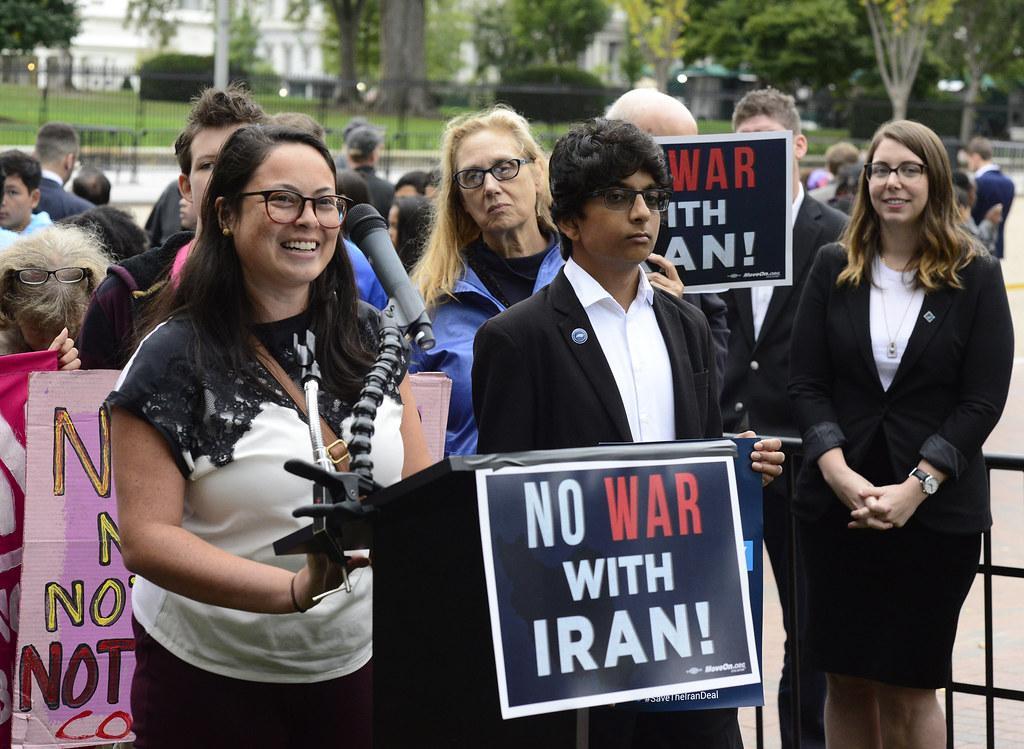
The Memorandum of Understanding signed on June 17 by President Trump and Iranian President Pezeshkian provides a roadmap towards peace between the two countries. Peace advocates should support it. The journey to this point has been tortuous, the interim agreement contains numerous ambiguities, and the Trump Administration as the agent of change from the US side is so deeply compromised that implementation of the steps will be extremely difficult. Nevertheless, the MOU deserves our support.
Unfortunately, Massachusetts Democratic members of Congress have not welcomed the MOU. They rightly point out that Trump started the war, that it was foolish, it was illegal, unconstitutional, it was costly, it damaged the world economy, and it accomplished nothing. That is all true – but they generally have not spoken to the MOU’s substance unless to criticize it.
If starting the war was wrong, ending it is right. The MOU is a reasonable framework for ending the current conflict and taking steps towards peace with Iran. It calls for opening the Hormuz strait; winding down US sanctions (and the US has already suspended sanctions on Iranian oil sales); reduction of the US military footprint in Iran’s neighborhood; curbs on Iran’s nuclear program with details to be negotiated; Israeli withdrawal from Lebanon; and a reconstruction investment fund for Iran, which would not involve any U.S. funds.
US policy towards Iran has been predicated on hostility to the Islamic Republic since 1979. The US political elite and media have long based their policy on the thesis that Iran is a threat to the region and the United States. US leaders claim that Iran’s nuclear program may lead to its arming itself with nuclear weapons; that Iran’s ballistic missile program threatens its neighbors, especially Israel; that it funds terrorist proxies, naming Hezbollah, Hamas, and Ansar Allah (Houthis) as dangerous sources of instability; that it seeks to destroy Israel and attack the United States; that its repressive internal regime is of a piece with its regional troublemaking.
These premises are profoundly flawed. Iran’s supreme leader has rightly ruled that nuclear weapons violate religious morality, much as Popes Francis and Leo have done. After 47 years it should be clear that Iran has never really sought to build a nuclear weapon, as it surely would have done so by now had that been its intention. Rather, its nuclear program is evidently designed to force the U.S. to the table and get it to end US sanctions and negotiate with Iran on a respectful basis. It is the US and Israel, not Iran, that are armed with nuclear weapons – and Trump who explicitly threatened to use them on Iran. Does Iran arm terrorists? Maybe sometimes, but it is Israel, armed by the US, that has laid waste to the Middle East, attacking Palestine, Lebanon, Iraq, Syria, Iran, and Yemen, killing tens or hundreds of thousands, over just the past three years – although Iran has certainly done what it could to hit back in response to those constant provocations. If the goal were to end state-supported terrorism, surely Israel, not Iran, would be at the top of the list.
Within the anti-Iran consensus among US elites, one wing calls for diplomacy to obtain concessions from Iran, and for economic sanctions to force Iran to follow US wishes. President Obama’s 2015 Joint Comprehensive Plan of Action (JCPOA) was based on this strategy. Obama first imposed sanctions, then promised sanctions relief in exchange for strict limits on Iran’s nuclear enrichment program – although little sanctions relief was actually delivered by the U.S. before President Trump ended the JCPOA in 2018.
The other wing of the US elite, joined by Israeli prime minister Benyamin Netanyahu, calls for war to destroy Iran’s military capacity, its nuclear program, cripple its economy, ensure it could not threaten its neighbors or Israel, and if possible, overthrow its government. President Trump took up this approach when he joined Israel in bombing Iran’s nuclear facilities in June last year and then resumed full scale war with Iran on February 28.
But after Iran struck back at Israel and at US bases and economic infrastructure in the Gulf states, and closed the Strait of Hormuz, everyone understood that the US military campaign to subdue Iran had failed. The MOU that Trump and Iran’s president Pezeshkian signed on June 17 reflects this reality and sets forward a direction that, if implemented, would not only end the US-Iran war, but would begin to reverse the long anti-Iran campaign waged by the U.S. It could be a historic step towards reconciliation between the U.S. and Iran.
It is ironic that the reactionary, racist, ultra-imperialist administration of Donald Trump could be the one to reverse decades of bipartisan U.S. hostile policy. But just as Nixon went to China, such shifts can happen, and when liberals stick to a cold-war mindset, they can be led from the right side of US politics. Another example is Trump’s two-year rapprochement with North Korea’s Kim Jong Un in his first term, in which he met Kim three times and signed peace framework agreements – though he ultimately dropped the project and reverted to a posture of hostility. Because Trump has no firm ideology, he sometimes can read the situation more clearly than politicians whose policies are anchored in an ossified world view. We can in no way count on Trump and Vice President J.D. Vance to get this negotiation over the finish line – but we can and should push them to do so.
Indeed, the situation today calls for peace with Iran and a completely new Middle East policy. Israel has become a liability for the United States more clearly than ever before, and US support for Israel’s constant wars on its neighbors and genocide directed at its occupied Palestinian population, its invasion of Lebanon, and its attack on Iran, are now very unpopular in the U.S. Iran has successfully asserted its ability to defend itself. And as Trump said on June 18, the world economy is teetering as it runs short of oil.
Vice President Vance held out the possibility that Iran can receive a $300 billion reconstruction fund based on the Gulf states, provided a final agreement is reached. In Switzerland on June 21, he asked: “How much more can we accomplish together? Can we turn over a new leaf? Can we change relations in the Middle East permanently, or do we go back to doing things the old way?”
Let us try to make that happen. In any case, the wealthy elite of the Gulf are evidently ready to invest in Iran’s reconstruction from the destruction the US has caused. Why? To make money on the investments, to get their foot in the door for future business deals in the potentially lucrative Iranian market, and in the hope that economic ties will reduce the likelihood of a future war.
A diplomatic resolution of the US-Iran hostility would be positive for the US, Iran, and the region. Massachusetts’ Democratic members of Congress should speak in favor of diplomacy and seek to implement them.
Cole Harrison is administrative director of Massachusetts Peace Action and staff organizer for its Stop the War on Iran Campaign