
By Jeff Klein
Everyone is telling us what “The Iranian People” want. We read it in wall-to-wall media coverage. We hear it trumpeted daily by opinion leaders, establishment commentators and politicians from both parties. They all agree that “The Iranian People” are asking for our help – including a possible US military intervention — to overthrow their government. This narrative is everywhere. Our news feeds even regularly feature Iranian expats who are demanding that we bomb their country.
As Donald Trump threatens renewed attacks, it is important to have some perspective on what is actually happening in Iran.
So, what do Iranians actually want? Some humility is in order here. Outside of Iran, the honest answer is that we simply do not know with any certainty.
We can assume that most Iranians—like people everywhere—want a better life for themselves and their families. Beyond that, it is foolish to believe that the Iranian people agree on any one thing.
Iran is a large and diverse country with a population of 90 million people. The idea that “the Iranian people” are united in opposition to the present governmental system of the Islamic Republic is an artifact of Western interests and a media which reflects and supports the longstanding goal of regime change.
Obviously, many Iranians are demanding fundamental change. But even the Iranian opposition forces are not united in their aims. They vary from sectors which primarily protest the current dire economic situation, peaceful demonstrations demanding reforms, radical and sometimes violent protests aiming to overthrow the government. A relative fringe, which receives outsized media coverage, advocates a return to the previous monarchy, if necessary, through outside military intervention.
Reza Pahlavi, the son of the Shah who was overthrown in 1979, has been feted repeatedly in Israel, where he applauded the attacks on Iran which killed over a thousand civilians last year. As one observer notes: “Over the past several years, monarchist outlets and networks have developed an outsized presence in diaspora media ecosystems—amplified in part by foreign-linked platforms and resources. Sustained media production and propaganda have not only elevated monarchism as a brand, but also marginalized rival opposition currents, helping frame the monarchy as the only coherent alternative to the Islamic Republic.” Pro-monarchist gatherings outside Iran—including around Boston—often feature Israeli flags prominently.
Aside from a foreign-connected fringe, the vast majority of Iranians are clearly opposed to the idea of bombing their country into regime change. They rightly fear the chaos that might follow a successful US-Israeli attack.
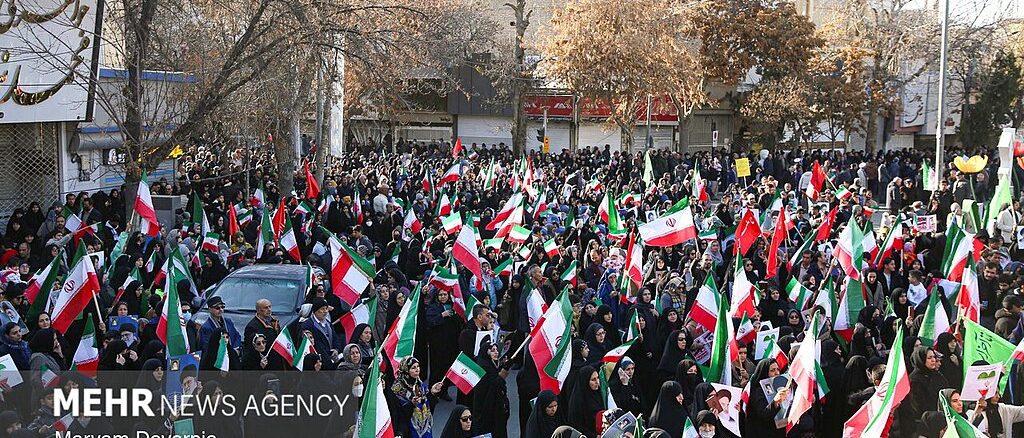
Moreover, it is impossible to deny that there is a deep well of support for the Islamic Republic. The large-scale pro-government demonstrations a few weeks ago received almost no coverage, or were dismissed outright, in media outside of Iran. The Iranian government claims that millions marched. Outside Iran, Western media reported “only” 300-400,000. Photos and videos show in any case that the pro-government crowds were very large.
The present round of protests in Iran began in late December as a response to soaring inflation and the near collapse of the Iranian currency. Though Iranian government policies and mismanagement may have contributed to the crisis, the most decisive cause is the decades of severe US-imposed economic sanctions. The US government has the right to cut off its own trade with any country, but imposing a virtual blockade and sanctioning Iran’s commercial relations with third countries are clearly illegal under international law. The Iranian government attributes the immediate monetary crisis of December to US financial manipulations. Skepticism is warranted, but there is some evidence that this may be true.
The economic protests in Iran were initially peaceful and did not meet with notable government repression. But soon, in January, more radical and violent protests broke out demanding the overthrow of the government. These were met with a forceful response from Iranian security forces that led to many deaths and injuries. The Iranian government claims that opposition “riots” were supported and promoted from abroad. While we do not know the full extent of these outside interventions, it is true that voices in Israel and the US have boasted about their active participation.
The actual death toll in Iran remains uncertain. The Iranian government claims about 3000 dead and asserts that most of these were government employees or innocent bystanders. The reports of much higher figures – 6000, 12,000 or even 30,000 dead – which are routinely cited in anti-Iranian media, have been spread mainly by suspect organizations with ties to and financing from US and Israeli government sources.
Meanwhile, the most strident calls to bomb Iran come from Israel and its US echo chamber, led by AIPAC. These views are repeated by Israel-serving Republican members of Congress like Ted Cruze and Lindsey Graham — and the more neocon elements within the Trump administration. To imagine that these actors are motivated by concern for the Iranian people is laughable.
Unfortunately, many Democrats who claim to oppose a US attack on Iran – at least until Congress is consulted – often repeat the one-sided narrative that serves to justify US intervention. Some liberals and anti-war progressives do the same.
The reality is that for decades, Israel has promoted policies aimed at the overthrow of the Islamic Republic. Israel’s aim, as they sometime state in the Hebrew media, is for a destabilized, weak and fragmented Iran. This may be accomplished through arming and mobilizing of non-Persian ethnic minorities like Kurds, Azeris, Arabs and Balouchis. In other words, the Syrian solution. It is because Israel regards Iran as their only meaningful adversary in the region.
Likewise, the US establishment sees Iran as the principal obstacle to unchallenged American hegemony in the oil-rich Middle East.
This is nothing new. European and then US intervention against Iran goes back more than a century. After 1900, Britain took control of Iran’s oil under the then Anglo-Persian Oil Company (the company survives today as BP). In 1953, the US joined the UK in overthrowing a democratic government that sought to reclaim Iran’s sovereignty over its own resources. Hostility to Iranian self-determination has continued ever since. After the overthrow of the US-imposed Shah Pahlevi, the US backed a years-long Iraqi war against the Islamic Republic which took hundreds of thousands of Iranian lives. During that war, the US shot down an Iranian civilian airliner, taking the lives of nearly 300 innocent people – for which we never apologized. We cheered repeated Israeli attacks on Iran and the killings of Iranian civilians – then added our own attacks and assassinations. We maintain to this day a stifling and illegal economic embargo on Iran.
The excuses vary – “democracy” promotion, a supposed nuclear weapons program, Iranian “terrorism” and regional “aggression” — but the policy is consistent. We have seen the same scenario used against other purported “enemies” of the US, from Indonesia, to Vietnam, from Chile to Iraq. The cost has been millions of lives lost and trillions of dollars spent on wars.
As people of good will who favor peace, democracy and human rights, and who live in the US, what then should be our response?
A government like the present Islamic Republic of Iran may not be the system most of us would choose. We sympathize with aspirations of many Iranians for a more open and democratic society. But we don’t get a vote. And we should be wary of amplifying narratives that aim to justify military action against Iran. Instead, we should stand with the Iranian people by opposing any US attack on their country.
When pro-intervention advocates uphold the “agency” of people in Iran (or elsewhere), in practice they tend to highlight only the voices of those which validate their views. Others, with differing opinions, do not count. We should not fall into this trap.
For various reasons, not least the US/Israeli-led defeat of secular Arab nationalism and the decades-long promotion of “Islam” as an alternative, millions of people in the region have opted for a resistance anchored in religious piety that is joined with nationalism and even anti-imperialism. This trend is notable not only for Iranians, but also Hamas in Palestine and Hezbollah in Lebanon.
In 1979, masses of Iranians rose up to oust a repressive monarchy armed to the teeth and backed by the US and its allies. They did not seek and did not receive any foreign support. Today, it is up to Iranians and Iranians alone to determine the future of their country. We may or may not approve of the outcome, but in the end, it is not up to us.
Take action: Contact Congress to say Don’t Bomb Iran!