
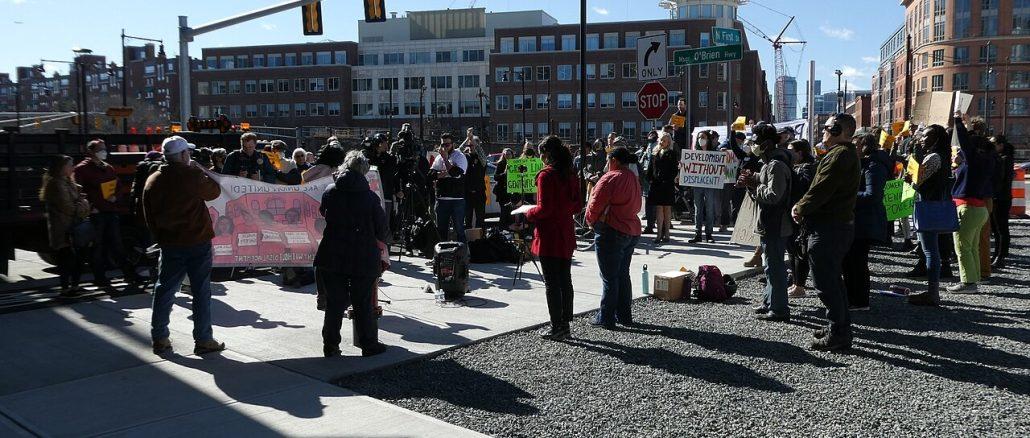
Housing advocates across the state have worked to put rent control on the ballot this November, in an effort to slow the rampant displacement caused by the housing crisis and by unreasonable rent increases that outpace inflation. Passing this ballot initiative would limit annual rent increases across the state to no more than the Consumer Price Index (CPI), with an overall cap of 5%. The limit would then continue to apply when new renters move in, meaning rent cannot increase dramatically between tenants (taking away one of the incentives to evict longstanding tenants in rent-controlled housing).
The proposed policy would also exempt small landlords in owner-occupied buildings with four or fewer units. It is designed to protect tenants from large corporate investors who unreasonably raise rents, while allowing local landlords to earn a reasonable return on investment. It also exempts new construction for the first 10 years, so it does not constrain investment in new construction to address the pressing housing shortage.
Many arguments against rent control policies—such as the claim that it would reduce the supply of rental housing—are not supported by reputable literature. Studies conducted in New Jersey and Massachusetts have found no negative impact on construction rates due to rent control. Zoning and interest rates are much stronger predictors of new housing construction than rent regulations.[1], [2]
Looking at the impacts on renters, studies show that tenants in rent-controlled units move less frequently and are less likely to be forced out of their homes due to rapidly rising rents. Stability in the community boosts local health and educational attainment, strengthens social safety nets and democratic participation, and supports the local economy as households spend that money in the local economy rather than on rent.[3] Additionally, students who experienced zero moves are over 10% more likely to graduate than those who moved three times during their childhood.[4]
Rent control will not solve the housing crisis on its own. We need to build hundreds of thousands of new units across the state over the next decade to meet the true housing needs of individuals and families across the Commonwealth.[5] However, rent control will help slow the immediate, dire impacts of displacement and predatory rental increases we are seeing in our communities. Rent stabilization is good for communities because it protects housing stability for the people who make up communities.
by Kiam Jamrog-McQuaid, At-Large City Councilor, Easthampton MA; Economic and Public Policy Research Analyst
—
[1] Stacy, C., Davis, C., Freemark, Y. S., Lo, L., MacDonald, G., Zheng, V., & Pendall, R. (2023). Land-use reforms and housing costs: Does allowing for increased density lead to greater affordability? Urban Studies, 60(14), 2919–2940. https://doi.org/10.1177/00420980231159500
[2] Ambrosius, J. D., Gilderbloom, J. I., Steele, W. J., Meareneighborhoodss, W. L., & Keating, D. (2015). Forty years of rent control: Reexamining New Jersey’s moderate local policies after the great recession. Cities, 49, 121–133. https://doi.org/10.1016/j.cities.2015.08.001
[3] Social Determinants of Health: Housing and Health in Los Angeles County. (2015). Los Angeles County Department of Public Health. http://publichealth.lacounty.gov/ha/reports/LAHealthBrief2011/HousingHealth/SD_Housing_Fs.pdf
[4] Rumberger, R. W. (2015). Student Mobility: Causes, Consequences, and Solutions. National Education Policy Center. https://nepc.colorado.edu/sites/default/files/pb_rumberger-student-mobility.pdf
[5] Executive Office of Housing and Livable Communities. (2025). A Home for Everyone: Statewide Housing Needs Assessment. https://www.mass.gov/doc/statewide-housing-needs-assessment/download