
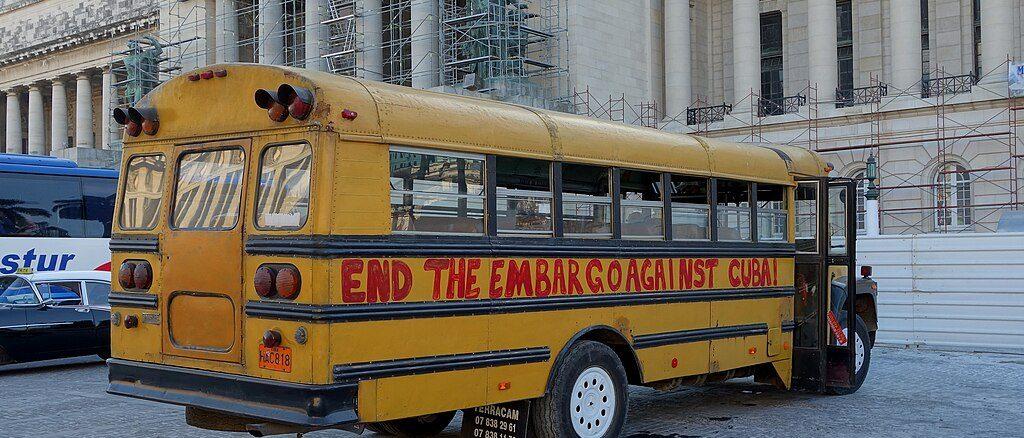
By Merri Ansara
Many people in Cuba are living with the kind of fear that I can imagine many undocumented or partially documented residents in the US are experiencing—they have no idea when or how Trump is going to come after them, what their future is, how they are going to live through the next months and years.
Most of you reading this know that Cuba is in a deepening crisis. Not only has the Trump US already cut off oil deliveries from Venezuela and Mexico, but Trump has now issued an executive order declaring Cuba a hostile country funding and financing terrorist groups and has threatened to impose a full blockade on oil via tariffs on any country that attempts to make deliveries. Plus, of course, the US has totally militarized the Caribbean, both on sea and on land, building up its military bases in Puerto Rico, stationing bases for its aircraft and attack carriers in countries like Trinidad. A tariff blockade can quickly turn into a full military blockade—and attacks, as has been shown in the bombings of civilian boats and the chasing and seizure of tankers for the last 6 months.
Electricity powers people’s homes, pumps the water to their homes, runs public utilities and manufacturing, powers hospitals, medical equipment, doctor’s offices and blood banks, keeps the lights on in schools, runs computer and phone systems, refrigerates food stores in warehouses as well as in homes; gasoline powers public and private transportation, farm equipment, fumigation equipment. Cuba’s electrification system—on which all modern societies depend—has long been in crisis given U.S. sanctions and choking of Cuba’s fuel supply.
There is a critical difference between the people of the U.S. and the people of Cuba. The government of Cuba has a comprehensive plan to keep all residents of Cuba as safe as is humanly possible when the worst effects of the US government actions strike. The Cuban people know that their government cares about its citizens’ wellbeing and protection.
The day before yesterday and yesterday, the government of Cuba announced its plans to meet the crisis of the Oil Blockade. It is a plan to survive, it is a plan to win.
In reading it, with its many references to ways in which Cuba was able to organize during the Covid 19 pandemic, I am reminded of just where I am living. I spent the first 7 months of the pandemic here, and I felt extraordinarily safe, because of the ways in which life, the economy, the social circles, the educational outreach were organized and protected. And I knew that if I were to fall ill, everything possible would be done to save me. The statements from the Ministries and the plans on how to protect and save the country in the current and impending situation also emphasize Cuba’s experience in natural disasters, where almost never are lives lost, almost never are people not protected in the most fundamental ways. Time and again in putting out the measures to be taken, people are called on to participate in the planning, and provinces, municipalities and other local entities are called on to think through how measures should be applied in their specific situations. Again there is an emphasis on innovation and creativity. There will be a greater attempt to move in photovoltaic (solar) panels where now there are none (thanks to stepped up help from China, I believe). This country has also learned from the Special Period, where oil deliveries (then primarily from the Soviet Union) were cut off overnight, and when Cuba had virtually no oil production of its own, and no solar.
The plans being made now to meet the crisis won’t be perfect; people aren’t perfect; we each make history in accordance with our own history. But there is a measured, organized approach, a comprehensive plan, made by experts in crisis management. We still are in absolute crisis mode; but I do not believe that there will be the chaotic humanitarian crisis that many abroad are envisioning. Cuba is an organized, community society. There will be mass migration, of this I am sure. There will be more people in the streets, not exactly homeless because there is not very much of that here given the right to housing and the custom of doubling up. But there will be more beggars, there will be more people rummaging in the trash, there will be more psychological breakdowns resulting in more wandering and desperation. There will be more people dying for lack of medicines or medical equipment. Infant mortality will continue to rise. There will be horrors, horrors that in reality exist even in our own country but that are covered up by the facade of middle class complacency that—until Trump—has mostly blanketed the US and US people.
But I also think the Cuban people will rally to join the ones who are already guaranteed to actively be working and working to try to make sure that Cuba gets through this, trying to engage others. As everyone who visits Cuba knows, one of the most important things to be said about the Cuban people is their sense of solidarity. They do not fracture in a crisis as we in the US often tend to, have now, on the most national as well as on the most fundamental individual level—though sometimes crises can bring out the best in us, as we see in Minneapolis. In Cuba, crises seem always to bring out the best in people; it is not an individualist but a community and family based society.
This is in some ways a tough country to be in. Not just now but always, in my 57 years experience of it, all of which have been spent under the economic and psychological pressures of the US Embargo, with just the short period of 1985 to 1989 of the blossoming of the Rectification Period feeling like halcyon days of contentment and expansion. But this is a country with a rock of a foundation: the moral compass of Fidel; the belief in self that grew and grew in those first generations; the absolute sense of protection that until recently all children felt was not only theirs but their right; the expanding power of women, not in emulation of men but as women, with women’s encircling approaches not to power but to powerfulness; the idea of individual entitlement often in conflict with collective pressures but nonetheless formative; the absolute right of workers, again often at odds with the collective pressures but there nonetheless. I could go on but I know that everyone reading this who has had a chance to be here, including those who had no interest in the politics of the Revolution, has felt it, has come away from Cuba changed, has come away reaffirmed in their own selves to their own right to a moral rock, their right to solidarity, their right to community, their right to feel the importance of community over profit.
There will be no regime change in Cuba. There will be no collapse. There is a humanitarian crisis now, which will worsen. We, the US, are almost fully responsible for that crisis; we can change it.
Cuba will get through this. And we will help them. We have our own moral rocks and we will throw them against the immoral, cynical, corrupt, violent, predatory government that is our misfortune and our own history to have.
But what must we do? We, who already are trying to protect our neighbors who have had to flee from their economically and politically besieged homelands? We who have still to fight for the right of Palestine and Gaza to exist? We who have still to try to save our own governing and electoral system?
We have to stretch ourselves to fight also for the right of Cuba to exist, for its sovereignty, for its moral rock of the rights of the individual and families within community and society to build its own future.
Here is what you, reader, can do:
- Support and promote co sponsorship of the bill that Rep Jim McGovern and colleagues will be issuing in the coming days to lift the embargo
- Support and promote co sponsorship of the companion bill that the Senate will be issuing, perhaps already in the form of the Wyden bill (S136)
- Support and circulate the letter condemning the Trump US policies and calling for respect for the rights of Cuba that will be coming out shortly
- Let others know that the fight for Cuba’s independence, the fight for Venezuela’s independence is not separate from the rights of recent immigrants to the United States to live and work in peace
If Cuba wins, we win. If Venezuela wins, we win. If we abolish ICE, we win. If Gaza and Palestine win, we win.