This article is Part Six of a series on Mexico’s history and economic development. You can read Part One, Part Two, Part Three, Part Four,and Part Five.
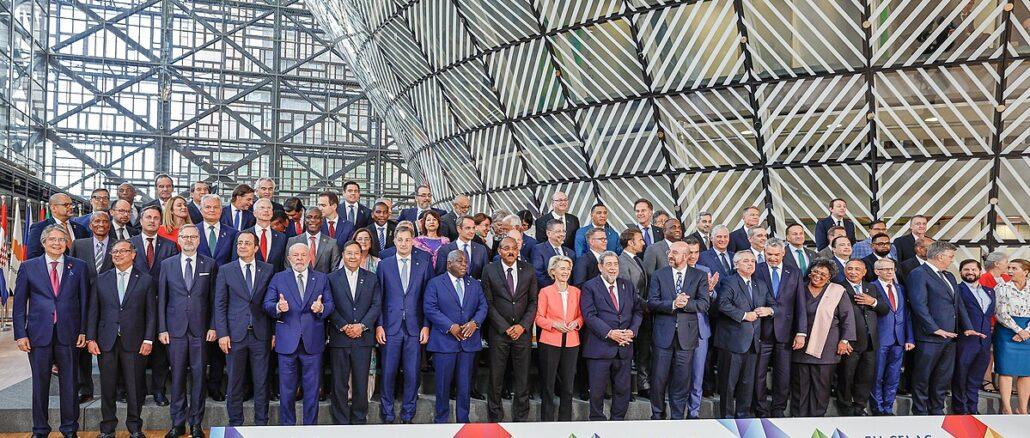
At the 9th Summit of CELAC (the Community of Latin American and Caribbean States) Mexico’s first female president, Claudia Sheinbaum Pardo, took center stage to model Mexico’s economic and social success. Over the past 7 years continuous progressive change has heralded the country’s historical “4th Transformation.” President Sheinbaum’s prominent speech featured themes of equality, unity and inclusion as guiding foundations for Latin America.
Attention to her repetitive adage, from the bottom up was repeated by others. Sheinbaum calls it ‘Mexican humanism’. “Every single day we consolidate rights for the people of Mexico, rights that were taken away from them during the neoliberal period.” Her message was both galvanizing and diplomatic, one of urgent, forward-moving politics. Rather than denouncing the threatening northern obstacles that Mexico faces daily, she echoed the President of Honduras Xiomara Castro, former Chair of CELAC, who stated in her ‘Welcome’ to Honduras speech, the enormous neoliberal damage done to her region. President Sheinbaum also acknowledged the 35 year neoliberal period that removed many of the human and civil rights which were national, social, and cultural protections for the Mexican people. Her authoritative presentation spoke to her country’s substantial success story while sharing care and warm words about all Latin American peoples, moving the heads of state attending.
While US economic performance has been shaky, at best, Mexico’s GDP nearly doubled from 2021-24. In the few months since President Trump re-assumed office in January 2025, the Mexican Peso has increased in value by 5 percent. During that same time period the US dollar has weakened, a development experts attribute to tariffs and other economic decisions. In the midst of uncertainty with one of Mexico’s largest trading partners Sheinbaum called positive attention to new regional partnerships such as the “Medical Manufacturing Trade Agreement for reliable scientific cooperation” and “that Brazil, Cuba and Argentina are already cooperating for a regional health policy. The Summit also called for debt relief through a “climate Action Swap,” noted in COP 16 whereby active regional environmental policies could remove the liabilities that presently exist from climate catastrophes. The Summit participants also called for a “Free Palestine,” exhibiting a spirit of international solidarity.
President Sheinbaum called upon CELAC to convene its next Summit for ‘economic well-being’ which may be modeled after the successful Mexican ‘Bienestar’ Program of widespread salary and pension benefits. President Gustavo Petro of Colombia likened CELAC’s organizational system goal as similar to the European Union’s unifying arrangement. “The main tenet of our work,” noted Sheinbaum, is “to maintain the well being of peoples which eliminates racism, classism, sanctions and criminalization of migrants, that causes the migrant movements.” She continued, “Heroes and heroines are immigrants who not only support Mexico with US jobs, but also who work to support the US economy itself no matter their immigrant status.” She and other leaders vociferously opposed migrants sent to El Salvador prisons.
Cuba’s presentation gave the Summit background of colonialism and imperialism as major obstacles to economic progress on their island, noting the 60 years of US historical abuses dealt to the Cuban people. Because of its people first policies seen in heroic medical deeds during and beyond Covid crisis, and pharmaceutical research discoveries together with its self-sufficiency and willingness to work with other nations, Cuba is not culturally isolated. In fact it has friends in surrounding nations and throughout the world. For 30 years over 180 United Nations Member States have regularly supported Cuba’s freedom from sanctions and a US blockade. President Miguel Díaz-Canel analyzed the historic but regular sanction blows by the US whose policies have worsened against Cuba in recent years, crippling aspects of energy infrastructure and deliveries to the island, blockading essential medical equipment and food staples. At the same time, Cuba must also adapt to severe climate change. The country’s advancement in medical practice, manufacturing, and distribution give credence to one of the main goals of the Summit, the growing need for mutual support, in this instance to protect Cuba’s rural doctors who provide modern international medical care unavailable in the hinterlands of Latin America and the Caribbean.
President Bernado Arevalo of Guatemala spoke in lofty far-reaching aspirations of what could lie ahead with greater South American and Caribbean mutual aid and support. President Ralph Everard Gonsalves, third term Labor Party leader of St. Vincent and the Grenadines took the opportunity to remind the new President in Guatemala that the Indigenous Garifuni peoples who have come under attack, originally came from his island’s jurisdiction and needed greater Guatemalan protection for their lands from private and public interests. Both countries will benefit from the Mexico to Guatemala Tren Maya railroad now in process through Belize for greater Central American access to Gulf ports and for needed Inter-American trading and transportation. It is predicted that job growth from this development may significantly lessen economic migration needs.
CELAC can bring in a new inter-oceanic era of prosperity with like-minded countries. Positive change can happen with integration and solidarity, providing clean energy, ensuring biodiversity, egalitarianism, and humanism in each nation, with no one left behind. President Sheinbaum emphasized the scope of the Summit’s power: “There are 663 million people who can work towards greater peace and prosperity and with a GDP of 6.6 trillion dollars.” She called on members to ally with one another against unfair treatment, growing US military prowess, and foreign exploitation.
She also reminded Summit participants that Latin America and the Caribbean nationals contain 35 percent of the world’s people, 30 percent of the world’s forests, 25 percent of the minerals, and 20 percent of global oil and a significant source of food production. With determined social and economic integration, President Sheinbaum urged, all of Latin America and the Caribbean can be perpetually self-sufficient, fortifying their sovereignty.
—
Ellen Mass is a member of MAPA’s Latin America and Caribbean Working Group.