
By Jake Harper
On July 27th, approximately 350,000 people nationwide lost the legal right to work, including nearly 20,000 in Massachusetts alone. Overwhelmingly, they are Haitians, many of whom arrived here in the wake of the 2010 earthquake, who have lived and worked here lawfully for up to a decade and a half under Temporary Protected Status (TPS). They pay taxes. They staff our nursing homes and schools. They perform manual labour jobs otherwise vacant and unfilled. As of July 27th, their employers are legally required to fire them. This has not happened because Haiti (or Syria and Yemen, for that matter) has now become safe. It happened simply because the Supreme Court ruled in Mullin v. Doe that no court can challenge the Trump Administration’s decision.
Time and time again, the present administration has set itself against the principle American claimed at the outset: the idea that birthplace, worship, and ancestry should be irrelevant to belonging in the United States, provided you are committed to equality, liberty, and self-government. An administration so eagerly claiming to inherit the legacy of the founding fathers should perhaps heed George Washington’s precept that the United States government ‘requires only that they who live under its protection should demean themselves as good citizens’, giving ‘to bigotry no sanction’ and to persecution ‘no acceptance’.
Claims that the administration targets only ‘criminals’ or those living here without legal authorization remain an illusion. Many Haitians residing under TPS arrived in the United States in the wake of the catastrophic earthquake of 2010, which triggered an ongoing humanitarian crisis and decimated the nation’s already fragile socio-economic and political infrastructure. Vanishingly few have been granted pathways to citizenship or the right to remain within the country beyond TPS, placing their futures in the communities many have built in the past 15 years in jeopardy.
The Haitian community within the United States has faced longstanding prejudice even prior to the present administration and the ongoing TPS struggle. Trump’s hideously racist comments in the 2024 debates attracted international ridicule and need not be repeated, but exclusion targeted towards the Haitian community runs far deeper. The CDC’s 1983 naming of Haitians as an HIV ‘risk group’ – the only risk group defined by nationality – and the blood donation ban and widespread stigmatization that followed provide another example. It’s worth noting that, in the Mullin ruling, the Supreme Court, in a highly unusual move, declined to reproduce in print the statements that the plaintiffs identified as the strongest evidence of discriminatory purpose. I spoke recently with Geoffrey Pipoly, the appellate litigator who argued the case for the Haitian plaintiffs before the Supreme Court. He directly referred to the handling of this evidence as a ‘rhetorical sleight of hand’, one which Justice Alito is too skilled a writer to have needed if the argument were truly sound. In Pipoly’s view, the majority ultimately ‘don’t believe it (the ruling), and they know it’s racist, and they simply don’t care’.
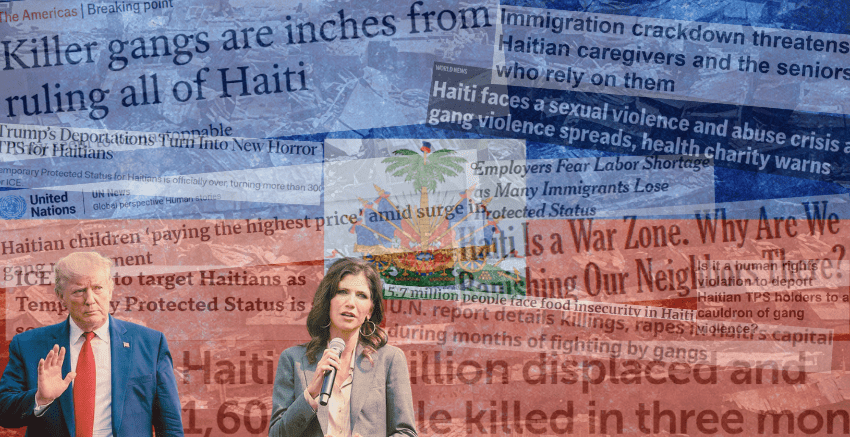
Beyond its contentious legal basis, the forcible deportation of Haitian TPS holders is an obvious tragedy for basic human rights and dignity. The Haitian government has essentially collapsed, unable to reliably provide basic provisions of security, food, and healthcare. The capital, Port-au-Prince, has been perpetually immersed in brute violence and open conflict between armed gangs and militias who control close to 90% of its territory; UNICEF estimates 30-50% of combatants to be children. Close to 6 million face ‘acute’ food insecurity, and around 1.5 million are internally displaced. Sexual violence is endemic, the majority of incidents being gang rapes perpetrated by armed groups. The moral stain upon the United States if it were to go ahead with deporting 350,000 to a nation in such a state is self-evident.
Of course, appeals to decency largely fall on deaf ears in the current administration. Perhaps, then, an administration that has adopted “America First” as its mantra should consider that the planned deportations would be as much an act of economic self-harm for the United States as they would be ethically reprehensible; research suggests that in the Boston area alone Haitians contributed over $250 million to the economy in 2017.
Within the healthcare industry, where Haitian TPS holders make up a disproportionate amount of the labor force, the effects of deportation will be particularly stark. The National Domestic Workers Alliance estimates that approximately 13,000 Haitian TPS holders work as nursing assistants nationwide, with a further 8,000 employed as caregivers. Global Boston suggests that approximately half of all Haitian women in the Boston metropolitan region are employed in nursing. A congressional report published by Senators Warren and Markey and Representative Pressley found one Massachusetts care provider had already lost 101 Haitian employees in the last year even prior to Mullin v. Doe, replacing barely 60 per cent and losing an additional $24,000 per pay period in overtime and agency cover. Such change, in a sector already subject to a 13% vacancy rate, would prove a ‘seismic shock’ to the Massachusetts economy and care sector, as put by Boston University finance professor Mark Williams. In short, the United States cannot afford another round of heartless deportations, neither ethically nor financially.
The United States has a long and unfortunate history of prejudice and calculated selfishness against Haiti. When the Haitian people mounted the only successful slave revolt in modern history at the turn of the 19th century, the United States neglected to recognise them for over 50 years. It then stood by as France extracted a damning indemnity that served to cripple Haiti’s development. In the 20th century, the US invaded and occupied Haiti at the behest of financial interests, overseeing military rule and forced labour, and to some degree propped up the brutal dictatorship of the Duvaliers in the late 20th century. This judgement, that self-interest mattered more than principle, is one being made again: this time only in the inverse, abandoning those who are already here and holding up a beleaguered care system. It is one that any self-respecting nation, claiming to epitomise individual liberty and justice, should not stand for.
Jake Harper is an intern at Massachusetts Peace Action visiting from the University of the Cambridge in the UK, where he studies Political Science and Sociology.