
by Cambel Shim
The shootings of Renée Good on January 7, 2026, and Alex Pretti on January 24, 2026, in Minneapolis represent more than isolated tragedies. They show a systematic deployment of authoritarian tactics by the Trump administration to justify state violence and the suppression of dissenting perspectives.
In the case of Renée Good, within hours of her shooting and before investigations could begin, Trump administration officials made pronouncements about her intent and character. DHS Secretary Kristi Noem, Border Patrol Commander Greg Bovino, and White House deputy chief of staff Stephen Miller immediately labeled the victim as a “domestic terrorist” who sought to “massacre law enforcement”. This rush to define Renée Good illustrates a hallmark of authoritarian rule. The ability to craft the narrative before the facts are in is essential to retaining control.
NPR noted that Trump’s administration has “repeatedly made unproven or incorrect claims when describing immigrants targeted for deportation, U.S. citizens arrested while protesting the administration’s immigration crackdown, and people who simply drove through areas where an immigration enforcement operation was going on”. Conservative media outlets quickly echoed the sentiment and jumped to dehumanize victims. For example, Matt Walsh, a right-wing political commentator and host of “The Matt Walsh Show”, took to the social media platform X to label Good as a “lesbian agitator” protecting “68 IQ Somali scammers”. The consistent emphasis on Good’s sexual orientation and the act of labeling her as a domestic terrorist serve a specific purpose. This language signals to the general public that she was fundamentally “other,” not part of a community deserving of protection. This follows a recognizable pattern from authoritarian regimes in which the victim must be transformed from a citizen with rights into a threat to the state.
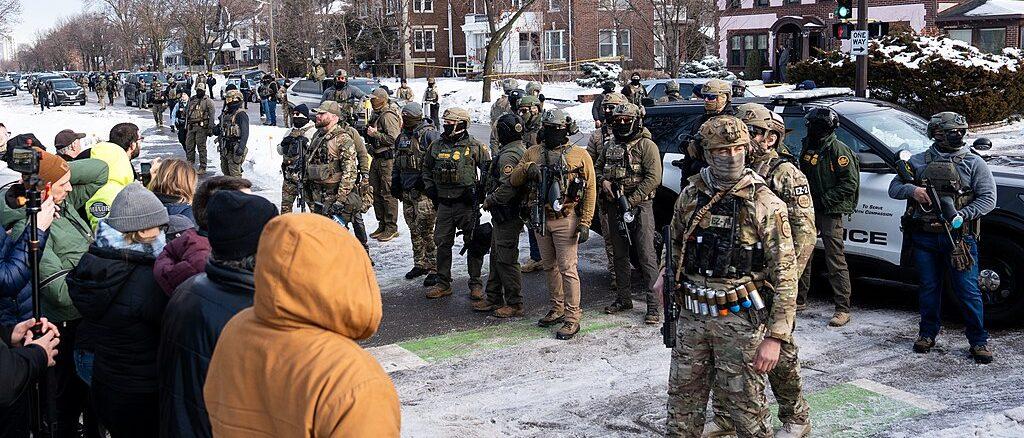
Another key aspect of Trump’s authoritarianism is the continuous and consistent escalation of both violence and law-breaking by ICE agents. Good’s killing was the ninth time in five states and Washington, D.C that ICE agents had opened fire on people since September 2025. Four other people were killed during federal deportation operations . This quick escalation of violence works to scare and suppress dissenting views into silence. Furthermore, the administration continually rejected the basic investigative procedures necessary when trying to uncover what actually happened. Minnesota Governor Tim Walz stated that federal officials’ “closing the crime scene, sweeping away the evidence, defying a court order and not allowing anyone to look at it” represented “an inflection point in America.”
Similar misdirection and falsehoods came out of the Trump Administration in the wake of Alex Pretti’s shooting. Many videos show him recording agents with his phone before being pepper-sprayed and eventually thrown to the ground, held down, and shot after the officers removed his legal firearm. This evidence contradicts federal claims that he “approached U.S. Border Patrol officers with a 9mm semi-automatic handgun” and “attacked” them. Following Pretti’s death, nine people were arrested and indicted on federal civil rights charges, including independent journalists Don Lemon and Georgia Fort, for allegedly interfering with First Amendment rights during a protest at a church.
Trump is only willing to protect those whose views match his administration, and will continue to discredit, silence, or jail critical voices. For example, the Trump Administration immediately declared that the ICE agents who shot Pretti did nothing wrong and had “absolute immunity” because he was “doing his job”. Such an assertion of immunity before any investigation is quintessentially authoritarian. The responses to the Minneapolis killings reveal how authoritarian rule operates: immediate narrative control, dehumanization of victims, assertion of state immunity, repression of dissent, and the manufacture of crises that justify extraordinary measures. Renée Good was a mother, a poet, an activist, and a citizen supporting her neighbors. Alex Pretti was an ICU nurse who “cared about people deeply.” Both died as a direct result of escalating militarization and an administration willing to defend any use of force rather than admit error.