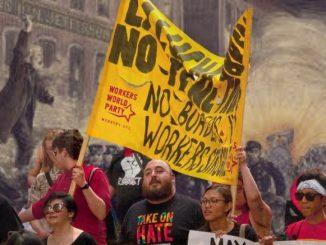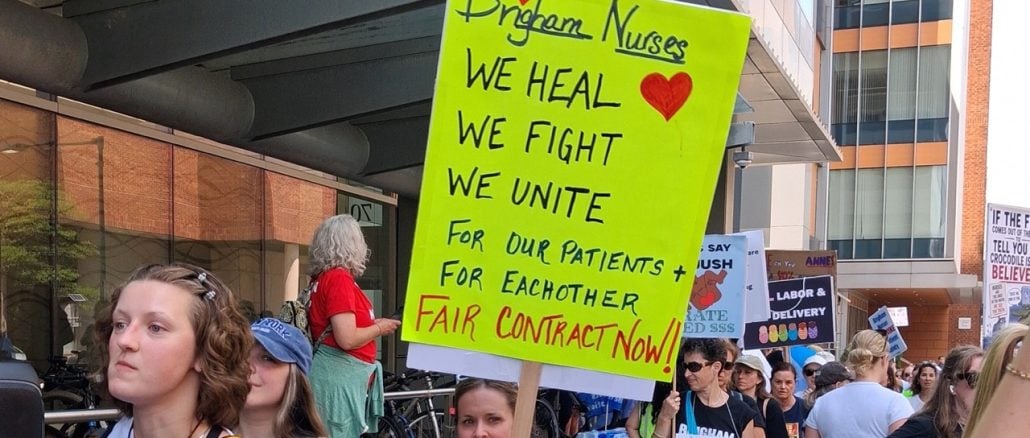
On Wednesday morning, July 8th, at seven o’clock, 4000 RNs launched a twenty-four-hour strike at Boston’s Brigham & Women’s Hospital, part of the Mass General Brigham conglomerate (MGB), the largest private-sector employer in Massachusetts. And at eight o’clock, 450 home-care clinicians employed by MGB began a seven-day strike for a first contract. Both bargaining units are represented by the Massachusetts Nurses Association (MNA).
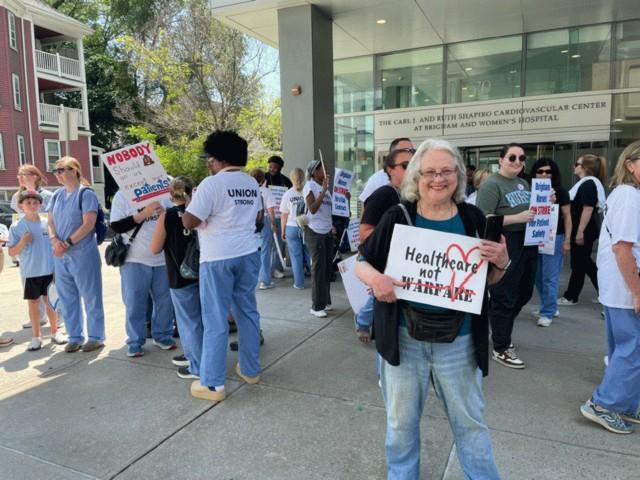
Mass picketing flooded all the streets of the Brigham complex of buildings, amid supportive honks from passing cars and trucks. The swelling ranks of the striking nurses were augmented by contingents of other healthcare and human service workers, teachers and construction workers, elected officials and supporters of all backgrounds. Picketing was also organized at Brigham’s satellite sites across the region, such as at Patriot Place in Foxborough.
Nurses with signs and noisemakers paraded down the sidewalks on both sides of the streets surrounding the multiple buildings of the BWH hospitals — Francis St., Binney St., Jimmy Fund Way and elsewhere — while trucks and cars joined the procession from the streets with horns tooting and blaring. Everywhere nurses gathered in small clutches for breaks while continuing to chant and cheer the endless streams of picketers. One of our seasoned MAPA activists reports, “I’ve actually never in my life seen anything so monumentally impressive.”
MNA’s bargaining unit of home-care clinicians — registered nurses, occupational and physical therapists, nutritionists, speech language pathologists and social workers — are picketing for the duration of their seven day strike. MGB Home Care clinicians and supporters will picket through July 14th at Mass General Assembly Row Somerville, 399 Revolution Drive, Somerville. Picketing starts at nine o’clock every morning.
MGB has imposed a four-day lockout on the hospital RN strikers, who will picket 24/7 until July 13th at 75 Francis Street.
The strikers are quite articulate about their issues when asked. The nurses’ demand for an across-the-board raise, one that elevates all, no matter what pay scale they are on, has been met with silence from the seven-figured top executives, in service to the multi-millionaire and billionaire board members, drawn from the rotten core of finance capital, including the CEO of Lockheed-Martin. This gross inequality is seen as insulting by many strikers. Others stress management’s refusal to commit to a cap on rising health insurance premiums and deductibles. Safety issues are prominent among their demands, for patients and for staff. Complaints of inadquate numbers of staff and frequent lack of adequate training of new and temporary staff undermines any sense of security.
This week’s labor action is not unrelated to the 1991 bipartisan deregulation of hospital finance which unleashed a cascade of changes, including a rash of mergers, acquisitions and hospital closures across the state. In 1994, Brigham & Women’s Hospital and Massachusetts General Hospital announced a “partnership,” and the race was on, with remaining not-for-profit institutions competing for market share.
The current MGB conglomerate refuses to back the systemic healthcare changes that would guarantee safety, economic security and community health, such as enforceable safe staffing standards and a real universal care system, with Massachusetts Medicare for All legislation being bottled up in committee at the State House for decades. Legislation to establish safe staffing standards and Massachusetts Medicare for All has been supported by the Massachusets Nurses Association with broad community support during legislative session after legislative session.
MAPA’s Fund Health Care Not Warfare working group has been on top of this marketplace distortion right along, is in the thick of things on the picket line now, and will continue to advocate for and report on the struggle for quality health care for all in Massachusetts.
By Sandy Eaton