
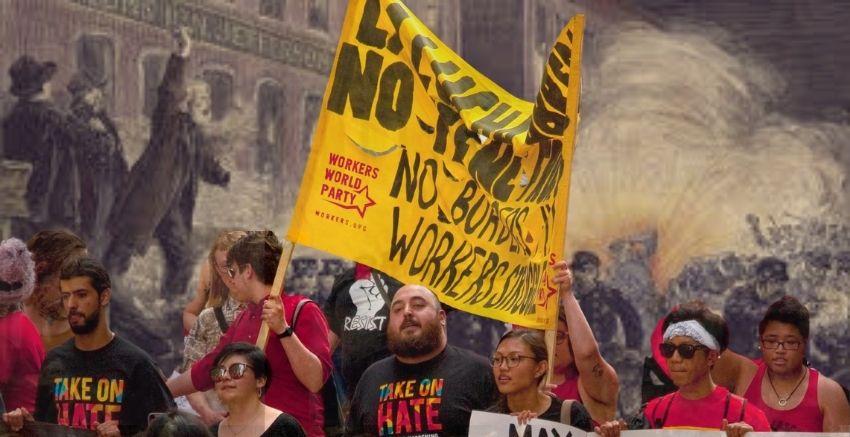
by Jeanne Trubek
Why did May 1st become International Workers Day throughout the world?
It began with a general strike in the United States. The country was experiencing a long economic depression that started in 1873 and continued for 5½ years. The Great Upheaval – workers fighting back against their ever-worsening conditions – began in 1877. Railroads, the key industry of the time, kept cutting wages. In West Virginia the Baltimore and Ohio Railroad Company ordered a 10% reduction in wages – the third reduction over the past year – while also increasing dividends to the shareholders by 10%. The railroad workers went on strike.
Workers began to strike across the country to improve their conditions. The railroads called on the state and federal governments to break the strikes. States sent in their National Guards and President Hayes sent in the soldiers from the Army and Marines to assist the railroad owners. It is estimated that over 100,000 workers were involved in these strikes. Over 1,000 were arrested. About 100 were killed. This era was the beginning of the formation of unions for workers. The Knights of Labor began in 1869, the Workingmen’s Party was established in 1876, and the Federation of Organized Trades and Labor Unions of the United States and Canada was established in 1881 (changing its name to the American Federation of Labor or AFL in 1886)
A key demand, adopted by workers across the nation, was for an 8-hour work day.
On May 1, 1886, Chicago unionists and other workers combined to make the city the center of the national movement for an 8-hour day. During late April of 1886 workers attended scores of meetings and marched through the streets demanding an 8-hour day. On Saturday, May 1, 35,000 workers walked off their jobs. Tens of thousands more, both skilled and unskilled, joined them on May 3 and 4. Crowds traveled from workplace to workplace urging fellow workers to strike, many adopting the radical demand of “Eight Hours’ Work for Ten Hours’ Pay.” Police clashed with strikers at least a dozen times, three of those clashes involved shootings.
On May 4, 1886 a peaceful demonstration was held in Chicago’s Haymarket Square. The police charged in. An unknown person threw a bomb. In response, the police arrested 8 labor organizers, including 6 who were not at Haymarket at the time. All were convicted.
Three years later the International Workers Congress, held in Paris in 1889, established the Second International for Labor, Socialist, and Marxist parties. It adopted a resolution for a “great international demonstration” in support of working-class demands for the eight-hour day. The date was chosen by the American Federation of Labor to commemorate the general strike in the United States, which had begun on the 1st of May, 1886.
This demonstration subsequently became a yearly event. May Day is still officially recognized in much of the world, but not in the United States of America. In 1894 the United States instead declared the first Monday of September Labor Day. Despite its unofficial status May Day is still celebrated by workers and their allies in cities and towns across America.