
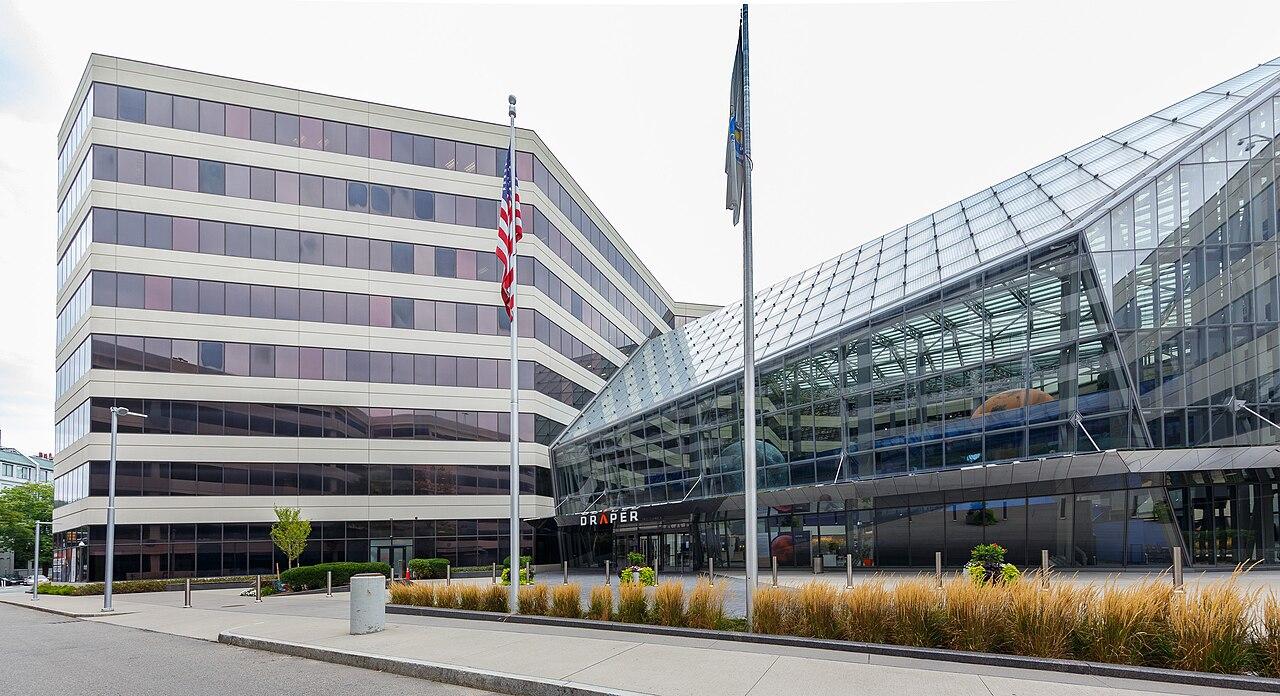
The state of Massachusetts’ history of major participation in military industry is no secret. The US is spending around $3 trillion on a new generation of nuclear weapons, as well as huge amounts on new conventional weapons. Massachusetts, like other US states, seeks a share of this expanding military research and production. So, as a matter of course, the Healy administration is spending $25 million on developing a microelectronics facility in Lowell to help Draper Labs work on the new generation of strategic nuclear weapons — so that Draper’s guidance and control systems can guide nuclear bombs to their targets.
In early 2025, Draper opened its newest corporate facility at UMass Lowell as an anchor tenant in LINC (the Lowell Innovation Network Corridor). LINC is a 1.2 million square foot mixed-use development claiming to foster a “thriving innovation ecosystem”, a public-private development project made possible by the University of Massachusetts Lowell, the University of Massachusetts Building Authority, and the City of Lowell–with significant support from the Commonwealth of Massachusetts.
Later, in October 2025, Massachusetts Governor Maura Healey announced $47 million in state investments and grants to create the Strategic Hub for Innovation, Exchange, and Leadership in Defense (SHIELD), to coordinate defense-sector innovation and expand microelectronics, biomedical and military work across the Commonwealth. $25 million of the money is to help fund the construction of Draper Lab’s Integrated Microelectronics Production & Advanced Chip Technology (IMPACT) Center in Lowell’s LINC.
In April 2026 the Lowell City Council voted to move forward on an agreement with Wexford Development LLC to build Draper’s 75,000 square foot IMPACT microelectronics facility, which would be leased to Draper. The city sold Parcel 15 in the Hamilton Canal Innovation District for $1.49 million for the facility. The Healy administration hasn’t said exactly what the $25 million is for, but $25 million will certainly pay for a very significant portion of the facilities’ $100 million total development cost.
The April 2026 announcement also included state funds for: $3 million investment in a Natick Soldier Systems Center “BioNexus” effort that will be combined with $7 million from the army, and $1 million for small business partnerships with the Air Force at Hanscom Air Base in Lexington.
Draper’s IMPACT facility is expected to bring 150 highly skilled jobs to the area. The facility will produce advanced microelectronic design, production and packing for Draper Laboratory’s U.S. military-industrial, military and aerospace customers. Draper plans to provide up to $10 million in programming, research, and educational resources to UMass Lowell over the coming decade.
The role of Draper as a defense contractor and as a profiteer of war cannot be overstated.
Since the inception of our nation’s Strategic Nuclear Weapons Systems (SNWS) 70 years ago, Cambridge, MA-based Draper Labs has provided the guidance and navigation sub-systems for the nation’s sea-based leg of the nuclear triad. Most importantly, it has provided inertial guidance systems for the submarine launched ballistic missiles (SLBM). Since the program began in the 1950s, every U.S. Navy-deployed SLBM has been equipped with an inertial guidance subsystem designed by Draper engineers.
Draper has also provided engineering and technology development to the U.S. Air Force since 1957, including work on the Minuteman and Sentinel ground-based leg of the nuclear triad. Draper provides the key components for the Minuteman III, the high-performance gyroscopes and inertial measurement units (IMUs). Daper has a new building at Hill Air Force Base in Utah for work on Sentinel, which will replace the Minuteman III.
Each sub carries up to 20 Trident II D5 ballistic missiles. Draper is replacing the missile guidance systems with upgraded ones for the Trident II D5LE (life-extended) missiles. The new Mk6 guidance system provides mission flexibility and increased accuracy. The same systems will be used on the new Columbia strategic nuclear missile subs. While each Trident can carry up to 8 nuclear warheads, the average has been 4 or 5. ith the New Start Treaty gone as of February 2025 they could go back up to 8 per missile. Under New Start, 918 warheads were deployed on the subs, but this could now go much higher too.
Two warhead types are deployed on SLBMs: the 90-kiloton enhanced W76-1, with a blast force 15 times that of the Hiroshima bomb, and the 455-kiloton W88, with a blast force over 30 times that of the Hiroshima bomb. The W76-1 is a new warhead that is replacing the W76-0.1,600 of them have been produced.
As people have died as a direct consequence of US-instigated wars such as the Ukraine war, and the US-Israel war on Iran, let’s hope that, in their desperation, they don’t push the nuclear button and cause us all to suffer and die in the nuclear winter the Commonwealth of MA and Draper Labs helped create.
By Richard Krushnic