
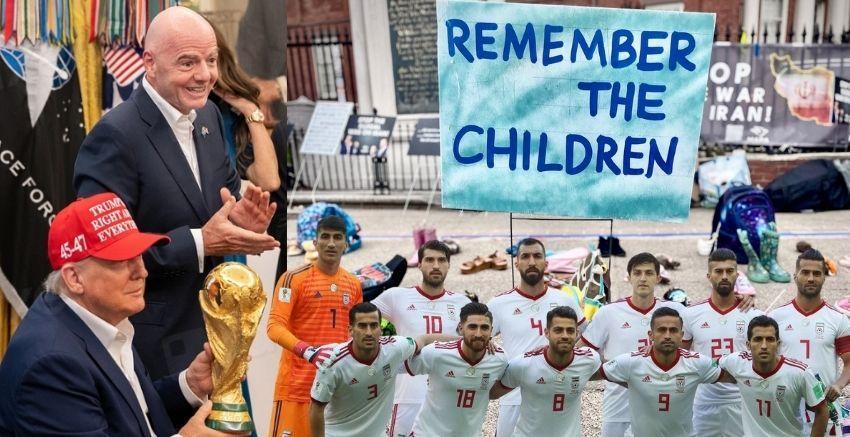
“The beautiful game” of soccer is being played across the US, Canada, and Mexico and promises “to unite the world.” Beyond the view of stadium lights, television cameras, and smiling fans, however, lurk some ugly realities.
Controversies started long before the World Cup began on June 11, including calls to boycott the tournament. Among the reasons are FIFA’s double standards. Three days after its invasion of Ukraine in 2022, Russia was suspended from the organization. 2.5 years into a genocide against Gaza, Israel remains a member. Calls worldwide to move the World Cup out of the US for its global aggression, war crimes, and treatment of migrants, also went unheeded.
As the tournament was set to begin, several delegations were singled out upon their arrival at US airports, their members often subjected to hours of interrogation and denial of their visas. The most intensely scrutinized were Iran, whom the US bombed in February at the behest of Israel, and with whom the war continues.
“The most oppressed team” at the World Cup
After their June 22 game against Belgium in Los Angeles, the Iranian team left a note on the whiteboard in their locker room. “The spirit of Iran remains alive and steadfast,” it read, followed by “#168” and “#Minab” written in red marker, referring to the US missile attack on an elementary school which killed 168 civilians, most of them children. The note goes on to thank Los Angeles for their hospitality and to thank their fans. “May peace, respect, and friendship prevail among all nations,” it concludes.
The note comes across as especially gracious, given that it did not mention the hostility with which the Iranian team has been treated by host nation, the United States.
Beginning months ago, the team faced hurdles over obtaining visas. Then, upon arrival at the airport, the visas of 15 members of the Iranian staff were rejected, and only four later won their appeals for reinstatement. That was just the beginning.
After playing their first match in the tournament against New Zealand, the team was told they had to leave American soil within two hours after every game and could only return one day prior to the start of the next match. They had been forced to relocate their training base from Arizona to Tijuana, and FIFA rejected the team’s request that their group stage games be moved out of the US. The sudden restrictions increased their travel, immigration, and customs times, increased their fatigue, and lessened their training and recovery times, not to mention the psychological toll it took on the players.
As midfielder Saeid Ezatolah said in a press conference after a tie game with Belgium: “You cannot deny that our situation has (not) been the same as all the other teams…[They] have managed to focus on their planning, where we have to spend so much time commuting.”
“It’s a disaster World Cup; a disaster,” said team captain Mehdi Taremi.
After the first game, FIFA President Gianni Infantino had promised to intervene, but “No one helps. No one. FIFA did nothing.”
“We play for our people. We want them to be happy. We want to bring (the) joy. We want to send a message of peace for the people—in Iran, outside of Iran, for the FIFA, for everyone. But there is no peace about the others to us.”
Although they were allowed into the country two days prior to their final heartbreaking match with Egypt, the team was delayed at the airport while they waited for Taremi and assistant manager Saeed Alhoei, who both complained of harassment by US authorities.
All of this is in addition to the facts that FIFA scrapped the ticket allocation for Iranian fans in early June, the team faced protests before every game and boos when their national anthem was played, and players were asked to comment on political matters by western reporters. Their own media team had not been allowed into the country.
Homeland Security Secretary Markwayne Mullin even went so far as to broadcast his glee over their mistreatment: “I’m just glad they’re done, and they’re not coming back,” he admitted. “I was so happy when we were able to pull their visas and said they could leave U.S. soil, and I might have sung a song or two, or maybe danced a happy dance.”
Coach Amir Ghalenoei, who said his was the “most oppressed team” at the World Cup, had asked the coaches of the other 47 teams to speak out about their unfair treatment. None did. “We are here for football, not politics,” he stated at a post-game press conference. “If I had seen another team being treated the way we are being treated, I would say something.”
FIFA’s Double Standards
Within 72 hours of Russia bombing Ukraine in February of 2022, FIFA had suspended them. After two and a half years of bombing Gaza, breaking international law, and being charged with genocide, however, Israel remains an active member. The settler colony and terrorist state, who play in the Union of European Football Associations (UEFA), failed to qualify for the World Cup but calls for their suspension continue.
Despite FIFA’s claim that it “is committed to respecting all internationally recognized human rights and shall strive to promote the protection of these rights”, they’ve failed to follow their own human rights policy when it comes to Israel.
Besides killing over 500 members of the Palestinian Football Association from 2023 to 2025, Israel’s violations include preventing Palestinian players from travelling to participate in tournaments, targeting sports stadiums and facilities and destroying hundreds of them, and allowing clubs in illegal settlements to play in the Israeli league.
After a scheduled vote to ban Israel from the UEFA was cancelled last October, Infantino claimed that “FIFA cannot solve geopolitical problems.”
Maybe not, but that hasn’t stopped them from trying. Besides suspending Russia, they also sanctioned South Africa, even expelling them in 1976 before reinstating them in 1992, and Yugoslavia was suspended in 1994.
Boycott the US
Reasons cited to boycott the US venue are almost too many to list—Trump’s war with Iran, complicity with war crimes in Palestine and Lebanon, bombing Venezuela and the seizure of President Maduro, bombing fishing boats based on spurious claims of drug trafficking, bombing Nigeria on Christmas Day, threatening to take over Cuba and Greenland, and its treatment of immigrants and refugees by ICE.
Furthermore, ticket prices are astronomical, and the games have reached a new level of commercialism. They now include “hydration breaks,” during which Fox Sports conveniently shows commercials worth between $200,000 and $750,000 each, and some include halftime shows. It’s estimated that FIFA will make a record $6 billion from the tournament.
FIFA’s hypocrisy reached a crescendo when Infantino, whose friendship with Trump is well-known, awarded him a newly invented “FIFA Peace Prize” in December.
The golden sheen of the World Cup trophy, which Trump will hand to the captain of the winning team on July 19, has been tarnished by both a politically compromised FIFA and a shameful display of prejudice by the United States. Had “the beautiful game” been played fairly off the pitch, it could have united the world in friendly competition, even during wartime. Instead, we’ve witnessed elements of an ugliness which only tears the world even further apart.
by Jeannie Connerney
—
Jeannie Connerney is an activist and writer. She is a member of Watertown Citizens for Peace, Justice and the Environment; Pax Christi; and Massachusetts Peace Action, where she serves on the editorial board of The Peace Advocate.