
by Ken Y.
Oh, wow! Did you watch it?
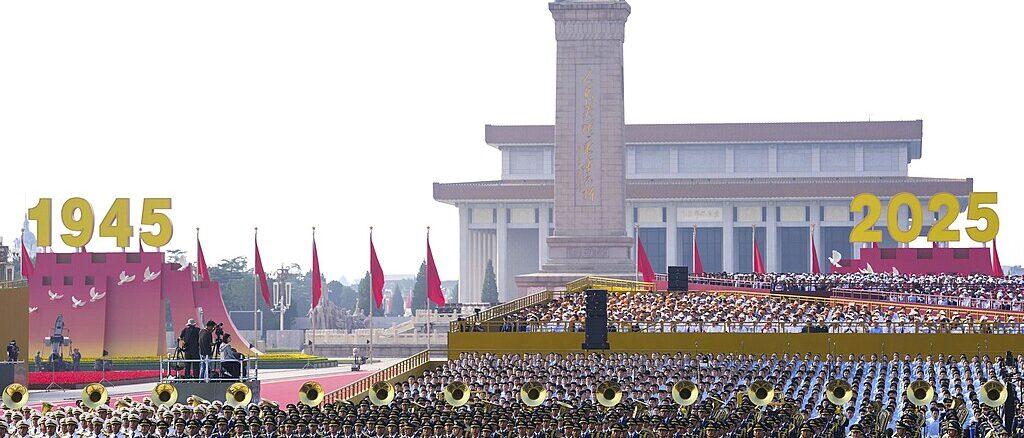
By all accounts, it was a true SPECTACLE!
However, that is where the consensus ends.
There is a plethora of divergent descriptions and comments in the US media describing the parade as:
-
A celebration of the end of WW2.
-
An anti-US or anti-West parade.
-
A Chinese rewriting of history that sidelines the main role of the US (and maybe western Europe).
-
A threat to Taiwan.
-
The rise of Chinese militarism to threaten its neighbors.
-
The rise of Chinese militarism to threaten the entire world – for global hegemony.
-
The rise of Chinese militarism to threaten its own citizens into obedience.
So what was the purpose of this extravaganza?
The event was officially called: “Commemoration of the 80th Anniversary of the Victory of the Chinese People’s War of Resistance Against Japanese Aggression and the World Anti-Fascist War”.
I know, that is a mouthful. However, to simply call it an event to “celebrate the end of WW2” really misses the point.
I was talking with a friend in Dalian, China, who said that she was so moved and proud of the event and of China. In fact, many people in China were moved to tears watching the event.
Why?
HISTORY MATTERS
In the West, many people think that WW2 began when the Germans invaded Poland on September 1, 1939 (including ChatGPT). By that time, China had been under attack by the Japanese in Manchuria for eight years. The West does not consider that invasion as a part of WW2, but instead calls it a “pre-cursor” to WW2. Tell that to the people who suffered and died during those eight years.
Who gets to decide?
Not only did the Japanese invade Manchuria, which was a part of China, and install the puppet regime, Manchuguo, but also set up the notorious Unit 731 that was conducting violent and inhumane biological experiments on live Chinese captives in Harbin by 1936.
The Japanese continued their southward expansion in full earnest after the Marco Polo Bridge incident on July 7, 1937 on the outskirts of Beijing. Their full-scale assault to completely subdue the government of China (the KMT at the time) culminated in what is known as the Nanjing Massacre, where over 300,000 civilians were slaughtered over the course of six weeks. The Japanese adopted the “Three Alls Policy” – “Kill All, Burn All, Loot All.”
If you have not done so, you must watch the movies, Death to Rights (2025), and City of Life and Death (2009)(aka Nanjing, Nanjing in Chinese) about the Nanjing Massacre. (You may be able to watch them on Youtube.)
I remember, when I was young, my father telling me hair-raising stories of how the Japanese soldiers conducted beheading contests with captured Chinese.
Then there is this sanitized term, “Comfort women”, to describe sexual slavery forced upon many women and young girls in China, Korea, the Philippines, and other countries.
The US entered the war after the bombing of Pearl Harbor on December 7, 1941 and lost 291,000 lives on foreign soil for four years. Their contributions and sacrifices are noteworthy and recognized by the present Chinese government and people. Examples of this gratitude by the Chinese are the many invitations of the descendants of US General Joseph Stilwell, and Clair Chennault (of the Flying Tigers fame) to visit China as honorees and dear friends of the Chinese people.
Meanwhile, the Chinese resisted the invading Japanese for 14 years – from 1931 to 1945. They sacrificed 35 million people (20 million civilians and 15 million soldiers). However, do not consider them unfortunate victims. They were true heroes and martyrs who fought against the subjugation by the Japanese. Their herculean task of fighting the Japanese with much inferior weapons tied down the Japanese troops on Chinese soil for 14 years and prevented them from easily overtaking the rest of Southeast Asia and even the eastern parts of the Soviet Union. For being the bulwark of resistance against imperial Japan, China (under the KMT) was given a seat as a permanent member of the Security Council of the newly formed United Nations in 1945.
After its surrender, the Japanese government has not sincerely and fully apologized or reconciled their war crimes with their aggrieved neighbors. Each year, the prime minister and other leaders of Japan pay homage at the Yasukuni Shrine that contains the remains of convicted war criminals. Their textbooks whitewash the atrocities during WW2.
So why bring up the past? Why not let bygones be bygones? The reason is because without truth and honesty, without acknowledgement and apologies, without atonement and reconciliation, the wounds of the victims and their descendants will not heal; justice will not exist, and history may repeat itself.
This history helps to explain why so many Chinese feel proud of their government and the progress of their society, and why some were brought to tears watching the Commemoration.
WHAT IS REALITY?
Of all these different interpretations of the parade listed at the beginning, which ones are accurate? Is it totally subjective, depending on your perspective and politics?
There is probably no easy way to answer the question.
As stated above, a brief history of some of the sacrifices and determination of China during WW2 may shed some light on the mindset of the Chinese government and people.
Another way to shed more light on the subject is to look at the present facts.
-
The US has 700 military bases around the world including many surrounding China. China has one base (Djoubouti), and none anywhere near the US.
-
China has not fired a single bullet on foreign soil since 1979 and that conflict/war lasted for one month with no taking of any territory. How many wars has the US been involved in since that time? (In Lindsey O’Rouke’s book, Covert Regime Change: America’s Secret Cold War, she identified over 80 US-backed regime changes since the end of WW2.)
-
25 countries sent their heads of state to participate in the 9/3/25 parade. Did the US media mention this fact or did it only mention President Putin and President Kim? In fact, many countries in Asia that are supposed to be threatened by China sent their leaders: Vietnam, Cambodia, Laos, Indonesia, Malaysia, Mongolia, Pakistan, Nepal, Maldives, Kazakhstan, Uzbekistan, Kyrgyzstan, Tajikistan, Turkmenistan, Iran, and even some European and other countries – Belarus, Serbia, Slovakia, Armenia, Azerbaijan, Cuba, Zimbabwe, and the Republic of the Congo. I wonder how many countries attended the recent US military parade in Washington DC.
-
While there were so many military weapons during the parade, visitors to China are amazed at the peace and tranquility and the lack of police presence anywhere. Meanwhile, we see the militarization in US cities like Washington DC and potentially Chicago and others.
HOW CAN WE PROMOTE PEACE WITH CHINA?
We should demand that our government:
-
Abide by the two Communiques that the United States has agreed to since 1972 and 1979, which state that the US acknowledges that all Chinese on either side of the Taiwan Strait maintain there is one China and that Taiwan is a part of China, and that the United States recognizes that the government of the People’s Republic of China is the sole legal government of China, and acknowledges the PRC’s position that Taiwan is part of China.
-
Take a position of not using nuclear weapons in a first-strike scenario. (China has already taken the position of No First Strike with nuclear weapons.)
-
Stop selling weapons to Taiwan since this action violates the sovereignty of China, and is in violation of the two Communiques.
-
Reduce our military spending. Our government will try to spin the parade as a compelling reason to escalate our military budget. We must say NO! The US military budget is approaching $1 trillion for the first time in history. China’s budget is one-fourth to one-third the size.
-
Finally — and this one is the most enjoyable — visit China, if you can, to truly understand the civilization, the people, and the society.
In Peace,
Ken Y.
—
Ken Y. was born in Hong Kong and grew up in the Boston area, where he attended elementary, high school, and college. Ken is an activist and retired educator from the Boston and Newton Public Schools.