
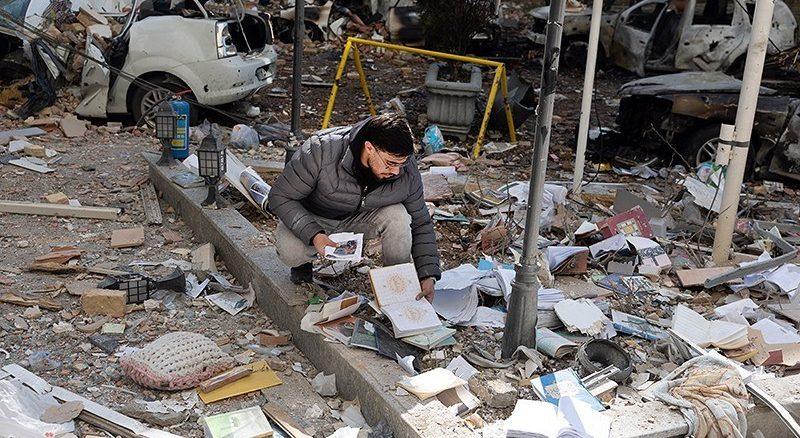
Last week, on Wednesday, April 22, Amal Khalil, a Lebanese journalist, was targeted and killed by Israeli forces while reporting on an earlier Israeli attack with her colleague Zeinab Faraj. Khalil and Faraj took shelter in a building, where rescue workers tried to reach the pair, but were forced to retreat under Israeli fire. In response to the attack, Nawaf Salam, the Lebanese Prime Minister, accused the Israeli military of war crimes, highlighting how the “targeting [of] journalists and obstructing the access of rescue teams to them, and then the renewed targeting of those teams after they’d arrived, constitute described war crimes.” The term “war crimes” appears with increasing frequency in reporting on recent armed conflicts, but a label without legitimate consequence is ultimately just a label.
War crimes are outlined in international law as some of the gravest crimes that take place in armed conflicts, including “murder, torture, pillage, or intentionally directing attacks against the civilian population, humanitarian aid workers, religious and educational buildings, and hospitals.” Over the years, the international community has established specialized courts to prosecute crimes under international law, such as the International Criminal Court. However, these entities have often failed to hold war criminals accountable, allowing many to continue to benefit from and operate with complete impunity.
We have seen this play out in Sudan, where both the Sudanese Armed Forces (SAF) and Rapid Support Forces (RSF) have executed large-scale attacks against civilians, while also inflicting “extensive destruction of essential infrastructure for survival, including medical centers, markets, food and water systems, and displacement camps.” At the September 2025 UN Security Council vote renewing the Sudan sanctions regime, the U.S. representative asserted that “the international community remains focused on stemming the flow of arms and promoting accountability for those who perpetuate violence and instability in Darfur.” Yet the U.S. has continued supplying arms to the UAE, which publicly channels weapons to the RSF, the same group the U.S. has determined is committing genocide in Sudan. Even with a U.N. arms embargo and heavy sanctions, both sides refuse to halt their violence, in part because they continue to receive funding and arms shipments from regional and international supporters. The gap between what the international community says and what its member states actually do is precisely what allows war criminals to operate with impunity.
In some cases, particularly when geopolitical interests align, consequences can materialize, as seen after the Bucha Massacre in Ukraine. In March 2022, Russian forces occupied Bucha, where evidence emerged of summary executions, unlawful killings, enforced disappearances, and torture, all of which constitute war crimes. The massacre was met with international condemnation, with then-President Joe Biden calling for a war crimes trial against Russian President Vladimir Putin. In response, Russia was suspended from the United Nations Human Rights Council and ultimately resigned from the body. An ICC investigation was opened and European states imposed further sanctions on Russia and increased military support for Ukraine. These consequences reflected Western strategic interests in containing Russian aggression as much as they reflected a commitment to international law. The same mechanisms have never been mobilized against allied states committing equally documented atrocities. Despite this combination of sanctions, diplomatic pressure, legal investigations, and military aid to Ukraine, Russia has continued to commit documented war crimes. A year after the Bucha Massacre, the ICC issued an arrest warrant for Putin on charges of war crimes concerning the forced deportation of Ukrainian children to Russia. Still, this warrant remains unenforceable, as Russia is not a member of the ICC and no state with access to Putin will act on it. The question is not whether the mechanisms exist; it is who they are deployed against, and why.
The case of Israel illustrates not just the insufficiency of international accountability mechanisms, but their active obstruction. Israeli Prime Minister Benjamin Netanyahu has had an ICC arrest warrant since November 2024 on charges of “war crimes of starvation as a method of warfare” and of “intentionally directing an attack against the civilian population.” Rather than supporting the court it had invoked against Russia, the U.S. threatened sanctions against the ICC itself. The U.S. has also repeatedly vetoed U.N. Security Council resolutions calling for a ceasefire in Gaza, providing Israel the same diplomatic cover that allows the RSF to continue to operate in Sudan, though far more directly. The difference between then and now is not merely a failure of international law; it is powerful states deliberately eroding the will to enforce it. The international mechanisms that generated even symbolic consequences for Russia have been neutralized. Nawaf Salam called what happened to Amal Khalil a war crime. No court will hear it. Instead, her name will be added to the long list of victims for whom justice was never served.
by Abby Greenblatt