
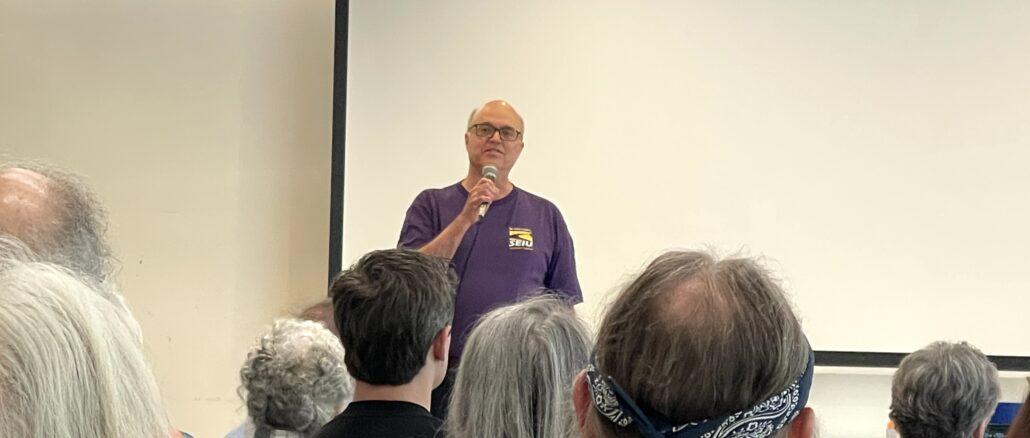
by Harris Gruman
The following is a transcription of the Keynote Presentation to the MAPA annual meeting by Harris Gruman on May 10, 2025.
Ten years ago, Paul Shannon and Cole Harrison invited me to participate in a conference on building a convergence of the “Big Three” issues of the left: Justice, Peace, and the Environment. The call for convergence was tentative, more of a call for an alliance, for being there for each other, than for an intrinsic unity of action. Let me recap how our dilemma unfolded that day.
As a labor movement person, I had been asked to address justice in relation to the other two. I began by pointing out that Justice is the greatest and most successful, though certainly unfinished, revolution in human history. I like to call it “The Democratic Revolution” as well, since it is essentially the rising up of the Democratic Principle against the Aristocratic Principle (in all their various guises).
Although there have been struggles for justice throughout human history, I date the beginning of the global, conscious movement for justice from 1789, and specifically from the publication of the Abbe Sieyes’ pamphlet “Qu’est-ce que le tiers état” (“What Is the Third Estate”). The Third Estate were the commoners, as distinct from the small minority of the nobility; what we call the 99 Percent vs. the One Percent, whether the latter be aristocrats or plutocrats.
Sieyes answered the question “What Is the Third Estate” quite simply: “Hitherto, Rien, Nothing! Henceforward, Tout, All!” Those words launched a series of significant events. Black slaves rose up in what is now Haiti and accomplished the only successful slave uprising in history; poor women in Paris led the storming of the Bastille, hated symbol of monarchy; workers in the Amiens armaments works lay down their tools and went on strike; sailors in the British navy mutinied, as far away as Tahiti. Auspicious beginnings!
But let me give you a more contemporary and much more de-romanticized statement of this movement. My Uncle David – who recently passed away at the age of 96 – was a National Maritime Union organizer, a ship’s machinist, and a civil engineer. He used to say, “My philosophy is PANG, People Ain’t No Good; and its corollary, PANFG, People Ain’t No Fucking Good!” People would say, “Nu, David, how you talk, you an idealist, an activist all your life,” to which he would reply, “It’s because people ain’t no good that no one should have so much political power or wealth that they can really harm others; that’s why I support democracy and socialism!”
The success of the revolution for justice is most eloquently expressed by the observation that for thousands of years of civilization, your chances in life depended mainly on the family you were born into or the person you married. Then, for two short generations, my generation and the generation of my Uncle David, it actually mattered more what you studied or what you did for work. That high-water mark of justice I like to call “Utopia 1966,” the year of the highest economic equality, a Civil Rights movement in victorious march, a rising women’s movement.
That’s why, for a brief moment, a real organic convergence emerged between justice, peace and the environment. With that level of justice, a majority could see all three issues as essential. It’s no accident that many of us in this room date from that moment.
But the moment did not hold. 1967 was a sinister year, albeit in a subterranean way. It was the first year since the New Deal that if you were born that year, you were more likely to be worse off than your parents rather than better off. And things have been backsliding ever since. When I was a kid, one-and-a-half percent of GDP went to the top One Percent. That was a lot for just one percent to get, and they seemed pretty damn rich to the rest of us. But today, TWELVE percent of GDP goes to the One Percent. That’s why there were no billionaires to speak of back then, but today there are many, and we have our first trillionaire, co-President Elon Musk. And one’s life chances are being determined once again by family and marriage.
So, I recommitted myself to a focus on justice. I wanted to regain the vantage point of Utopia 1966, that level of justice that opened to convergence. Hence my work in the labor movement.
But along came the chicken and egg problem of our time in the person of none other than Mikhail Gorbachev, speaking to the United Nations in the late 1980s. “We’ve all been working for justice since 1789” (yes, he said “1789”), “but now we have to turn our full attention to human survival itself, to the threats of nuclear annihilation and eco-system collapse.” We had concluded that we needed to recuperate that Utopia 1966 level of justice to build a movement for peace and the environment, but what if we don’t even survive long enough to do it? What a conundrum.
We concluded the conference with a resigned demand to keep on trying to address all three, whether together or separately. Not terribly satisfying.
But today I come bearing glad tidings. I will now present to you a considered hypothesis about the key to the intrinsic convergence of Justice, Peace, & Environment. It is the Caring Society, or, to put it in more militant terms, “the revolt of the caring class.”
The caring class are the “direct care workers,” those who do low-tech, hands-on, person-to-person care; for example, home care aides to the elderly and people with disabilities, mental health and substance use counselors in group homes and clinics, childcare providers. They stand at the INTRINSIC convergence of Justice, Peace and the Environment. Let me explain.
Justice is the most obvious. Direct care workers are today’s fastest growing sector of the working class. There are half a million direct care workers in Massachusetts alone, 80,000 of them in my union, SEIU. The majority are Black, Brown and Asian; the majority are women. They make $18 an hour non-union and $21 an hour union. You can’t pay your rent in the state of Massachusetts on those wages! Meanwhile, we all, rich and poor, Republican or Democrat, need care in our lives, usually multiple times. That we all need access to affordable care and the workers need good livable jobs is at the center of our contemporary struggle for justice.
Less obvious but just as important is the intrinsic relation between direct care work and the Environment. We demand the creation of “Green Jobs,” for a “Green New Deal,” but what are “Green Jobs”? Energy jobs can be made “greener,” but by definition they can never be green – that is, completely harmless to the environment. Even solar energy or EV’s require lithium and cobalt, minerals mined by child labor in the Congo, that lead to coups like the overthrow of Evo Morales in Bolivia (who sought to keep that wealth for his own people), or wars like the one that barreled out of the Donbas between Russia and Ukraine (look at the wheeling and dealing of Hunter Biden ten years ago or Donald Trump today over their control). We simply cannot keep accelerating our use of thermal energy, in any form, without breaking our eco-system.
But direct care jobs do not harm the environment; they do not use thermal energy. That’s why Japanese degrowth ecologist Kohei Saito said, “If you want to see what green jobs look like, I’ll show you direct care jobs.”
And direct care work is just as intrinsic to our struggle for peace. The federal budget is based on the progressive income tax, one of the great triumphs of the justice revolution (and one “made in America” as well). That progressive revenue feeds two large buckets: Medicaid and the Military. Every dollar for Medicaid (that is, for care) is a dollar less for war; every dollar for the military is a dollar lost to Medicaid/care. We can see the centrality of this battleline to our politics by looking at the failure of Joe Biden and the disaster of Donald Trump.
Joe Biden came into office promising to pour a half trillion dollars into direct care and pay for it with higher taxes on the wealthy and multi-national corporations. He called it Build Back Better, and it’s why my union busted its hump getting him elected. What a triumph this would be on all fronts, uniting and healing the country across ideological lines. But two Democratic Senators, Manchin and Sinema, rose up and blocked the bill. Okay, time for arm-twisting, horse-trading, time to win half a loaf. No. Biden gave up the fight and walked away with nothing for direct care. Then a year later, he’s ramping up a massive new Cold War with Russia, China, and Iran. Militarism is triumphant, direct care limps along, and the environment is left to hollow rhetoric as we become the largest natural gas producer in the world.
All of this is a magnificent runway for the arrival of Donald Trump. His centerpiece: rolling back the just legacy of progressive taxes once and for all and paying for it by CUTTING a half trillion dollars from Medicaid. Meanwhile, “drill, baby, drill” while the military remains sacrosanct.
It’s never been so clear that when we fight for the Caring Society, we fight for Justice, Peace and the Environment at the same time! Today I offer the Caring Society as the key to our convergence as ONE MOVEMENT.
But we need to hurry and build that movement while we can!
—
Video of this presentation may be viewed at https://youtu.be/qe-1MtW2UqM.
Harris Gruman is a member of MAPA’s Board of Directors as well as the Executive Director of the Service Employees International Union Massachusetts State Council.